Event submissions
Published
 10.3390/APD20symposium-14938 (registering DOI)
 This submission belongs to the session S6. Other Topics of the event Antimicrobial Peptides: Yesterday, Today and Tomorrow
Published date
12 Oct, 2023
Academic Editor
'%3e%3cpath%20d='M12.6657%2010.9104C12.4185%2010.325%2012.0599%209.79327%2011.6097%209.34482C11.1609%208.89508%2010.6293%208.5365%2010.0442%208.28888C10.0389%208.28626%2010.0337%208.28495%2010.0285%208.28233C10.8446%207.69279%2011.3752%206.73249%2011.3752%205.64904C11.3752%203.8542%209.92103%202.39999%208.1262%202.39999C6.33136%202.39999%204.87715%203.8542%204.87715%205.64904C4.87715%206.73249%205.40774%207.69279%206.22393%208.28364C6.21869%208.28626%206.21345%208.28757%206.20821%208.29019C5.62129%208.5378%205.09463%208.89284%204.64265%209.34613C4.1929%209.79493%203.83432%2010.3266%203.58671%2010.9117C3.34345%2011.4845%203.21226%2012.0987%203.20023%2012.7209C3.19988%2012.7349%203.20233%2012.7488%203.20744%2012.7619C3.21255%2012.7749%203.22022%2012.7867%203.22998%2012.7968C3.23975%2012.8068%203.25142%2012.8147%203.26431%2012.8202C3.2772%2012.8256%203.29105%2012.8284%203.30504%2012.8284H4.09109C4.14874%2012.8284%204.19459%2012.7825%204.1959%2012.7262C4.2221%2011.7148%204.62823%2010.7676%205.34617%2010.0497C6.08899%209.30683%207.0755%208.89808%208.1262%208.89808C9.17689%208.89808%2010.1634%209.30683%2010.9062%2010.0497C11.6242%2010.7676%2012.0303%2011.7148%2012.0565%2012.7262C12.0578%2012.7838%2012.1037%2012.8284%2012.1613%2012.8284H12.9474C12.9613%2012.8284%2012.9752%2012.8256%2012.9881%2012.8202C13.001%2012.8147%2013.0126%2012.8068%2013.0224%2012.7968C13.0322%2012.7867%2013.0398%2012.7749%2013.0449%2012.7619C13.0501%2012.7488%2013.0525%2012.7349%2013.0522%2012.7209C13.0391%2012.0947%2012.9094%2011.4855%2012.6657%2010.9104ZM8.1262%207.9024C7.52486%207.9024%206.9589%207.6679%206.53312%207.24211C6.10733%206.81633%205.87283%206.25037%205.87283%205.64904C5.87283%205.0477%206.10733%204.48174%206.53312%204.05596C6.9589%203.63018%207.52486%203.39567%208.1262%203.39567C8.72753%203.39567%209.29349%203.63018%209.71927%204.05596C10.1451%204.48174%2010.3796%205.0477%2010.3796%205.64904C10.3796%206.25037%2010.1451%206.81633%209.71927%207.24211C9.29349%207.6679%208.72753%207.9024%208.1262%207.9024Z'%20fill='%235D1EE1'/%3e%3c/g%3e%3c/svg%3e) Guangshun Wang
Guangshun WangCitation
Diego Alejandro Falico, Javier Alejandro Lopez, Raoul Van Damme, Els Prinsen, Analysis of the skin secretion of Leptodactylus labyrinthicus, the frog’s biohazard protective clothing, in Proceedings of Antimicrobial Peptides: Yesterday, Today and Tomorrow, 1 October–7 October 2023, MDPI: Basel, Switzerland, doi: 10.3390/APD20symposium-14938
Share
Email
Facebook
Twitter
LinkedIn
Analysis of the skin secretion of Leptodactylus labyrinthicus, the frog’s biohazard protective clothing
'%3e%3cpath%20d='M12.6647%2010.9104C12.4176%2010.325%2012.0589%209.7933%2011.6088%209.34485C11.16%208.89511%2010.6283%208.53653%2010.0432%208.28891C10.038%208.28629%2010.0327%208.28498%2010.0275%208.28236C10.8437%207.69282%2011.3743%206.73252%2011.3743%205.64907C11.3743%203.85423%209.92005%202.40002%208.12522%202.40002C6.33038%202.40002%204.87618%203.85423%204.87618%205.64907C4.87618%206.73252%205.40677%207.69282%206.22296%208.28367C6.21772%208.28629%206.21248%208.2876%206.20724%208.29022C5.62031%208.53783%205.09365%208.89287%204.64167%209.34616C4.19192%209.79496%203.83334%2010.3266%203.58573%2010.9117C3.34247%2011.4846%203.21128%2012.0987%203.19925%2012.721C3.1989%2012.735%203.20135%2012.7489%203.20646%2012.7619C3.21157%2012.7749%203.21924%2012.7868%203.22901%2012.7968C3.23877%2012.8068%203.25045%2012.8148%203.26334%2012.8202C3.27623%2012.8256%203.29007%2012.8284%203.30406%2012.8284H4.09012C4.14776%2012.8284%204.19362%2012.7825%204.19493%2012.7262C4.22113%2011.7148%204.62726%2010.7676%205.34519%2010.0497C6.08802%209.30686%207.07452%208.89811%208.12522%208.89811C9.17592%208.89811%2010.1624%209.30686%2010.9052%2010.0497C11.6232%2010.7676%2012.0293%2011.7148%2012.0555%2012.7262C12.0568%2012.7839%2012.1027%2012.8284%2012.1603%2012.8284H12.9464C12.9604%2012.8284%2012.9742%2012.8256%2012.9871%2012.8202C13%2012.8148%2013.0117%2012.8068%2013.0214%2012.7968C13.0312%2012.7868%2013.0389%2012.7749%2013.044%2012.7619C13.0491%2012.7489%2013.0515%2012.735%2013.0512%2012.721C13.0381%2012.0947%2012.9084%2011.4856%2012.6647%2010.9104ZM8.12522%207.90243C7.52388%207.90243%206.95792%207.66793%206.53214%207.24215C6.10636%206.81636%205.87185%206.2504%205.87185%205.64907C5.87185%205.04773%206.10636%204.48177%206.53214%204.05599C6.95792%203.63021%207.52388%203.3957%208.12522%203.3957C8.72655%203.3957%209.29252%203.63021%209.7183%204.05599C10.1441%204.48177%2010.3786%205.04773%2010.3786%205.64907C10.3786%206.2504%2010.1441%206.81636%209.7183%207.24215C9.29252%207.66793%208.72655%207.90243%208.12522%207.90243Z'%20fill='%235D1EE1'/%3e%3c/g%3e%3c/svg%3e)
Diego Alejandro Falico 1,2
Javier Alejandro Lopez 3,4
Raoul Van Damme 2

Els Prinsen 1
1. Department of Biology, University of Antwerp, Groenenborgerlaan 171, 2020 Antwerpen, Belgium.
2. Department of Biology, University of Antwerp, Universiteitsplein 1, 2610 Wilrijk, Belgium
3. Instituto Nacional de Limnología (INALI: CONICET-UNL). Ciudad Universitaria. Santa Fe,
Argentina
4. Departamento de Ciencias Naturales, Facultad de Humanidades y Ciencias,
Universidad Nacional del Litoral (UNL), Santa Fe, Argentina
Abstract
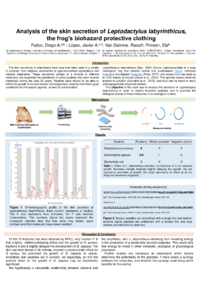
The secretion of amphibians has been used for many years for different purposes such as religion, culture, agro-economics or even as therapeutic agents. Although these secretions are a mixture of different molecules, especially the active peptides therein have been studied intensively during the past 30 years. Peptides have shown to be able to inhibit the growth of different human microorganisms (making from them good candidates for potential therapeutic agents), and soil microorganisms. The objectives of this work was to analyze the secretion of Leptodactylus labyrinthicus in order to identify bioactive peptides, with emphasis on their biological activity in an ecological context. Results reported here shown that, when fractioning the skin secretion of L. labyrinthicus, the growth of Staphylococcus aureus and Burkholderia cepacia were slowly delayed by fractions 8 and 9, but not any delaying effect was observed on Escherichia coli. Interestingly, the whole secretion, have shown a growth promotion for Burkholderia cepacia, but not any effect on Staphylococcus aureus and Escherichia coli. In addition, two peptides already described in the literature, known as Pentadactylin (which inhibit E. coli, P. aeruginosa and S. aureus), and Ocellatin-F1 (which inhibit E.coli and P. aeruginosa), were found in fractions 8 and 9 of this frog skin secretion. In view of these results we hypothesize that, the secretion of Leptodactylus labyrinthicus is a mix of molecules that act in synergy as a bio-regulator mechanism selecting or benefiting microorganisms on the frog’s skin population for ecological, immunological or other purposes not well understood to the moment.
Keywords
Leptodactylus labyrinthicus
amphibian skin secretions
amphibian peptides
Poster
Falico et al. Skin secretion of Leptodactylus labyrinthicus..pdf
Ensemble AI Approach for Predicting Hemolysis Using Sequence and Concentration of Functional Peptides
Engineering of a novel skin secretion peptide of an endemic amphibian of Ecuador (Callimedusa ecuatoriana) into promising antimicrobial molecules.