Event submissions
Published
 10.3390/APD20symposium-14939 (registering DOI)
 This submission belongs to the session S3. Promising antimicrobial leads and mechanisms of action of the event Antimicrobial Peptides: Yesterday, Today and Tomorrow
Published date
12 Oct, 2023
Academic Editor
'%3e%3cpath%20d='M12.6657%2010.9104C12.4185%2010.325%2012.0599%209.79327%2011.6097%209.34482C11.1609%208.89508%2010.6293%208.5365%2010.0442%208.28888C10.0389%208.28626%2010.0337%208.28495%2010.0285%208.28233C10.8446%207.69279%2011.3752%206.73249%2011.3752%205.64904C11.3752%203.8542%209.92103%202.39999%208.1262%202.39999C6.33136%202.39999%204.87715%203.8542%204.87715%205.64904C4.87715%206.73249%205.40774%207.69279%206.22393%208.28364C6.21869%208.28626%206.21345%208.28757%206.20821%208.29019C5.62129%208.5378%205.09463%208.89284%204.64265%209.34613C4.1929%209.79493%203.83432%2010.3266%203.58671%2010.9117C3.34345%2011.4845%203.21226%2012.0987%203.20023%2012.7209C3.19988%2012.7349%203.20233%2012.7488%203.20744%2012.7619C3.21255%2012.7749%203.22022%2012.7867%203.22998%2012.7968C3.23975%2012.8068%203.25142%2012.8147%203.26431%2012.8202C3.2772%2012.8256%203.29105%2012.8284%203.30504%2012.8284H4.09109C4.14874%2012.8284%204.19459%2012.7825%204.1959%2012.7262C4.2221%2011.7148%204.62823%2010.7676%205.34617%2010.0497C6.08899%209.30683%207.0755%208.89808%208.1262%208.89808C9.17689%208.89808%2010.1634%209.30683%2010.9062%2010.0497C11.6242%2010.7676%2012.0303%2011.7148%2012.0565%2012.7262C12.0578%2012.7838%2012.1037%2012.8284%2012.1613%2012.8284H12.9474C12.9613%2012.8284%2012.9752%2012.8256%2012.9881%2012.8202C13.001%2012.8147%2013.0126%2012.8068%2013.0224%2012.7968C13.0322%2012.7867%2013.0398%2012.7749%2013.0449%2012.7619C13.0501%2012.7488%2013.0525%2012.7349%2013.0522%2012.7209C13.0391%2012.0947%2012.9094%2011.4855%2012.6657%2010.9104ZM8.1262%207.9024C7.52486%207.9024%206.9589%207.6679%206.53312%207.24211C6.10733%206.81633%205.87283%206.25037%205.87283%205.64904C5.87283%205.0477%206.10733%204.48174%206.53312%204.05596C6.9589%203.63018%207.52486%203.39567%208.1262%203.39567C8.72753%203.39567%209.29349%203.63018%209.71927%204.05596C10.1451%204.48174%2010.3796%205.0477%2010.3796%205.64904C10.3796%206.25037%2010.1451%206.81633%209.71927%207.24211C9.29349%207.6679%208.72753%207.9024%208.1262%207.9024Z'%20fill='%235D1EE1'/%3e%3c/g%3e%3c/svg%3e) Monique Van Hoek
Monique Van HoekCitation
Nina Espinosa de los Monteros-Silva, Stefanny M. Bonilla-Jiménez, Giovanna Morán-Marcillo, Sebastián Bermúdez-Puga, José R. Almeida, Carolina Proaño-Bolaños, Engineering of a novel skin secretion peptide of an endemic amphibian of Ecuador (Callimedusa ecuatoriana) into promising antimicrobial molecules., in Proceedings of Antimicrobial Peptides: Yesterday, Today and Tomorrow, 1 October–7 October 2023, MDPI: Basel, Switzerland, doi: 10.3390/APD20symposium-14939
Share
Email
Facebook
Twitter
LinkedIn
Engineering of a novel skin secretion peptide of an endemic amphibian of Ecuador (Callimedusa ecuatoriana) into promising antimicrobial molecules.
'%3e%3cpath%20d='M12.6647%2010.9104C12.4176%2010.325%2012.0589%209.7933%2011.6088%209.34485C11.16%208.89511%2010.6283%208.53653%2010.0432%208.28891C10.038%208.28629%2010.0327%208.28498%2010.0275%208.28236C10.8437%207.69282%2011.3743%206.73252%2011.3743%205.64907C11.3743%203.85423%209.92005%202.40002%208.12522%202.40002C6.33038%202.40002%204.87618%203.85423%204.87618%205.64907C4.87618%206.73252%205.40677%207.69282%206.22296%208.28367C6.21772%208.28629%206.21248%208.2876%206.20724%208.29022C5.62031%208.53783%205.09365%208.89287%204.64167%209.34616C4.19192%209.79496%203.83334%2010.3266%203.58573%2010.9117C3.34247%2011.4846%203.21128%2012.0987%203.19925%2012.721C3.1989%2012.735%203.20135%2012.7489%203.20646%2012.7619C3.21157%2012.7749%203.21924%2012.7868%203.22901%2012.7968C3.23877%2012.8068%203.25045%2012.8148%203.26334%2012.8202C3.27623%2012.8256%203.29007%2012.8284%203.30406%2012.8284H4.09012C4.14776%2012.8284%204.19362%2012.7825%204.19493%2012.7262C4.22113%2011.7148%204.62726%2010.7676%205.34519%2010.0497C6.08802%209.30686%207.07452%208.89811%208.12522%208.89811C9.17592%208.89811%2010.1624%209.30686%2010.9052%2010.0497C11.6232%2010.7676%2012.0293%2011.7148%2012.0555%2012.7262C12.0568%2012.7839%2012.1027%2012.8284%2012.1603%2012.8284H12.9464C12.9604%2012.8284%2012.9742%2012.8256%2012.9871%2012.8202C13%2012.8148%2013.0117%2012.8068%2013.0214%2012.7968C13.0312%2012.7868%2013.0389%2012.7749%2013.044%2012.7619C13.0491%2012.7489%2013.0515%2012.735%2013.0512%2012.721C13.0381%2012.0947%2012.9084%2011.4856%2012.6647%2010.9104ZM8.12522%207.90243C7.52388%207.90243%206.95792%207.66793%206.53214%207.24215C6.10636%206.81636%205.87185%206.2504%205.87185%205.64907C5.87185%205.04773%206.10636%204.48177%206.53214%204.05599C6.95792%203.63021%207.52388%203.3957%208.12522%203.3957C8.72655%203.3957%209.29252%203.63021%209.7183%204.05599C10.1441%204.48177%2010.3786%205.04773%2010.3786%205.64907C10.3786%206.2504%2010.1441%206.81636%209.7183%207.24215C9.29252%207.66793%208.72655%207.90243%208.12522%207.90243Z'%20fill='%235D1EE1'/%3e%3c/g%3e%3c/svg%3e)
Nina Espinosa de los Monteros-Silva 1,2
Stefanny M. Bonilla-Jiménez 1
Giovanna Morán-Marcillo 1
Sebastián Bermúdez-Puga 1,3

José R. Almeida 1,4

Carolina Proaño-Bolaños 1
1. Biomolecules Discovery Group, Laboratory of Molecular Biology and Biochemistry, Universidad Regional Amazónica Ikiam, km 7 ½ vía Muyuna, Tena 150150, Ecuador.
2. Life Sciences Faculty, Universidad Regional Amazónica Ikiam, km 7 ½ vía Muyuna, Tena 150150, Ecuador.
3. Laboratory of Microbial Biomolecules, Department of Biochemical and Pharmaceutical Technology, University of São Paulo, São Paulo, Brazil.
4. School of Pharmacy, University of Reading, Reading RG6 6UB, UK.
Abstract
Amphibian skin secretion has been an important source of broad-spectrum and membrane-targeting antimicrobial peptides, which promise to tackle the antibiotic resistance crisis.Callimedusa ecuatoriana from Ecuador is an example of an unexplored species, that can hold a library of novel chemical scaffolds with antibiotic action. In this study, we report a novel skin peptide (PTR-CE1) identified by molecular cloning of mRNA precursor. We demonstrated that it lacks of antimicrobial activity. So, using the natural sequence of PTR-CE1 as a template, we designed and synthesized two analogs (PTR-CE1a and PTR-CE1b). Both engineered peptides displayed high antibacterial activity, even against the ampicillin-resistant bacterial strains. While PTR-CE1b showed MIC values of 106.5-212.99 mM and less than 10% of damage to red blood cells at 3.02 mM, PTR-CE1a displayed a more potent broad-spectrum effect against all the tested microorganisms, with MIC values of 3.02-12.06 mM, and low hemolytic properties at 6.66 mM. This study highlights the role of the secondary structure for antimicrobial activity and shows how inactive peptides can be useful as a template for the generation of new molecules with high activity and low toxicity.
Keywords
Toxicity
synthetic antimicrobial peptides
amphibian skin secretion peptides
proline
alpha-helix kink.
Poster
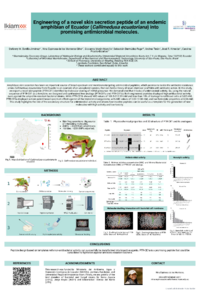
Poster_APDSymposium_PTRCE1_VFinal.pdf
Analysis of the skin secretion of Leptodactylus labyrinthicus, the frog’s biohazard protective clothing
KR-12, the minimal antibacterial peptide of human cathelicidin LL-37: Discovery, engineering and applications