Event submissions
Published
 10.3390/APD20symposium-14946 (registering DOI)
 This submission belongs to the session S3. Promising antimicrobial leads and mechanisms of action of the event Antimicrobial Peptides: Yesterday, Today and Tomorrow
Published date
12 Oct, 2023
Academic Editor
'%3e%3cpath%20d='M12.6657%2010.9104C12.4185%2010.325%2012.0599%209.79327%2011.6097%209.34482C11.1609%208.89508%2010.6293%208.5365%2010.0442%208.28888C10.0389%208.28626%2010.0337%208.28495%2010.0285%208.28233C10.8446%207.69279%2011.3752%206.73249%2011.3752%205.64904C11.3752%203.8542%209.92103%202.39999%208.1262%202.39999C6.33136%202.39999%204.87715%203.8542%204.87715%205.64904C4.87715%206.73249%205.40774%207.69279%206.22393%208.28364C6.21869%208.28626%206.21345%208.28757%206.20821%208.29019C5.62129%208.5378%205.09463%208.89284%204.64265%209.34613C4.1929%209.79493%203.83432%2010.3266%203.58671%2010.9117C3.34345%2011.4845%203.21226%2012.0987%203.20023%2012.7209C3.19988%2012.7349%203.20233%2012.7488%203.20744%2012.7619C3.21255%2012.7749%203.22022%2012.7867%203.22998%2012.7968C3.23975%2012.8068%203.25142%2012.8147%203.26431%2012.8202C3.2772%2012.8256%203.29105%2012.8284%203.30504%2012.8284H4.09109C4.14874%2012.8284%204.19459%2012.7825%204.1959%2012.7262C4.2221%2011.7148%204.62823%2010.7676%205.34617%2010.0497C6.08899%209.30683%207.0755%208.89808%208.1262%208.89808C9.17689%208.89808%2010.1634%209.30683%2010.9062%2010.0497C11.6242%2010.7676%2012.0303%2011.7148%2012.0565%2012.7262C12.0578%2012.7838%2012.1037%2012.8284%2012.1613%2012.8284H12.9474C12.9613%2012.8284%2012.9752%2012.8256%2012.9881%2012.8202C13.001%2012.8147%2013.0126%2012.8068%2013.0224%2012.7968C13.0322%2012.7867%2013.0398%2012.7749%2013.0449%2012.7619C13.0501%2012.7488%2013.0525%2012.7349%2013.0522%2012.7209C13.0391%2012.0947%2012.9094%2011.4855%2012.6657%2010.9104ZM8.1262%207.9024C7.52486%207.9024%206.9589%207.6679%206.53312%207.24211C6.10733%206.81633%205.87283%206.25037%205.87283%205.64904C5.87283%205.0477%206.10733%204.48174%206.53312%204.05596C6.9589%203.63018%207.52486%203.39567%208.1262%203.39567C8.72753%203.39567%209.29349%203.63018%209.71927%204.05596C10.1451%204.48174%2010.3796%205.0477%2010.3796%205.64904C10.3796%206.25037%2010.1451%206.81633%209.71927%207.24211C9.29349%207.6679%208.72753%207.9024%208.1262%207.9024Z'%20fill='%235D1EE1'/%3e%3c/g%3e%3c/svg%3e) Guangshun Wang
Guangshun WangCitation
Sergio González Acosta, Patricia Asensio Calavia, Andrea Otazo Pérez, Manuel Rodríguez López, Antonio Moralez de la Nuez, José Manuel Pérez de la Lastra, Parrot cathelicidins as a new source of antimicrobial agents, in Proceedings of Antimicrobial Peptides: Yesterday, Today and Tomorrow, 1 October–7 October 2023, MDPI: Basel, Switzerland, doi: 10.3390/APD20symposium-14946
Share
Email
Facebook
Twitter
LinkedIn
Parrot cathelicidins as a new source of antimicrobial agents
'%3e%3cpath%20d='M12.6647%2010.9104C12.4176%2010.325%2012.0589%209.7933%2011.6088%209.34485C11.16%208.89511%2010.6283%208.53653%2010.0432%208.28891C10.038%208.28629%2010.0327%208.28498%2010.0275%208.28236C10.8437%207.69282%2011.3743%206.73252%2011.3743%205.64907C11.3743%203.85423%209.92005%202.40002%208.12522%202.40002C6.33038%202.40002%204.87618%203.85423%204.87618%205.64907C4.87618%206.73252%205.40677%207.69282%206.22296%208.28367C6.21772%208.28629%206.21248%208.2876%206.20724%208.29022C5.62031%208.53783%205.09365%208.89287%204.64167%209.34616C4.19192%209.79496%203.83334%2010.3266%203.58573%2010.9117C3.34247%2011.4846%203.21128%2012.0987%203.19925%2012.721C3.1989%2012.735%203.20135%2012.7489%203.20646%2012.7619C3.21157%2012.7749%203.21924%2012.7868%203.22901%2012.7968C3.23877%2012.8068%203.25045%2012.8148%203.26334%2012.8202C3.27623%2012.8256%203.29007%2012.8284%203.30406%2012.8284H4.09012C4.14776%2012.8284%204.19362%2012.7825%204.19493%2012.7262C4.22113%2011.7148%204.62726%2010.7676%205.34519%2010.0497C6.08802%209.30686%207.07452%208.89811%208.12522%208.89811C9.17592%208.89811%2010.1624%209.30686%2010.9052%2010.0497C11.6232%2010.7676%2012.0293%2011.7148%2012.0555%2012.7262C12.0568%2012.7839%2012.1027%2012.8284%2012.1603%2012.8284H12.9464C12.9604%2012.8284%2012.9742%2012.8256%2012.9871%2012.8202C13%2012.8148%2013.0117%2012.8068%2013.0214%2012.7968C13.0312%2012.7868%2013.0389%2012.7749%2013.044%2012.7619C13.0491%2012.7489%2013.0515%2012.735%2013.0512%2012.721C13.0381%2012.0947%2012.9084%2011.4856%2012.6647%2010.9104ZM8.12522%207.90243C7.52388%207.90243%206.95792%207.66793%206.53214%207.24215C6.10636%206.81636%205.87185%206.2504%205.87185%205.64907C5.87185%205.04773%206.10636%204.48177%206.53214%204.05599C6.95792%203.63021%207.52388%203.3957%208.12522%203.3957C8.72655%203.3957%209.29252%203.63021%209.7183%204.05599C10.1441%204.48177%2010.3786%205.04773%2010.3786%205.64907C10.3786%206.2504%2010.1441%206.81636%209.7183%207.24215C9.29252%207.66793%208.72655%207.90243%208.12522%207.90243Z'%20fill='%235D1EE1'/%3e%3c/g%3e%3c/svg%3e)
Sergio González Acosta 1
Patricia Asensio Calavia 1
Andrea Otazo Pérez 1
Manuel Rodríguez López 1

Antonio Moralez de la Nuez 1,2
José Manuel Pérez de la Lastra 1
1. Instituto Productos Naturales y Agrobiología
2. Departamento de Patología Animal, Producción Animal, Bromatología y Tecnología de los Alimentos. Universidad de Las Palmas de Gran Canaria
Abstract
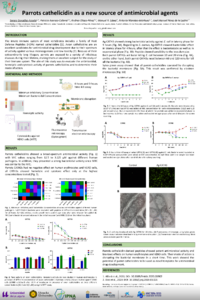
The innate immune system of most vertebrates includes a family of host defense peptides named cathelicidins. Avian cathelicidins are excellent candidates for antimicrobial drug development due to their broad spectrum of activity against various microorganisms and low toxicity. Because of their extraordinarily long lifespan, parrots are exposed to a variety of infectious diseases during their lifetime, making them an excellent subject for the study of their immune system. The aim of this study was to evaluate the antimicrobial, hemolytic and cytotoxic activity of parrot cathelicidins and to determine their mode of action. To conduct in vitro tests, we synthesized six peptides: two from Amazona guildingii, two from Eolophus roseicapilla, and two from Gallus gallus (as reference peptides). Our data demonstrated that even at the greatest concentration examined, the peptides had no effect on VERO cells and human erythrocytes. At lower concentrations, the peptides showed strong antimicrobial activity with MIC and MBC values ranging from 12.5 µM to 1.56 µM. However, none of the peptides showed activity against Candida albicans. We used Sytox Green and performed a 4-hours time-kill assay to investigate the mechanism of action. The kinetic assay showed that the peptides required between 20 and 60 min to kill Escherichia coli and that they operated by disturbing the bacterial membrane. In general, parrot cathelicidin-derived peptides showed potent antimicrobial activity and could be used as novel templates for antimicrobial drug development.
Keywords
Cathelicidins
Psittaciformes
Antimicrobial
Poster
Parrot cathelicidins as a new source of antimicrobial agents.pdf
Prediction of the penetration efficiency of proapoptotic peptides by cell-penetrating peptides (CPP) and anticancer peptides (ACP) using bioinformatics frameworks
Reptile cathelicidins and their potential as new antimicrobial compounds