Event submissions
Published
 10.3390/APD20symposium-14947 (registering DOI)
 This submission belongs to the session S6. Other Topics of the event Antimicrobial Peptides: Yesterday, Today and Tomorrow
Published date
12 Oct, 2023
Academic Editor
'%3e%3cpath%20d='M12.6657%2010.9104C12.4185%2010.325%2012.0599%209.79327%2011.6097%209.34482C11.1609%208.89508%2010.6293%208.5365%2010.0442%208.28888C10.0389%208.28626%2010.0337%208.28495%2010.0285%208.28233C10.8446%207.69279%2011.3752%206.73249%2011.3752%205.64904C11.3752%203.8542%209.92103%202.39999%208.1262%202.39999C6.33136%202.39999%204.87715%203.8542%204.87715%205.64904C4.87715%206.73249%205.40774%207.69279%206.22393%208.28364C6.21869%208.28626%206.21345%208.28757%206.20821%208.29019C5.62129%208.5378%205.09463%208.89284%204.64265%209.34613C4.1929%209.79493%203.83432%2010.3266%203.58671%2010.9117C3.34345%2011.4845%203.21226%2012.0987%203.20023%2012.7209C3.19988%2012.7349%203.20233%2012.7488%203.20744%2012.7619C3.21255%2012.7749%203.22022%2012.7867%203.22998%2012.7968C3.23975%2012.8068%203.25142%2012.8147%203.26431%2012.8202C3.2772%2012.8256%203.29105%2012.8284%203.30504%2012.8284H4.09109C4.14874%2012.8284%204.19459%2012.7825%204.1959%2012.7262C4.2221%2011.7148%204.62823%2010.7676%205.34617%2010.0497C6.08899%209.30683%207.0755%208.89808%208.1262%208.89808C9.17689%208.89808%2010.1634%209.30683%2010.9062%2010.0497C11.6242%2010.7676%2012.0303%2011.7148%2012.0565%2012.7262C12.0578%2012.7838%2012.1037%2012.8284%2012.1613%2012.8284H12.9474C12.9613%2012.8284%2012.9752%2012.8256%2012.9881%2012.8202C13.001%2012.8147%2013.0126%2012.8068%2013.0224%2012.7968C13.0322%2012.7867%2013.0398%2012.7749%2013.0449%2012.7619C13.0501%2012.7488%2013.0525%2012.7349%2013.0522%2012.7209C13.0391%2012.0947%2012.9094%2011.4855%2012.6657%2010.9104ZM8.1262%207.9024C7.52486%207.9024%206.9589%207.6679%206.53312%207.24211C6.10733%206.81633%205.87283%206.25037%205.87283%205.64904C5.87283%205.0477%206.10733%204.48174%206.53312%204.05596C6.9589%203.63018%207.52486%203.39567%208.1262%203.39567C8.72753%203.39567%209.29349%203.63018%209.71927%204.05596C10.1451%204.48174%2010.3796%205.0477%2010.3796%205.64904C10.3796%206.25037%2010.1451%206.81633%209.71927%207.24211C9.29349%207.6679%208.72753%207.9024%208.1262%207.9024Z'%20fill='%235D1EE1'/%3e%3c/g%3e%3c/svg%3e) Guangshun Wang
Guangshun WangCitation
Andrea Otazo Pérez, Sergio González Acosta, Patricia Asensio Calavia, Beatriz González Almécija, Antonio Morales de la Nuez, Manuel Rodríguez López, José Manuel Pérez de la Lastra, Reptile cathelicidins and their potential as new antimicrobial compounds, in Proceedings of Antimicrobial Peptides: Yesterday, Today and Tomorrow, 1 October–7 October 2023, MDPI: Basel, Switzerland, doi: 10.3390/APD20symposium-14947
Share
Email
Facebook
Twitter
LinkedIn
Reptile cathelicidins and their potential as new antimicrobial compounds
'%3e%3cpath%20d='M12.6647%2010.9104C12.4176%2010.325%2012.0589%209.7933%2011.6088%209.34485C11.16%208.89511%2010.6283%208.53653%2010.0432%208.28891C10.038%208.28629%2010.0327%208.28498%2010.0275%208.28236C10.8437%207.69282%2011.3743%206.73252%2011.3743%205.64907C11.3743%203.85423%209.92005%202.40002%208.12522%202.40002C6.33038%202.40002%204.87618%203.85423%204.87618%205.64907C4.87618%206.73252%205.40677%207.69282%206.22296%208.28367C6.21772%208.28629%206.21248%208.2876%206.20724%208.29022C5.62031%208.53783%205.09365%208.89287%204.64167%209.34616C4.19192%209.79496%203.83334%2010.3266%203.58573%2010.9117C3.34247%2011.4846%203.21128%2012.0987%203.19925%2012.721C3.1989%2012.735%203.20135%2012.7489%203.20646%2012.7619C3.21157%2012.7749%203.21924%2012.7868%203.22901%2012.7968C3.23877%2012.8068%203.25045%2012.8148%203.26334%2012.8202C3.27623%2012.8256%203.29007%2012.8284%203.30406%2012.8284H4.09012C4.14776%2012.8284%204.19362%2012.7825%204.19493%2012.7262C4.22113%2011.7148%204.62726%2010.7676%205.34519%2010.0497C6.08802%209.30686%207.07452%208.89811%208.12522%208.89811C9.17592%208.89811%2010.1624%209.30686%2010.9052%2010.0497C11.6232%2010.7676%2012.0293%2011.7148%2012.0555%2012.7262C12.0568%2012.7839%2012.1027%2012.8284%2012.1603%2012.8284H12.9464C12.9604%2012.8284%2012.9742%2012.8256%2012.9871%2012.8202C13%2012.8148%2013.0117%2012.8068%2013.0214%2012.7968C13.0312%2012.7868%2013.0389%2012.7749%2013.044%2012.7619C13.0491%2012.7489%2013.0515%2012.735%2013.0512%2012.721C13.0381%2012.0947%2012.9084%2011.4856%2012.6647%2010.9104ZM8.12522%207.90243C7.52388%207.90243%206.95792%207.66793%206.53214%207.24215C6.10636%206.81636%205.87185%206.2504%205.87185%205.64907C5.87185%205.04773%206.10636%204.48177%206.53214%204.05599C6.95792%203.63021%207.52388%203.3957%208.12522%203.3957C8.72655%203.3957%209.29252%203.63021%209.7183%204.05599C10.1441%204.48177%2010.3786%205.04773%2010.3786%205.64907C10.3786%206.2504%2010.1441%206.81636%209.7183%207.24215C9.29252%207.66793%208.72655%207.90243%208.12522%207.90243Z'%20fill='%235D1EE1'/%3e%3c/g%3e%3c/svg%3e)
Andrea Otazo Pérez 1,2
Sergio González Acosta 1,2
Patricia Asensio Calavia 1,2
Beatriz González Almécija 1

Antonio Morales de la Nuez 3
Manuel Rodríguez López 1
José Manuel Pérez de la Lastra 1
1. Institute of Natural Products and Agrobiology (IPNA-CSIC), Avda. Astrofísico Francisco Sánchez, 3, 38206, San Cristóbal de La Laguna, España.
2. Universidad de La Laguna, Avda. Astrofísico Francisco Sánchez, SN. Edificio Calabaza-AN.2D Apdo. 456 38200, San Cristóbal de La Laguna, España.
3. Animal Production and Biotechnology Group, Institute of Animal Health and Food Safety, Universidad de Las Palmas de Gran Canaria, 35413, Arucas, Las Palmas, Spain
Abstract
Cathelicidins are a family of host defense peptides (HDP) with different functions, highlighting their antimicrobial activity, expressed in most vertebrates. These peptides present a high variability, differentiating their sequence, structure, and function among different animal species. In this research, mining the available reptile genomes on NCBI database has been carried out to identify new cathelicidins. An analysis of the structure and physicochemical properties of the peptides was made and 6 of them were selected to synthesize and study their potential as antimicrobial compounds in vitro. For this, the minimum inhibitory concentration (MIC) and the minimum bactericidal concentration (MBC) were characterized against 5 human pathogenic bacteria. For peptides that showed the highest activity, their bacteriostatic or bactericidal character as well as their lytic activity and their period of action was studied. For this, kill curves were carried out with the bacteria in the latency and exponential phase. To study the possible toxicity of peptides, a hemolytic activity assay with rat erythrocytes and a MTT cytotoxicity assay with Vero cells were carried out. Novel reptile peptides showed good antimicrobial activity between 0.39 and 25 micromolar against the bacteria which they were tested, exhibiting bactericidal activity when the microorganism is in the latency phase and bacteriostatic activity when it's in the exponential phase. Peptides had an active period of approximately 6 hours and showed lytic activity against bacteria. On the other hand, there was no hemolytic or cytotoxic activity at concentrations that they were effective against microorganisms.
Keywords
Host defense peptides
Antimicrobial activity
Reptilia
Cathelicidin family
Poster
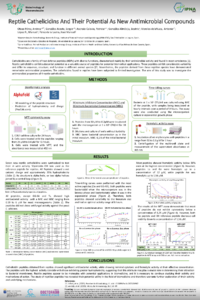
Póster Reptile Cathelicidins.pdf
Parrot cathelicidins as a new source of antimicrobial agents
In silico and in vitro approach of antimicrobial peptides from fish