Event submissions
Published
 10.3390/APD20symposium-14948 (registering DOI)
 This submission belongs to the session S6. Other Topics of the event Antimicrobial Peptides: Yesterday, Today and Tomorrow
Published date
12 Oct, 2023
Academic Editor
'%3e%3cpath%20d='M12.6657%2010.9104C12.4185%2010.325%2012.0599%209.79327%2011.6097%209.34482C11.1609%208.89508%2010.6293%208.5365%2010.0442%208.28888C10.0389%208.28626%2010.0337%208.28495%2010.0285%208.28233C10.8446%207.69279%2011.3752%206.73249%2011.3752%205.64904C11.3752%203.8542%209.92103%202.39999%208.1262%202.39999C6.33136%202.39999%204.87715%203.8542%204.87715%205.64904C4.87715%206.73249%205.40774%207.69279%206.22393%208.28364C6.21869%208.28626%206.21345%208.28757%206.20821%208.29019C5.62129%208.5378%205.09463%208.89284%204.64265%209.34613C4.1929%209.79493%203.83432%2010.3266%203.58671%2010.9117C3.34345%2011.4845%203.21226%2012.0987%203.20023%2012.7209C3.19988%2012.7349%203.20233%2012.7488%203.20744%2012.7619C3.21255%2012.7749%203.22022%2012.7867%203.22998%2012.7968C3.23975%2012.8068%203.25142%2012.8147%203.26431%2012.8202C3.2772%2012.8256%203.29105%2012.8284%203.30504%2012.8284H4.09109C4.14874%2012.8284%204.19459%2012.7825%204.1959%2012.7262C4.2221%2011.7148%204.62823%2010.7676%205.34617%2010.0497C6.08899%209.30683%207.0755%208.89808%208.1262%208.89808C9.17689%208.89808%2010.1634%209.30683%2010.9062%2010.0497C11.6242%2010.7676%2012.0303%2011.7148%2012.0565%2012.7262C12.0578%2012.7838%2012.1037%2012.8284%2012.1613%2012.8284H12.9474C12.9613%2012.8284%2012.9752%2012.8256%2012.9881%2012.8202C13.001%2012.8147%2013.0126%2012.8068%2013.0224%2012.7968C13.0322%2012.7867%2013.0398%2012.7749%2013.0449%2012.7619C13.0501%2012.7488%2013.0525%2012.7349%2013.0522%2012.7209C13.0391%2012.0947%2012.9094%2011.4855%2012.6657%2010.9104ZM8.1262%207.9024C7.52486%207.9024%206.9589%207.6679%206.53312%207.24211C6.10733%206.81633%205.87283%206.25037%205.87283%205.64904C5.87283%205.0477%206.10733%204.48174%206.53312%204.05596C6.9589%203.63018%207.52486%203.39567%208.1262%203.39567C8.72753%203.39567%209.29349%203.63018%209.71927%204.05596C10.1451%204.48174%2010.3796%205.0477%2010.3796%205.64904C10.3796%206.25037%2010.1451%206.81633%209.71927%207.24211C9.29349%207.6679%208.72753%207.9024%208.1262%207.9024Z'%20fill='%235D1EE1'/%3e%3c/g%3e%3c/svg%3e) Guangshun Wang
Guangshun WangCitation
Patricia Asensio-Calavia, Andrea Otazo-Pérez, Sergio González-Acosta, Beatriz González-Almécija, Antonio Morales-delaNuez, Manuel R. López, José M. Pérez de la Lastra, In silico and in vitro approach of antimicrobial peptides from fish, in Proceedings of Antimicrobial Peptides: Yesterday, Today and Tomorrow, 1 October–7 October 2023, MDPI: Basel, Switzerland, doi: 10.3390/APD20symposium-14948
Share
Email
Facebook
Twitter
LinkedIn
In silico and in vitro approach of antimicrobial peptides from fish
'%3e%3cpath%20d='M12.6647%2010.9104C12.4176%2010.325%2012.0589%209.7933%2011.6088%209.34485C11.16%208.89511%2010.6283%208.53653%2010.0432%208.28891C10.038%208.28629%2010.0327%208.28498%2010.0275%208.28236C10.8437%207.69282%2011.3743%206.73252%2011.3743%205.64907C11.3743%203.85423%209.92005%202.40002%208.12522%202.40002C6.33038%202.40002%204.87618%203.85423%204.87618%205.64907C4.87618%206.73252%205.40677%207.69282%206.22296%208.28367C6.21772%208.28629%206.21248%208.2876%206.20724%208.29022C5.62031%208.53783%205.09365%208.89287%204.64167%209.34616C4.19192%209.79496%203.83334%2010.3266%203.58573%2010.9117C3.34247%2011.4846%203.21128%2012.0987%203.19925%2012.721C3.1989%2012.735%203.20135%2012.7489%203.20646%2012.7619C3.21157%2012.7749%203.21924%2012.7868%203.22901%2012.7968C3.23877%2012.8068%203.25045%2012.8148%203.26334%2012.8202C3.27623%2012.8256%203.29007%2012.8284%203.30406%2012.8284H4.09012C4.14776%2012.8284%204.19362%2012.7825%204.19493%2012.7262C4.22113%2011.7148%204.62726%2010.7676%205.34519%2010.0497C6.08802%209.30686%207.07452%208.89811%208.12522%208.89811C9.17592%208.89811%2010.1624%209.30686%2010.9052%2010.0497C11.6232%2010.7676%2012.0293%2011.7148%2012.0555%2012.7262C12.0568%2012.7839%2012.1027%2012.8284%2012.1603%2012.8284H12.9464C12.9604%2012.8284%2012.9742%2012.8256%2012.9871%2012.8202C13%2012.8148%2013.0117%2012.8068%2013.0214%2012.7968C13.0312%2012.7868%2013.0389%2012.7749%2013.044%2012.7619C13.0491%2012.7489%2013.0515%2012.735%2013.0512%2012.721C13.0381%2012.0947%2012.9084%2011.4856%2012.6647%2010.9104ZM8.12522%207.90243C7.52388%207.90243%206.95792%207.66793%206.53214%207.24215C6.10636%206.81636%205.87185%206.2504%205.87185%205.64907C5.87185%205.04773%206.10636%204.48177%206.53214%204.05599C6.95792%203.63021%207.52388%203.3957%208.12522%203.3957C8.72655%203.3957%209.29252%203.63021%209.7183%204.05599C10.1441%204.48177%2010.3786%205.04773%2010.3786%205.64907C10.3786%206.2504%2010.1441%206.81636%209.7183%207.24215C9.29252%207.66793%208.72655%207.90243%208.12522%207.90243Z'%20fill='%235D1EE1'/%3e%3c/g%3e%3c/svg%3e)
Patricia Asensio-Calavia 1,2
Andrea Otazo-Pérez 1,2
Sergio González-Acosta 1,2
Beatriz González-Almécija 1

Antonio Morales-delaNuez 1,3
Manuel R. López 1
José M. Pérez de la Lastra 1
1. Biotechnology of Macromolecules Research Group, Institute of Natural Products and Agrobiology (IPNA-CSIC), San Cristóbal de La Laguna, Spain
2. Universidad de la Laguna
3. Animal Production and Biotechnology Group, Institute of Animal Health and Food Safety, University of Las Palmas de Gran Canaria, Spain
Abstract
Fish constantly interact with microorganisms in their aquatic habitat. As a defense mechanism, they possess innate immune system-derived antimicrobial peptides that combat bacteria, viruses, and fungi. The piscidin family's characterization has been limited to Teleostei fish. This study aimed to select a subset of peptides annotated as piscidins in NCBI and evaluate their bioactivity and structure through both in silico and in vitro methodologies.
Beginning with 51 piscidin sequences, bioinformatic tools were utilized to screen for potential active peptides. These peptides exhibited attributes like α-helical structure, cationic charge, and potent activity against microorganisms and tumors. To explore promising candidates, five novel piscidin peptides were synthesized alongside a well-established active peptide, Epinecidin-1 from Epinephelus coioides. Our initial focus was assessing antibiotic and antifungal activities of each peptide against human pathogens (Escherichia coli, Staphylococcus aureus, Salmonella enterica, Enterococcus faecalis, Pseudomonas aeruginosa, Campylobacter jejuni, and Candida albicans). Outcomes demonstrated noteworthy activity at low concentrations, e.g., 1.56 µM against S. aureus or 3.125-6.25 µM against P. aeruginosa. Peptide toxicity was evaluated using rat erythrocytes and the Vero cell line, revealing toxicity at higher concentrations (25-50 µM) with milder effects at lower concentrations.
In conclusion, these peptides exhibited substantial in vitro antimicrobial activity, particularly against bacteria, aligning with in silico forecasts. These findings strongly underscore the potential of these peptides as agents against microorganisms, potentially aiding in the fight against antibiotic resistance. However, further research is imperative to delve into their mode of action and other potential immunomodulatory attributes.
Keywords
Antimicrobial peptide
Piscidin
Fish
Poster
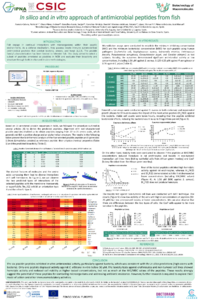
Poster_Patricia.pdf
Reptile cathelicidins and their potential as new antimicrobial compounds
SAMP: An Accurate Ensemble Model Based on Proportionalized Split Amino Acid Composition for Identifying Antimicrobial Peptides