Event submissions
Published
 10.3390/APD20symposium-14951 (registering DOI)
 This submission belongs to the session S6. Other Topics of the event Antimicrobial Peptides: Yesterday, Today and Tomorrow
Published date
12 Oct, 2023
Academic Editor
'%3e%3cpath%20d='M12.6657%2010.9104C12.4185%2010.325%2012.0599%209.79327%2011.6097%209.34482C11.1609%208.89508%2010.6293%208.5365%2010.0442%208.28888C10.0389%208.28626%2010.0337%208.28495%2010.0285%208.28233C10.8446%207.69279%2011.3752%206.73249%2011.3752%205.64904C11.3752%203.8542%209.92103%202.39999%208.1262%202.39999C6.33136%202.39999%204.87715%203.8542%204.87715%205.64904C4.87715%206.73249%205.40774%207.69279%206.22393%208.28364C6.21869%208.28626%206.21345%208.28757%206.20821%208.29019C5.62129%208.5378%205.09463%208.89284%204.64265%209.34613C4.1929%209.79493%203.83432%2010.3266%203.58671%2010.9117C3.34345%2011.4845%203.21226%2012.0987%203.20023%2012.7209C3.19988%2012.7349%203.20233%2012.7488%203.20744%2012.7619C3.21255%2012.7749%203.22022%2012.7867%203.22998%2012.7968C3.23975%2012.8068%203.25142%2012.8147%203.26431%2012.8202C3.2772%2012.8256%203.29105%2012.8284%203.30504%2012.8284H4.09109C4.14874%2012.8284%204.19459%2012.7825%204.1959%2012.7262C4.2221%2011.7148%204.62823%2010.7676%205.34617%2010.0497C6.08899%209.30683%207.0755%208.89808%208.1262%208.89808C9.17689%208.89808%2010.1634%209.30683%2010.9062%2010.0497C11.6242%2010.7676%2012.0303%2011.7148%2012.0565%2012.7262C12.0578%2012.7838%2012.1037%2012.8284%2012.1613%2012.8284H12.9474C12.9613%2012.8284%2012.9752%2012.8256%2012.9881%2012.8202C13.001%2012.8147%2013.0126%2012.8068%2013.0224%2012.7968C13.0322%2012.7867%2013.0398%2012.7749%2013.0449%2012.7619C13.0501%2012.7488%2013.0525%2012.7349%2013.0522%2012.7209C13.0391%2012.0947%2012.9094%2011.4855%2012.6657%2010.9104ZM8.1262%207.9024C7.52486%207.9024%206.9589%207.6679%206.53312%207.24211C6.10733%206.81633%205.87283%206.25037%205.87283%205.64904C5.87283%205.0477%206.10733%204.48174%206.53312%204.05596C6.9589%203.63018%207.52486%203.39567%208.1262%203.39567C8.72753%203.39567%209.29349%203.63018%209.71927%204.05596C10.1451%204.48174%2010.3796%205.0477%2010.3796%205.64904C10.3796%206.25037%2010.1451%206.81633%209.71927%207.24211C9.29349%207.6679%208.72753%207.9024%208.1262%207.9024Z'%20fill='%235D1EE1'/%3e%3c/g%3e%3c/svg%3e) Guangshun Wang
Guangshun WangCitation
Mariela Marani, Ana Paula Cuzziol Boccioni, Natalia Lorena Cancelarich, Silvana Aguilar, Nestor Guillermo Basso, Identification of novel antimicrobial peptides from the skin of Leptodactylus chaquensis (Anura Leptodactylidae) frog in northern Argentina, in Proceedings of Antimicrobial Peptides: Yesterday, Today and Tomorrow, 1 October–7 October 2023, MDPI: Basel, Switzerland, doi: 10.3390/APD20symposium-14951
Share
Email
Facebook
Twitter
LinkedIn
Identification of novel antimicrobial peptides from the skin of Leptodactylus chaquensis (Anura Leptodactylidae) frog in northern Argentina

Mariela Marani 1
'%3e%3cpath%20d='M12.6647%2010.9104C12.4176%2010.325%2012.0589%209.7933%2011.6088%209.34485C11.16%208.89511%2010.6283%208.53653%2010.0432%208.28891C10.038%208.28629%2010.0327%208.28498%2010.0275%208.28236C10.8437%207.69282%2011.3743%206.73252%2011.3743%205.64907C11.3743%203.85423%209.92005%202.40002%208.12522%202.40002C6.33038%202.40002%204.87618%203.85423%204.87618%205.64907C4.87618%206.73252%205.40677%207.69282%206.22296%208.28367C6.21772%208.28629%206.21248%208.2876%206.20724%208.29022C5.62031%208.53783%205.09365%208.89287%204.64167%209.34616C4.19192%209.79496%203.83334%2010.3266%203.58573%2010.9117C3.34247%2011.4846%203.21128%2012.0987%203.19925%2012.721C3.1989%2012.735%203.20135%2012.7489%203.20646%2012.7619C3.21157%2012.7749%203.21924%2012.7868%203.22901%2012.7968C3.23877%2012.8068%203.25045%2012.8148%203.26334%2012.8202C3.27623%2012.8256%203.29007%2012.8284%203.30406%2012.8284H4.09012C4.14776%2012.8284%204.19362%2012.7825%204.19493%2012.7262C4.22113%2011.7148%204.62726%2010.7676%205.34519%2010.0497C6.08802%209.30686%207.07452%208.89811%208.12522%208.89811C9.17592%208.89811%2010.1624%209.30686%2010.9052%2010.0497C11.6232%2010.7676%2012.0293%2011.7148%2012.0555%2012.7262C12.0568%2012.7839%2012.1027%2012.8284%2012.1603%2012.8284H12.9464C12.9604%2012.8284%2012.9742%2012.8256%2012.9871%2012.8202C13%2012.8148%2013.0117%2012.8068%2013.0214%2012.7968C13.0312%2012.7868%2013.0389%2012.7749%2013.044%2012.7619C13.0491%2012.7489%2013.0515%2012.735%2013.0512%2012.721C13.0381%2012.0947%2012.9084%2011.4856%2012.6647%2010.9104ZM8.12522%207.90243C7.52388%207.90243%206.95792%207.66793%206.53214%207.24215C6.10636%206.81636%205.87185%206.2504%205.87185%205.64907C5.87185%205.04773%206.10636%204.48177%206.53214%204.05599C6.95792%203.63021%207.52388%203.3957%208.12522%203.3957C8.72655%203.3957%209.29252%203.63021%209.7183%204.05599C10.1441%204.48177%2010.3786%205.04773%2010.3786%205.64907C10.3786%206.2504%2010.1441%206.81636%209.7183%207.24215C9.29252%207.66793%208.72655%207.90243%208.12522%207.90243Z'%20fill='%235D1EE1'/%3e%3c/g%3e%3c/svg%3e)
Ana Paula Cuzziol Boccioni 2,3
Natalia Lorena Cancelarich 1
Silvana Aguilar 1
Nestor Guillermo Basso 4
1. IPEEC CONICET, Puerto Madryn, Argentina
2. FBCB-UNL, Santa Fe, Argentina
3. CONICET
4. IDEAUS CONICET, Puerto Madryn, Argentina
Abstract
The search for innovative therapeutic solutions to address the escalating resistance of pathogens to antibiotics is a pressing global challenge. Bioprospecting for novel molecules is a cornerstone, providing essential data to fuel databases used in developing AI-driven tools. These tools are crucial for drug design, ushering in a new drug discovery and development era. Antimicrobial peptides (AMPs) have demonstrated their effectiveness against a broad spectrum of pathogens. These peptides are sourced from various natural origins, including amphibian skin, which is particularly abundant. The northern region of Argentina boasts an unexplored and diverse amphibian biodiversity, promising potential for the discovery of new AMPs. This study aimed to identify AMPs from Leptodactylus chaquensis frog skin collected in Corrientes, Argentina. Total mRNA was extracted from the skin, cDNA was synthesized, and cloned into E. coli DH5α cells. Plasmids of selected colonies were purified, PCR amplified, insert size assessed, and sequences obtained. Three prepro-peptides coding novel mature peptides were identified. The peptides, provisionally named Lch-1, Lch-2, and Lch-3, exhibited lengths of 25, 21, and 9 residues, with net charges of +1, 0, and -1, respectively. Hydrophobic percentages were 38%, 54%, and 44%, with theoretical 3D α-helical content in their structures. Lch-1 and -2 shared 43% and 41% sequence similarity with ocellatin-4 and -6 from Leptodactyus ocellatus. Predicted interactions with membranes suggest antimicrobial potential using the APD tool. Peptides will be synthesized for bioactivity assays. These findings underscore the significance of bioprospecting in uncovering distinct and unique bioactive compounds within each species.
Keywords
bioprospection
molecular biology
cloning
frog
Poster
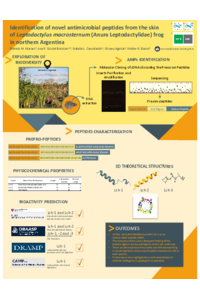
Marani_Poster_AMP_L.macrosternum.pdf
Study of somuncurin-1 behavior in two membrane models using Molecular Dynamics Simulations
Bat Cathelicidins as Natural Antimicrobial Agents: A Computational and In Vitro Investigation