Event submissions
Published
 10.3390/APD20symposium-14952 (registering DOI)
 This submission belongs to the session S6. Other Topics of the event Antimicrobial Peptides: Yesterday, Today and Tomorrow
Published date
12 Oct, 2023
Academic Editor
'%3e%3cpath%20d='M12.6657%2010.9104C12.4185%2010.325%2012.0599%209.79327%2011.6097%209.34482C11.1609%208.89508%2010.6293%208.5365%2010.0442%208.28888C10.0389%208.28626%2010.0337%208.28495%2010.0285%208.28233C10.8446%207.69279%2011.3752%206.73249%2011.3752%205.64904C11.3752%203.8542%209.92103%202.39999%208.1262%202.39999C6.33136%202.39999%204.87715%203.8542%204.87715%205.64904C4.87715%206.73249%205.40774%207.69279%206.22393%208.28364C6.21869%208.28626%206.21345%208.28757%206.20821%208.29019C5.62129%208.5378%205.09463%208.89284%204.64265%209.34613C4.1929%209.79493%203.83432%2010.3266%203.58671%2010.9117C3.34345%2011.4845%203.21226%2012.0987%203.20023%2012.7209C3.19988%2012.7349%203.20233%2012.7488%203.20744%2012.7619C3.21255%2012.7749%203.22022%2012.7867%203.22998%2012.7968C3.23975%2012.8068%203.25142%2012.8147%203.26431%2012.8202C3.2772%2012.8256%203.29105%2012.8284%203.30504%2012.8284H4.09109C4.14874%2012.8284%204.19459%2012.7825%204.1959%2012.7262C4.2221%2011.7148%204.62823%2010.7676%205.34617%2010.0497C6.08899%209.30683%207.0755%208.89808%208.1262%208.89808C9.17689%208.89808%2010.1634%209.30683%2010.9062%2010.0497C11.6242%2010.7676%2012.0303%2011.7148%2012.0565%2012.7262C12.0578%2012.7838%2012.1037%2012.8284%2012.1613%2012.8284H12.9474C12.9613%2012.8284%2012.9752%2012.8256%2012.9881%2012.8202C13.001%2012.8147%2013.0126%2012.8068%2013.0224%2012.7968C13.0322%2012.7867%2013.0398%2012.7749%2013.0449%2012.7619C13.0501%2012.7488%2013.0525%2012.7349%2013.0522%2012.7209C13.0391%2012.0947%2012.9094%2011.4855%2012.6657%2010.9104ZM8.1262%207.9024C7.52486%207.9024%206.9589%207.6679%206.53312%207.24211C6.10733%206.81633%205.87283%206.25037%205.87283%205.64904C5.87283%205.0477%206.10733%204.48174%206.53312%204.05596C6.9589%203.63018%207.52486%203.39567%208.1262%203.39567C8.72753%203.39567%209.29349%203.63018%209.71927%204.05596C10.1451%204.48174%2010.3796%205.0477%2010.3796%205.64904C10.3796%206.25037%2010.1451%206.81633%209.71927%207.24211C9.29349%207.6679%208.72753%207.9024%208.1262%207.9024Z'%20fill='%235D1EE1'/%3e%3c/g%3e%3c/svg%3e) Guangshun Wang
Guangshun WangCitation
Francisco Farrais-Solana, Beatriz Gonzalez-Almecija, José Manuel Pérez de la Lastra, Andrea Otazo-Pérez, Patricia Asensio-Calavia, Sergio González-Acosta, Antonio Morales-delaNuez, Manuel López R, Bat Cathelicidins as Natural Antimicrobial Agents: A Computational and In Vitro Investigation, in Proceedings of Antimicrobial Peptides: Yesterday, Today and Tomorrow, 1 October–7 October 2023, MDPI: Basel, Switzerland, doi: 10.3390/APD20symposium-14952
Share
Email
Facebook
Twitter
LinkedIn
Bat Cathelicidins as Natural Antimicrobial Agents: A Computational and In Vitro Investigation
'%3e%3cpath%20d='M12.6647%2010.9104C12.4176%2010.325%2012.0589%209.7933%2011.6088%209.34485C11.16%208.89511%2010.6283%208.53653%2010.0432%208.28891C10.038%208.28629%2010.0327%208.28498%2010.0275%208.28236C10.8437%207.69282%2011.3743%206.73252%2011.3743%205.64907C11.3743%203.85423%209.92005%202.40002%208.12522%202.40002C6.33038%202.40002%204.87618%203.85423%204.87618%205.64907C4.87618%206.73252%205.40677%207.69282%206.22296%208.28367C6.21772%208.28629%206.21248%208.2876%206.20724%208.29022C5.62031%208.53783%205.09365%208.89287%204.64167%209.34616C4.19192%209.79496%203.83334%2010.3266%203.58573%2010.9117C3.34247%2011.4846%203.21128%2012.0987%203.19925%2012.721C3.1989%2012.735%203.20135%2012.7489%203.20646%2012.7619C3.21157%2012.7749%203.21924%2012.7868%203.22901%2012.7968C3.23877%2012.8068%203.25045%2012.8148%203.26334%2012.8202C3.27623%2012.8256%203.29007%2012.8284%203.30406%2012.8284H4.09012C4.14776%2012.8284%204.19362%2012.7825%204.19493%2012.7262C4.22113%2011.7148%204.62726%2010.7676%205.34519%2010.0497C6.08802%209.30686%207.07452%208.89811%208.12522%208.89811C9.17592%208.89811%2010.1624%209.30686%2010.9052%2010.0497C11.6232%2010.7676%2012.0293%2011.7148%2012.0555%2012.7262C12.0568%2012.7839%2012.1027%2012.8284%2012.1603%2012.8284H12.9464C12.9604%2012.8284%2012.9742%2012.8256%2012.9871%2012.8202C13%2012.8148%2013.0117%2012.8068%2013.0214%2012.7968C13.0312%2012.7868%2013.0389%2012.7749%2013.044%2012.7619C13.0491%2012.7489%2013.0515%2012.735%2013.0512%2012.721C13.0381%2012.0947%2012.9084%2011.4856%2012.6647%2010.9104ZM8.12522%207.90243C7.52388%207.90243%206.95792%207.66793%206.53214%207.24215C6.10636%206.81636%205.87185%206.2504%205.87185%205.64907C5.87185%205.04773%206.10636%204.48177%206.53214%204.05599C6.95792%203.63021%207.52388%203.3957%208.12522%203.3957C8.72655%203.3957%209.29252%203.63021%209.7183%204.05599C10.1441%204.48177%2010.3786%205.04773%2010.3786%205.64907C10.3786%206.2504%2010.1441%206.81636%209.7183%207.24215C9.29252%207.66793%208.72655%207.90243%208.12522%207.90243Z'%20fill='%235D1EE1'/%3e%3c/g%3e%3c/svg%3e)
Francisco Farrais-Solana 1
Beatriz Gonzalez-Almecija 2
José Manuel Pérez de la Lastra 2
Andrea Otazo-Pérez 2,3
Patricia Asensio-Calavia 2,3
Sergio González-Acosta 2,3

Antonio Morales-delaNuez 2,4
Manuel López R 2
1. Macromolecules Biotechnology Research Group, Institute of Natural Products and Agrobiology (IPNA-CSIC), San Cristóbal de La Laguna, Spain
2. Macromolecules Biotechnology Research Group, Institute of Natural Products and Agrobiology (IPNA-CSIC), San Cristóbal de La Laguna, Spain.
3. Escuela de Doctorado y Estudios de Posgrado, Universidad de La Laguna, San Cristóbal de La Laguna, Spain.
4. Current address: Animal Production and Biotechnology Group, Institute of Animal Health and Food Safety, University of Las Palmas de Gran Canaria, Spain.
Abstract
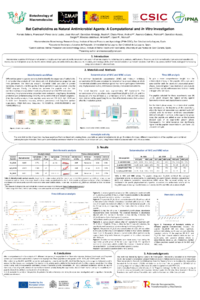
Antimicrobial peptides (AMPs) are small proteins that play an important role in the innate immune system of various organisms, including plants, animals, and humans. These natural defence molecules have attracted considerable interest due to their potential as alternative antimicrobial agents to combat infectious diseases. In this study, we used computational and in vitro methods to investigate the antimicrobial activity of cathelicidin family peptides from bat species with different ecological niches.
The study of the physicochemical parameters of the peptides (hydrophobicity and net charge), together with the study of the helical regions, allowed us to deduce the antimicrobial character of peptides. To analyse the antimicrobial activity in vitro, we first determine the minimum inhibitory concentration (MIC) and minimum bactericidal concentration (MBC) against four different bacteria: E. coli, Salmonella, S. aureus, and E. faecalis. We then selected the most effective peptide and assessed whether it acts as a bacteriostatic or bactericidal agent. Additionally, we investigated the duration of its activity and its ability to lyse bacterial cells. We accomplished this by plotting killing curves during both the exponential and latent phases of bacterial growth. Finally, we evaluated the peptide's potential to cause hemolysis in rat erythrocytes. 105
One of our peptides revealed a high antimicrobial activity, with MIC and MBC values ranging from 3.12 to 1.56 μM. It also demonstrated bactericidal properties during the stationary phase but acted as a bacteriostatic agent during the exponential phase. Notably, it exhibited lytic activity against the tested bacteria but no hemolytic activity against rat erythrocytes.
Keywords
Bat cathelicidins
minimum bactericidal concentration
minimum inhibitory concentration
killing curves
hemolysis activity
Poster
Póster_IMAP_REVISADO.pdf
Identification of novel antimicrobial peptides from the skin of Leptodactylus chaquensis (Anura Leptodactylidae) frog in northern Argentina
Drosocin-like peptides exhibit highly diverse antimicrobial activity and inhibit translation at two different stages