Event submissions
Published
 10.3390/APD20symposium-14958 (registering DOI)
 This submission belongs to the session S3. Promising antimicrobial leads and mechanisms of action of the event Antimicrobial Peptides: Yesterday, Today and Tomorrow
Published date
12 Oct, 2023
Academic Editor
'%3e%3cpath%20d='M12.6657%2010.9104C12.4185%2010.325%2012.0599%209.79327%2011.6097%209.34482C11.1609%208.89508%2010.6293%208.5365%2010.0442%208.28888C10.0389%208.28626%2010.0337%208.28495%2010.0285%208.28233C10.8446%207.69279%2011.3752%206.73249%2011.3752%205.64904C11.3752%203.8542%209.92103%202.39999%208.1262%202.39999C6.33136%202.39999%204.87715%203.8542%204.87715%205.64904C4.87715%206.73249%205.40774%207.69279%206.22393%208.28364C6.21869%208.28626%206.21345%208.28757%206.20821%208.29019C5.62129%208.5378%205.09463%208.89284%204.64265%209.34613C4.1929%209.79493%203.83432%2010.3266%203.58671%2010.9117C3.34345%2011.4845%203.21226%2012.0987%203.20023%2012.7209C3.19988%2012.7349%203.20233%2012.7488%203.20744%2012.7619C3.21255%2012.7749%203.22022%2012.7867%203.22998%2012.7968C3.23975%2012.8068%203.25142%2012.8147%203.26431%2012.8202C3.2772%2012.8256%203.29105%2012.8284%203.30504%2012.8284H4.09109C4.14874%2012.8284%204.19459%2012.7825%204.1959%2012.7262C4.2221%2011.7148%204.62823%2010.7676%205.34617%2010.0497C6.08899%209.30683%207.0755%208.89808%208.1262%208.89808C9.17689%208.89808%2010.1634%209.30683%2010.9062%2010.0497C11.6242%2010.7676%2012.0303%2011.7148%2012.0565%2012.7262C12.0578%2012.7838%2012.1037%2012.8284%2012.1613%2012.8284H12.9474C12.9613%2012.8284%2012.9752%2012.8256%2012.9881%2012.8202C13.001%2012.8147%2013.0126%2012.8068%2013.0224%2012.7968C13.0322%2012.7867%2013.0398%2012.7749%2013.0449%2012.7619C13.0501%2012.7488%2013.0525%2012.7349%2013.0522%2012.7209C13.0391%2012.0947%2012.9094%2011.4855%2012.6657%2010.9104ZM8.1262%207.9024C7.52486%207.9024%206.9589%207.6679%206.53312%207.24211C6.10733%206.81633%205.87283%206.25037%205.87283%205.64904C5.87283%205.0477%206.10733%204.48174%206.53312%204.05596C6.9589%203.63018%207.52486%203.39567%208.1262%203.39567C8.72753%203.39567%209.29349%203.63018%209.71927%204.05596C10.1451%204.48174%2010.3796%205.0477%2010.3796%205.64904C10.3796%206.25037%2010.1451%206.81633%209.71927%207.24211C9.29349%207.6679%208.72753%207.9024%208.1262%207.9024Z'%20fill='%235D1EE1'/%3e%3c/g%3e%3c/svg%3e) Guangshun Wang
Guangshun WangCitation
Esther Imperlini, Federica Massaro, Angelica Grifoni, Fernando Porcelli, Stefano Borocci, Francesco Buonocore, Effects of a chionodracine-derived antimicrobial peptide against bacteria virulence factors, in Proceedings of Antimicrobial Peptides: Yesterday, Today and Tomorrow, 1 October–7 October 2023, MDPI: Basel, Switzerland, doi: 10.3390/APD20symposium-14958
Share
Email
Facebook
Twitter
LinkedIn
Effects of a chionodracine-derived antimicrobial peptide against bacteria virulence factors
'%3e%3cpath%20d='M12.6647%2010.9104C12.4176%2010.325%2012.0589%209.7933%2011.6088%209.34485C11.16%208.89511%2010.6283%208.53653%2010.0432%208.28891C10.038%208.28629%2010.0327%208.28498%2010.0275%208.28236C10.8437%207.69282%2011.3743%206.73252%2011.3743%205.64907C11.3743%203.85423%209.92005%202.40002%208.12522%202.40002C6.33038%202.40002%204.87618%203.85423%204.87618%205.64907C4.87618%206.73252%205.40677%207.69282%206.22296%208.28367C6.21772%208.28629%206.21248%208.2876%206.20724%208.29022C5.62031%208.53783%205.09365%208.89287%204.64167%209.34616C4.19192%209.79496%203.83334%2010.3266%203.58573%2010.9117C3.34247%2011.4846%203.21128%2012.0987%203.19925%2012.721C3.1989%2012.735%203.20135%2012.7489%203.20646%2012.7619C3.21157%2012.7749%203.21924%2012.7868%203.22901%2012.7968C3.23877%2012.8068%203.25045%2012.8148%203.26334%2012.8202C3.27623%2012.8256%203.29007%2012.8284%203.30406%2012.8284H4.09012C4.14776%2012.8284%204.19362%2012.7825%204.19493%2012.7262C4.22113%2011.7148%204.62726%2010.7676%205.34519%2010.0497C6.08802%209.30686%207.07452%208.89811%208.12522%208.89811C9.17592%208.89811%2010.1624%209.30686%2010.9052%2010.0497C11.6232%2010.7676%2012.0293%2011.7148%2012.0555%2012.7262C12.0568%2012.7839%2012.1027%2012.8284%2012.1603%2012.8284H12.9464C12.9604%2012.8284%2012.9742%2012.8256%2012.9871%2012.8202C13%2012.8148%2013.0117%2012.8068%2013.0214%2012.7968C13.0312%2012.7868%2013.0389%2012.7749%2013.044%2012.7619C13.0491%2012.7489%2013.0515%2012.735%2013.0512%2012.721C13.0381%2012.0947%2012.9084%2011.4856%2012.6647%2010.9104ZM8.12522%207.90243C7.52388%207.90243%206.95792%207.66793%206.53214%207.24215C6.10636%206.81636%205.87185%206.2504%205.87185%205.64907C5.87185%205.04773%206.10636%204.48177%206.53214%204.05599C6.95792%203.63021%207.52388%203.3957%208.12522%203.3957C8.72655%203.3957%209.29252%203.63021%209.7183%204.05599C10.1441%204.48177%2010.3786%205.04773%2010.3786%205.64907C10.3786%206.2504%2010.1441%206.81636%209.7183%207.24215C9.29252%207.66793%208.72655%207.90243%208.12522%207.90243Z'%20fill='%235D1EE1'/%3e%3c/g%3e%3c/svg%3e)
Esther Imperlini 1
Federica Massaro 1
Angelica Grifoni 1
Fernando Porcelli 1
Stefano Borocci 1

Francesco Buonocore 1
1. Department for Innovation in Biological, AgroFood and Forest Systems, University of Tuscia, Viterbo, Italy
Abstract
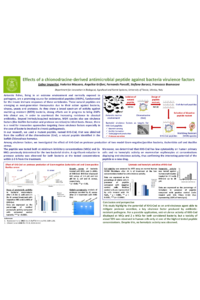
Antarctic fishes, living in an extreme environment and normally exposed to pathogens, are a promising source for antimicrobial peptides (AMPs), fundamental for the innate immune responses of these vertebrates. These natural peptides are emerging as next-generation therapeutics due to their action against bacteria, viruses, yeasts and protozoa. As they show a broad spectrum of activity against multidrug resistant (MDR) bacteria, strong efforts are in progress to bring AMPs into clinical use, in order to counteract the increasing resistance to classical antibiotics. Beyond intrinsic/acquired resistance, MDR species also uses virulence factors (like biofilm formation and protease secretion) to infect hosts. Hence, there is a need for innovative approaches targeting these virulence factors especially in the case of bacteria involved in chronic pathogenesis.
In our research, we used a mutant peptide, named KHS-Cnd, that was obtained from the scaffold of the chionodracine (Cnd), a natural peptide identified in the icefish Chionodraco hamatus. Among virulence factors, we investigated the effect of KHS-Cnd on protease production of two model Gram-negative/positive bacteria, Escherichia coli and Bacillus cereus. The peptide was tested both at minimum inhibitory concentrations (MICs) and 2x MICs previously determined for the two bacterial strains. A significant reduction in protease activity was observed for both bacteria at the tested concentrations within 1-3 h from the treatment. Moreover, we determined that KHS-Cnd has low cytotoxicity on human primary cells and no hemolytic activity on mammalian erythrocytes at concentrations displaying anti-virulence activity, thus confirming the interesting potential of the peptide as a new drug.
Keywords
antimicrobial peptide
chionodracine
virulence factors
protease activity
Poster
Imperlini et al. Poster APD2023.pdf
Lactococcus lactis subsp. lactis 431, a nisin producing strain isolated from kimchi
Identification and engineering of a human cathelicidin peptide LL-37mini as a novel antibiotic