Event submissions
Published
 10.3390/APD20symposium-14961 (registering DOI)
 This submission belongs to the session S3. Promising antimicrobial leads and mechanisms of action of the event Antimicrobial Peptides: Yesterday, Today and Tomorrow
Published date
12 Oct, 2023
Academic Editor
'%3e%3cpath%20d='M12.6657%2010.9104C12.4185%2010.325%2012.0599%209.79327%2011.6097%209.34482C11.1609%208.89508%2010.6293%208.5365%2010.0442%208.28888C10.0389%208.28626%2010.0337%208.28495%2010.0285%208.28233C10.8446%207.69279%2011.3752%206.73249%2011.3752%205.64904C11.3752%203.8542%209.92103%202.39999%208.1262%202.39999C6.33136%202.39999%204.87715%203.8542%204.87715%205.64904C4.87715%206.73249%205.40774%207.69279%206.22393%208.28364C6.21869%208.28626%206.21345%208.28757%206.20821%208.29019C5.62129%208.5378%205.09463%208.89284%204.64265%209.34613C4.1929%209.79493%203.83432%2010.3266%203.58671%2010.9117C3.34345%2011.4845%203.21226%2012.0987%203.20023%2012.7209C3.19988%2012.7349%203.20233%2012.7488%203.20744%2012.7619C3.21255%2012.7749%203.22022%2012.7867%203.22998%2012.7968C3.23975%2012.8068%203.25142%2012.8147%203.26431%2012.8202C3.2772%2012.8256%203.29105%2012.8284%203.30504%2012.8284H4.09109C4.14874%2012.8284%204.19459%2012.7825%204.1959%2012.7262C4.2221%2011.7148%204.62823%2010.7676%205.34617%2010.0497C6.08899%209.30683%207.0755%208.89808%208.1262%208.89808C9.17689%208.89808%2010.1634%209.30683%2010.9062%2010.0497C11.6242%2010.7676%2012.0303%2011.7148%2012.0565%2012.7262C12.0578%2012.7838%2012.1037%2012.8284%2012.1613%2012.8284H12.9474C12.9613%2012.8284%2012.9752%2012.8256%2012.9881%2012.8202C13.001%2012.8147%2013.0126%2012.8068%2013.0224%2012.7968C13.0322%2012.7867%2013.0398%2012.7749%2013.0449%2012.7619C13.0501%2012.7488%2013.0525%2012.7349%2013.0522%2012.7209C13.0391%2012.0947%2012.9094%2011.4855%2012.6657%2010.9104ZM8.1262%207.9024C7.52486%207.9024%206.9589%207.6679%206.53312%207.24211C6.10733%206.81633%205.87283%206.25037%205.87283%205.64904C5.87283%205.0477%206.10733%204.48174%206.53312%204.05596C6.9589%203.63018%207.52486%203.39567%208.1262%203.39567C8.72753%203.39567%209.29349%203.63018%209.71927%204.05596C10.1451%204.48174%2010.3796%205.0477%2010.3796%205.64904C10.3796%206.25037%2010.1451%206.81633%209.71927%207.24211C9.29349%207.6679%208.72753%207.9024%208.1262%207.9024Z'%20fill='%235D1EE1'/%3e%3c/g%3e%3c/svg%3e) Guangshun Wang
Guangshun WangCitation
Renee Fleeman, Breaking the Barrier: Polyproline Peptides Disrupt the Matrix of Hypervirulent Klebsiella pneumoniae Biofilms to Release Bacteria from their Protective Barrier., in Proceedings of Antimicrobial Peptides: Yesterday, Today and Tomorrow, 1 October–7 October 2023, MDPI: Basel, Switzerland, doi: 10.3390/APD20symposium-14961
Share
Email
Facebook
Twitter
LinkedIn
Breaking the Barrier: Polyproline Peptides Disrupt the Matrix of Hypervirulent Klebsiella pneumoniae Biofilms to Release Bacteria from their Protective Barrier.
'%3e%3cpath%20d='M12.6647%2010.9104C12.4176%2010.325%2012.0589%209.7933%2011.6088%209.34485C11.16%208.89511%2010.6283%208.53653%2010.0432%208.28891C10.038%208.28629%2010.0327%208.28498%2010.0275%208.28236C10.8437%207.69282%2011.3743%206.73252%2011.3743%205.64907C11.3743%203.85423%209.92005%202.40002%208.12522%202.40002C6.33038%202.40002%204.87618%203.85423%204.87618%205.64907C4.87618%206.73252%205.40677%207.69282%206.22296%208.28367C6.21772%208.28629%206.21248%208.2876%206.20724%208.29022C5.62031%208.53783%205.09365%208.89287%204.64167%209.34616C4.19192%209.79496%203.83334%2010.3266%203.58573%2010.9117C3.34247%2011.4846%203.21128%2012.0987%203.19925%2012.721C3.1989%2012.735%203.20135%2012.7489%203.20646%2012.7619C3.21157%2012.7749%203.21924%2012.7868%203.22901%2012.7968C3.23877%2012.8068%203.25045%2012.8148%203.26334%2012.8202C3.27623%2012.8256%203.29007%2012.8284%203.30406%2012.8284H4.09012C4.14776%2012.8284%204.19362%2012.7825%204.19493%2012.7262C4.22113%2011.7148%204.62726%2010.7676%205.34519%2010.0497C6.08802%209.30686%207.07452%208.89811%208.12522%208.89811C9.17592%208.89811%2010.1624%209.30686%2010.9052%2010.0497C11.6232%2010.7676%2012.0293%2011.7148%2012.0555%2012.7262C12.0568%2012.7839%2012.1027%2012.8284%2012.1603%2012.8284H12.9464C12.9604%2012.8284%2012.9742%2012.8256%2012.9871%2012.8202C13%2012.8148%2013.0117%2012.8068%2013.0214%2012.7968C13.0312%2012.7868%2013.0389%2012.7749%2013.044%2012.7619C13.0491%2012.7489%2013.0515%2012.735%2013.0512%2012.721C13.0381%2012.0947%2012.9084%2011.4856%2012.6647%2010.9104ZM8.12522%207.90243C7.52388%207.90243%206.95792%207.66793%206.53214%207.24215C6.10636%206.81636%205.87185%206.2504%205.87185%205.64907C5.87185%205.04773%206.10636%204.48177%206.53214%204.05599C6.95792%203.63021%207.52388%203.3957%208.12522%203.3957C8.72655%203.3957%209.29252%203.63021%209.7183%204.05599C10.1441%204.48177%2010.3786%205.04773%2010.3786%205.64907C10.3786%206.2504%2010.1441%206.81636%209.7183%207.24215C9.29252%207.66793%208.72655%207.90243%208.12522%207.90243Z'%20fill='%235D1EE1'/%3e%3c/g%3e%3c/svg%3e)
Renee Fleeman 1
1. University of Central Florida College of Medicine Burnett School of Biomedical Scienes
Abstract
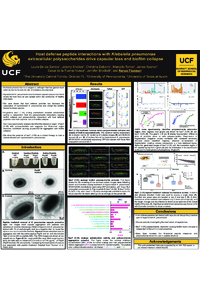
Klebsiella pneumoniae is a dangerous pathogen that has gained much notoriety due to its extreme rate of resistance development. K. pneumoniae acute and chronic wound treatment is complicated by the presence of biofilm formation, which contributes to drug resistance, persistence, tolerance, and slow wound healing. In addition to wound infections, biofilm formation abilities of K. pneumoniae lead to persistent, drug resistant catheter infections. Antimicrobial peptides have shown promise in recent years as a topical treatment and as a device coating to eradicate drug resistant K. pneumoniae. Previous work from our lab revealed a mechanism used by antimicrobial peptides to disrupt the capsule of K. pneumoniae. Recently, we have found that a polyproline peptide bac7 (1-35) can disrupt pre-formed biofilms of hypervirulent K. pneumoniae. Using confocal microscopy of K. pneumoniae NTUH K2044 biofilms with bacteria constitutively expressing GFP and matrix polysaccharides labeled with Texas red tagged Concanavalin A, we show bac7 (1-35) decreases the biofilm matrix material and releases the cells from their protective encasing. Live/dead staining images then revealed the dispersed cells were eradicated by the antimicrobial properties of the peptide. Interestingly, bac7 (1-35) treatment was found to decrease the mucoid phenotype of this species that is provided by capsular polysaccharides. Our results show that in addition to capsular polysaccharides, biofilm matrix polysaccharides are targeted by peptides to potentially sensitize hypervirulent K. pneumoniae to the host immune system and antibiotic therapies.
Keywords
Klebsiella pneumoniae
antimicrobial peptides
capsule polysaccharides
biofilm
Poster
RFLEEMAN APD20.pdf
Novel Fejervarin peptides promote acute and chronic skin wound healing