Event submissions
Published
This submission belongs to the session S7. Poster session of the event The 3rd International Electronic Conference on Agronomy
Published date
13 Oct, 2023
Academic Editor
'%3e%3cpath%20d='M12.6657%2010.9104C12.4185%2010.325%2012.0599%209.79327%2011.6097%209.34482C11.1609%208.89508%2010.6293%208.5365%2010.0442%208.28888C10.0389%208.28626%2010.0337%208.28495%2010.0285%208.28233C10.8446%207.69279%2011.3752%206.73249%2011.3752%205.64904C11.3752%203.8542%209.92103%202.39999%208.1262%202.39999C6.33136%202.39999%204.87715%203.8542%204.87715%205.64904C4.87715%206.73249%205.40774%207.69279%206.22393%208.28364C6.21869%208.28626%206.21345%208.28757%206.20821%208.29019C5.62129%208.5378%205.09463%208.89284%204.64265%209.34613C4.1929%209.79493%203.83432%2010.3266%203.58671%2010.9117C3.34345%2011.4845%203.21226%2012.0987%203.20023%2012.7209C3.19988%2012.7349%203.20233%2012.7488%203.20744%2012.7619C3.21255%2012.7749%203.22022%2012.7867%203.22998%2012.7968C3.23975%2012.8068%203.25142%2012.8147%203.26431%2012.8202C3.2772%2012.8256%203.29105%2012.8284%203.30504%2012.8284H4.09109C4.14874%2012.8284%204.19459%2012.7825%204.1959%2012.7262C4.2221%2011.7148%204.62823%2010.7676%205.34617%2010.0497C6.08899%209.30683%207.0755%208.89808%208.1262%208.89808C9.17689%208.89808%2010.1634%209.30683%2010.9062%2010.0497C11.6242%2010.7676%2012.0303%2011.7148%2012.0565%2012.7262C12.0578%2012.7838%2012.1037%2012.8284%2012.1613%2012.8284H12.9474C12.9613%2012.8284%2012.9752%2012.8256%2012.9881%2012.8202C13.001%2012.8147%2013.0126%2012.8068%2013.0224%2012.7968C13.0322%2012.7867%2013.0398%2012.7749%2013.0449%2012.7619C13.0501%2012.7488%2013.0525%2012.7349%2013.0522%2012.7209C13.0391%2012.0947%2012.9094%2011.4855%2012.6657%2010.9104ZM8.1262%207.9024C7.52486%207.9024%206.9589%207.6679%206.53312%207.24211C6.10733%206.81633%205.87283%206.25037%205.87283%205.64904C5.87283%205.0477%206.10733%204.48174%206.53312%204.05596C6.9589%203.63018%207.52486%203.39567%208.1262%203.39567C8.72753%203.39567%209.29349%203.63018%209.71927%204.05596C10.1451%204.48174%2010.3796%205.0477%2010.3796%205.64904C10.3796%206.25037%2010.1451%206.81633%209.71927%207.24211C9.29349%207.6679%208.72753%207.9024%208.1262%207.9024Z'%20fill='%235D1EE1'/%3e%3c/g%3e%3c/svg%3e) Paul Kwan
Paul KwanCitation
Mikhail Proskurnin, Dmitry Volkov, Dmitry Filatov, Ivan V. Mikheev, Olga Rogova, Temperature-dependent IR Spectroscopy of Silicate Soils with Cluster Analysis for Soil Differentiation, in Proceedings of The 3rd International Electronic Conference on Agronomy, 15 October–30 October 2023, MDPI: Basel, Switzerland
Share
Email
Facebook
Twitter
LinkedIn
Temperature-dependent IR Spectroscopy of Silicate Soils with Cluster Analysis for Soil Differentiation
'%3e%3cpath%20d='M12.6647%2010.9104C12.4176%2010.325%2012.0589%209.7933%2011.6088%209.34485C11.16%208.89511%2010.6283%208.53653%2010.0432%208.28891C10.038%208.28629%2010.0327%208.28498%2010.0275%208.28236C10.8437%207.69282%2011.3743%206.73252%2011.3743%205.64907C11.3743%203.85423%209.92005%202.40002%208.12522%202.40002C6.33038%202.40002%204.87618%203.85423%204.87618%205.64907C4.87618%206.73252%205.40677%207.69282%206.22296%208.28367C6.21772%208.28629%206.21248%208.2876%206.20724%208.29022C5.62031%208.53783%205.09365%208.89287%204.64167%209.34616C4.19192%209.79496%203.83334%2010.3266%203.58573%2010.9117C3.34247%2011.4846%203.21128%2012.0987%203.19925%2012.721C3.1989%2012.735%203.20135%2012.7489%203.20646%2012.7619C3.21157%2012.7749%203.21924%2012.7868%203.22901%2012.7968C3.23877%2012.8068%203.25045%2012.8148%203.26334%2012.8202C3.27623%2012.8256%203.29007%2012.8284%203.30406%2012.8284H4.09012C4.14776%2012.8284%204.19362%2012.7825%204.19493%2012.7262C4.22113%2011.7148%204.62726%2010.7676%205.34519%2010.0497C6.08802%209.30686%207.07452%208.89811%208.12522%208.89811C9.17592%208.89811%2010.1624%209.30686%2010.9052%2010.0497C11.6232%2010.7676%2012.0293%2011.7148%2012.0555%2012.7262C12.0568%2012.7839%2012.1027%2012.8284%2012.1603%2012.8284H12.9464C12.9604%2012.8284%2012.9742%2012.8256%2012.9871%2012.8202C13%2012.8148%2013.0117%2012.8068%2013.0214%2012.7968C13.0312%2012.7868%2013.0389%2012.7749%2013.044%2012.7619C13.0491%2012.7489%2013.0515%2012.735%2013.0512%2012.721C13.0381%2012.0947%2012.9084%2011.4856%2012.6647%2010.9104ZM8.12522%207.90243C7.52388%207.90243%206.95792%207.66793%206.53214%207.24215C6.10636%206.81636%205.87185%206.2504%205.87185%205.64907C5.87185%205.04773%206.10636%204.48177%206.53214%204.05599C6.95792%203.63021%207.52388%203.3957%208.12522%203.3957C8.72655%203.3957%209.29252%203.63021%209.7183%204.05599C10.1441%204.48177%2010.3786%205.04773%2010.3786%205.64907C10.3786%206.2504%2010.1441%206.81636%209.7183%207.24215C9.29252%207.66793%208.72655%207.90243%208.12522%207.90243Z'%20fill='%235D1EE1'/%3e%3c/g%3e%3c/svg%3e)
Mikhail Proskurnin 1
Dmitry Volkov 1,2
Dmitry Filatov 1
Ivan V. Mikheev 1
Olga Rogova 1,2
1. Chemistry Department of M.V. Lomonosov Moscow State University, Leninskie Gory, 1-3, GSP-1, 119991, Moscow, Russia
2. Department of Chemistry and Physical Chemistry of Soils, V.V. Dokuchaev Soil Science Institute, Pyzhevsky per., 7/2, 119017, Moscow, Russia
Abstract
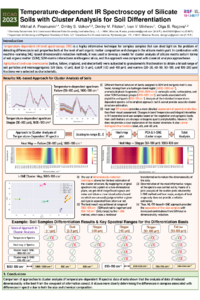
Temperature-dependent IR (TIR) spectroscopy is highly informative for complex samples. This approach increases the informativeness of soil IR spectra, which are characterized by low-intensity characteristic bands, especially those of soil organic matter (SOM). Cluster analysis with machine learning (ML) was used with attenuated total-reflection TIR. Dimensionality reduction algorithms are PCA, NMF, t-SNE, and LDA. Agricultural land-use chernozems (native, fallow, cropland, and shelterbelt) were subjected to granulometric fractionation to obtain a broad range of soil particles and microaggregates. Silt (size, <2 µm), dust (2–5 µm), cutoff (<20 and <50 µm), and narrow (20–30, 40–50, 50–100, and 100–200 µm) fractions were selected as characteristic. Different thermal behavior of bands assigned to SOM and inorganic matrix was found. Among them are hydrogen-bond region (4000–3200 cm–1), aromatic/aliphatic fragments (3100–2800 cm–1), carboxylic acids, carboxylates, and other SOM functional groups (1800–1200 cm–1), and bands associated with phytoliths and quartz (850–150 cm–1). While individual IR spectra do not provide enough information for differentiation due to broad and unresolved bands, changes in band frequencies and integral intensities in TIR (heatmap analysis) separates land-use samples based on the vegetation and agrogenic loads. Main contributions are changes in biogenic quartz and phytoliths. However, direct TIR analysis cannot distinguish fine fractions (dust, silt, and <20 µm). To the contrary, ML-TIR-based approaches, especially t-SNE, provided the separation of fine-size samples with increased contributions from SOM due to dimensionality reduction, which cannot be employed in direct approaches.
Keywords
infrared spectroscopy
temperature-dependent infrared spectra
cluster analysis
machine learning
molecular structure
soil organic matter
phytoliths
land use differentiation
Manuscript
poster_sciforum-078344.pdf
Poster
poster_sciforum-078344.pdf
A survey study of fig mosaic disease in southern Iraq confirming the presence of a fig fleck-associated virus (FFKaV)