Event submissions
Published
This submission belongs to the session S1. Disease, pest and weed control in sustainable agriculture of the event The 3rd International Electronic Conference on Agronomy
Published date
13 Oct, 2023
Academic Editor
'%3e%3cpath%20d='M12.6657%2010.9104C12.4185%2010.325%2012.0599%209.79327%2011.6097%209.34482C11.1609%208.89508%2010.6293%208.5365%2010.0442%208.28888C10.0389%208.28626%2010.0337%208.28495%2010.0285%208.28233C10.8446%207.69279%2011.3752%206.73249%2011.3752%205.64904C11.3752%203.8542%209.92103%202.39999%208.1262%202.39999C6.33136%202.39999%204.87715%203.8542%204.87715%205.64904C4.87715%206.73249%205.40774%207.69279%206.22393%208.28364C6.21869%208.28626%206.21345%208.28757%206.20821%208.29019C5.62129%208.5378%205.09463%208.89284%204.64265%209.34613C4.1929%209.79493%203.83432%2010.3266%203.58671%2010.9117C3.34345%2011.4845%203.21226%2012.0987%203.20023%2012.7209C3.19988%2012.7349%203.20233%2012.7488%203.20744%2012.7619C3.21255%2012.7749%203.22022%2012.7867%203.22998%2012.7968C3.23975%2012.8068%203.25142%2012.8147%203.26431%2012.8202C3.2772%2012.8256%203.29105%2012.8284%203.30504%2012.8284H4.09109C4.14874%2012.8284%204.19459%2012.7825%204.1959%2012.7262C4.2221%2011.7148%204.62823%2010.7676%205.34617%2010.0497C6.08899%209.30683%207.0755%208.89808%208.1262%208.89808C9.17689%208.89808%2010.1634%209.30683%2010.9062%2010.0497C11.6242%2010.7676%2012.0303%2011.7148%2012.0565%2012.7262C12.0578%2012.7838%2012.1037%2012.8284%2012.1613%2012.8284H12.9474C12.9613%2012.8284%2012.9752%2012.8256%2012.9881%2012.8202C13.001%2012.8147%2013.0126%2012.8068%2013.0224%2012.7968C13.0322%2012.7867%2013.0398%2012.7749%2013.0449%2012.7619C13.0501%2012.7488%2013.0525%2012.7349%2013.0522%2012.7209C13.0391%2012.0947%2012.9094%2011.4855%2012.6657%2010.9104ZM8.1262%207.9024C7.52486%207.9024%206.9589%207.6679%206.53312%207.24211C6.10733%206.81633%205.87283%206.25037%205.87283%205.64904C5.87283%205.0477%206.10733%204.48174%206.53312%204.05596C6.9589%203.63018%207.52486%203.39567%208.1262%203.39567C8.72753%203.39567%209.29349%203.63018%209.71927%204.05596C10.1451%204.48174%2010.3796%205.0477%2010.3796%205.64904C10.3796%206.25037%2010.1451%206.81633%209.71927%207.24211C9.29349%207.6679%208.72753%207.9024%208.1262%207.9024Z'%20fill='%235D1EE1'/%3e%3c/g%3e%3c/svg%3e) Thorsten Kraska
Thorsten KraskaCitation
Marco Antonio Tucuch Pérez, Janeth Magali Ramos Aguirre, Francisco Daniel Hernandez Castillo, Jesus Eduardo Ramírez Mendez, Roberto Arredondo Valdes, Herbicidal activity of secondary metabolites from Colletotrichum spp. on Sorghum bicolor and Phaseolus vulgaris development as indicator species in preemergence and their potential as a sustainable alternative in weed control, in Proceedings of The 3rd International Electronic Conference on Agronomy, 15 October–30 October 2023, MDPI: Basel, Switzerland
Share
Email
Facebook
Twitter
LinkedIn
Herbicidal activity of secondary metabolites from Colletotrichum spp. on Sorghum bicolor and Phaseolus vulgaris development as indicator species in preemergence and their potential as a sustainable alternative in weed control
'%3e%3cpath%20d='M12.6647%2010.9104C12.4176%2010.325%2012.0589%209.7933%2011.6088%209.34485C11.16%208.89511%2010.6283%208.53653%2010.0432%208.28891C10.038%208.28629%2010.0327%208.28498%2010.0275%208.28236C10.8437%207.69282%2011.3743%206.73252%2011.3743%205.64907C11.3743%203.85423%209.92005%202.40002%208.12522%202.40002C6.33038%202.40002%204.87618%203.85423%204.87618%205.64907C4.87618%206.73252%205.40677%207.69282%206.22296%208.28367C6.21772%208.28629%206.21248%208.2876%206.20724%208.29022C5.62031%208.53783%205.09365%208.89287%204.64167%209.34616C4.19192%209.79496%203.83334%2010.3266%203.58573%2010.9117C3.34247%2011.4846%203.21128%2012.0987%203.19925%2012.721C3.1989%2012.735%203.20135%2012.7489%203.20646%2012.7619C3.21157%2012.7749%203.21924%2012.7868%203.22901%2012.7968C3.23877%2012.8068%203.25045%2012.8148%203.26334%2012.8202C3.27623%2012.8256%203.29007%2012.8284%203.30406%2012.8284H4.09012C4.14776%2012.8284%204.19362%2012.7825%204.19493%2012.7262C4.22113%2011.7148%204.62726%2010.7676%205.34519%2010.0497C6.08802%209.30686%207.07452%208.89811%208.12522%208.89811C9.17592%208.89811%2010.1624%209.30686%2010.9052%2010.0497C11.6232%2010.7676%2012.0293%2011.7148%2012.0555%2012.7262C12.0568%2012.7839%2012.1027%2012.8284%2012.1603%2012.8284H12.9464C12.9604%2012.8284%2012.9742%2012.8256%2012.9871%2012.8202C13%2012.8148%2013.0117%2012.8068%2013.0214%2012.7968C13.0312%2012.7868%2013.0389%2012.7749%2013.044%2012.7619C13.0491%2012.7489%2013.0515%2012.735%2013.0512%2012.721C13.0381%2012.0947%2012.9084%2011.4856%2012.6647%2010.9104ZM8.12522%207.90243C7.52388%207.90243%206.95792%207.66793%206.53214%207.24215C6.10636%206.81636%205.87185%206.2504%205.87185%205.64907C5.87185%205.04773%206.10636%204.48177%206.53214%204.05599C6.95792%203.63021%207.52388%203.3957%208.12522%203.3957C8.72655%203.3957%209.29252%203.63021%209.7183%204.05599C10.1441%204.48177%2010.3786%205.04773%2010.3786%205.64907C10.3786%206.2504%2010.1441%206.81636%209.7183%207.24215C9.29252%207.66793%208.72655%207.90243%208.12522%207.90243Z'%20fill='%235D1EE1'/%3e%3c/g%3e%3c/svg%3e)
Marco Antonio Tucuch Pérez 1
Janeth Magali Ramos Aguirre 1
Francisco Daniel Hernandez Castillo 2
Jesus Eduardo Ramírez Mendez 3
Roberto Arredondo Valdes 1
1. Departamento de Nanobiociencias, Facultad de Ciencias Químicas, Universidad Autónoma de Coahuila. Ing. Cárdenas Valdez S/N, Col. República, ZC. 25280. Saltillo, Coahuila, México.
2. Departamento de Parasitología, Universidad Autónoma Agraria Antonio Narro. Calzada Antonio Narro 1923. Buenavista, ZC. 25315. Saltillo, Coahuila, México.
3. Departamento de Parasitología, Universidad Autónoma Agraria Antonio Narro. Departamento de Parasitología, Universidad Autónoma Agraria Antonio Narro. Calzada Antonio Narro 1923. Buenavista, ZC. 25315. Saltillo, Coahuila, México.
Abstract
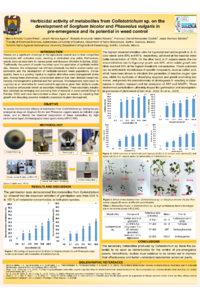
Weeds are a problem in agriculture because they compete with the crops for resources, causing losses in food production. Due to the recent necessity to change the paradigm to sustainable agriculture, it is necessary to develop alternatives to chemical herbicides. One alternative is bioherbicides based on microorganisms and their compounds. The present study evaluated the herbicidal activity in preemergence of metabolites from Colletotrichum spp. on the indicator species Sorghum bicolor as narrow-leaf weed and Phaseolus vulgaris as broad-leaf weed. Furthermore, were identified the compounds present in metabolites. The Mycology and Biotechnology Laboratory of Universidad Autonoma Agraria Antonio Narro provided the fungal strains. The metabolites were produced by liquid fermentation filtered with filters of 0.22 µm. The herbicidal activity was evaluated by placing the seeds in Petri dishes on filter paper previously soaked with the treatments. The treatments were concentrations of 6.2 to 100% of metabolites and an absolute witness; In this bioassay three replicates for each treatment were used. The metabolite compounds were characterized with analytical HPLC-ESI-MS, detection of auxins, and the enzymatic activity of celluloses. The metabolites presented herbicidal activity with an inhibition rate of the hypocotyl and radicle of 50 % and 67 % respectively at a concentration of 6.2 % on S. bicolor. In comparison, in P. vulgaris the inhibition rate of hypocotyl and radicle overcame 50 % at a concentration of 50 %. Regarding the germination rate, the metabolites were more efficient in S. bicolor. This study demonstrates the herbicidal effect in preemergence of the metabolites from Colletotrichum spp. and their possible application as a preemergence bioherbicide.
Keywords
Bioherbicide
biological control
weed
Colletotrichum
metabolites
Manuscript
Herbicidal activity of secondary metabolites from Colletotrichum spp.pdf
Poster
POSTER MICOHERBICIDAS FINAL.pdf
MICROBIAL SYNTHESIS OF SILVER NANOPARTICLES AND ITS EFFECT ON PLANT GROWTH PROMOTING BACTERIA
Myco-chemical constituents and anti-inflammatory activity of Terfezia claveryi Chatin from Algeria