Event submissions
Published
This submission belongs to the session S6. Horticultural and floricultural crops of the event The 3rd International Electronic Conference on Agronomy
Published date
13 Oct, 2023
Academic Editor
'%3e%3cpath%20d='M12.6657%2010.9104C12.4185%2010.325%2012.0599%209.79327%2011.6097%209.34482C11.1609%208.89508%2010.6293%208.5365%2010.0442%208.28888C10.0389%208.28626%2010.0337%208.28495%2010.0285%208.28233C10.8446%207.69279%2011.3752%206.73249%2011.3752%205.64904C11.3752%203.8542%209.92103%202.39999%208.1262%202.39999C6.33136%202.39999%204.87715%203.8542%204.87715%205.64904C4.87715%206.73249%205.40774%207.69279%206.22393%208.28364C6.21869%208.28626%206.21345%208.28757%206.20821%208.29019C5.62129%208.5378%205.09463%208.89284%204.64265%209.34613C4.1929%209.79493%203.83432%2010.3266%203.58671%2010.9117C3.34345%2011.4845%203.21226%2012.0987%203.20023%2012.7209C3.19988%2012.7349%203.20233%2012.7488%203.20744%2012.7619C3.21255%2012.7749%203.22022%2012.7867%203.22998%2012.7968C3.23975%2012.8068%203.25142%2012.8147%203.26431%2012.8202C3.2772%2012.8256%203.29105%2012.8284%203.30504%2012.8284H4.09109C4.14874%2012.8284%204.19459%2012.7825%204.1959%2012.7262C4.2221%2011.7148%204.62823%2010.7676%205.34617%2010.0497C6.08899%209.30683%207.0755%208.89808%208.1262%208.89808C9.17689%208.89808%2010.1634%209.30683%2010.9062%2010.0497C11.6242%2010.7676%2012.0303%2011.7148%2012.0565%2012.7262C12.0578%2012.7838%2012.1037%2012.8284%2012.1613%2012.8284H12.9474C12.9613%2012.8284%2012.9752%2012.8256%2012.9881%2012.8202C13.001%2012.8147%2013.0126%2012.8068%2013.0224%2012.7968C13.0322%2012.7867%2013.0398%2012.7749%2013.0449%2012.7619C13.0501%2012.7488%2013.0525%2012.7349%2013.0522%2012.7209C13.0391%2012.0947%2012.9094%2011.4855%2012.6657%2010.9104ZM8.1262%207.9024C7.52486%207.9024%206.9589%207.6679%206.53312%207.24211C6.10733%206.81633%205.87283%206.25037%205.87283%205.64904C5.87283%205.0477%206.10733%204.48174%206.53312%204.05596C6.9589%203.63018%207.52486%203.39567%208.1262%203.39567C8.72753%203.39567%209.29349%203.63018%209.71927%204.05596C10.1451%204.48174%2010.3796%205.0477%2010.3796%205.64904C10.3796%206.25037%2010.1451%206.81633%209.71927%207.24211C9.29349%207.6679%208.72753%207.9024%208.1262%207.9024Z'%20fill='%235D1EE1'/%3e%3c/g%3e%3c/svg%3e) Juan A. Fernández
Juan A. FernándezCitation
Aušra Brazaitytė, Viktorija Vaštakaitė-Kairienė, Rūta Sutulienė, Kristina Laužikė, Kamilė Stašytė, Pavelas Duchovskis, Response of lettuce to Se biofortification under different white LEDs lighting, in Proceedings of The 3rd International Electronic Conference on Agronomy, 15 October–30 October 2023, MDPI: Basel, Switzerland
Share
Email
Facebook
Twitter
LinkedIn
Response of lettuce to Se biofortification under different white LEDs lighting
'%3e%3cpath%20d='M12.6647%2010.9104C12.4176%2010.325%2012.0589%209.7933%2011.6088%209.34485C11.16%208.89511%2010.6283%208.53653%2010.0432%208.28891C10.038%208.28629%2010.0327%208.28498%2010.0275%208.28236C10.8437%207.69282%2011.3743%206.73252%2011.3743%205.64907C11.3743%203.85423%209.92005%202.40002%208.12522%202.40002C6.33038%202.40002%204.87618%203.85423%204.87618%205.64907C4.87618%206.73252%205.40677%207.69282%206.22296%208.28367C6.21772%208.28629%206.21248%208.2876%206.20724%208.29022C5.62031%208.53783%205.09365%208.89287%204.64167%209.34616C4.19192%209.79496%203.83334%2010.3266%203.58573%2010.9117C3.34247%2011.4846%203.21128%2012.0987%203.19925%2012.721C3.1989%2012.735%203.20135%2012.7489%203.20646%2012.7619C3.21157%2012.7749%203.21924%2012.7868%203.22901%2012.7968C3.23877%2012.8068%203.25045%2012.8148%203.26334%2012.8202C3.27623%2012.8256%203.29007%2012.8284%203.30406%2012.8284H4.09012C4.14776%2012.8284%204.19362%2012.7825%204.19493%2012.7262C4.22113%2011.7148%204.62726%2010.7676%205.34519%2010.0497C6.08802%209.30686%207.07452%208.89811%208.12522%208.89811C9.17592%208.89811%2010.1624%209.30686%2010.9052%2010.0497C11.6232%2010.7676%2012.0293%2011.7148%2012.0555%2012.7262C12.0568%2012.7839%2012.1027%2012.8284%2012.1603%2012.8284H12.9464C12.9604%2012.8284%2012.9742%2012.8256%2012.9871%2012.8202C13%2012.8148%2013.0117%2012.8068%2013.0214%2012.7968C13.0312%2012.7868%2013.0389%2012.7749%2013.044%2012.7619C13.0491%2012.7489%2013.0515%2012.735%2013.0512%2012.721C13.0381%2012.0947%2012.9084%2011.4856%2012.6647%2010.9104ZM8.12522%207.90243C7.52388%207.90243%206.95792%207.66793%206.53214%207.24215C6.10636%206.81636%205.87185%206.2504%205.87185%205.64907C5.87185%205.04773%206.10636%204.48177%206.53214%204.05599C6.95792%203.63021%207.52388%203.3957%208.12522%203.3957C8.72655%203.3957%209.29252%203.63021%209.7183%204.05599C10.1441%204.48177%2010.3786%205.04773%2010.3786%205.64907C10.3786%206.2504%2010.1441%206.81636%209.7183%207.24215C9.29252%207.66793%208.72655%207.90243%208.12522%207.90243Z'%20fill='%235D1EE1'/%3e%3c/g%3e%3c/svg%3e)
Aušra Brazaitytė 1

Viktorija Vaštakaitė-Kairienė 2
Rūta Sutulienė 2
Kristina Laužikė 2
Kamilė Stašytė 2
Pavelas Duchovskis 2
1. Institute of Horticulture, Lithuanian Research Centre for Agriculture and Forestry, Kaunas str. 30, Babtai, LT-54333, Lithuania
2. Institute of Horticulture, Lithuanian Research Centre for Agriculture and Forestry
Abstract
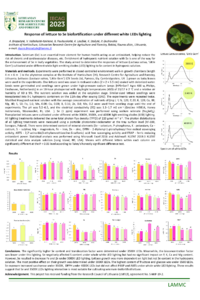
Selenium (Se) is an essential trace element for human health acting as an antioxidant, helping reduce the risk of chronic and cardiovascular diseases, etc. Enrichment of hydroponic nutrient solution with Se is one of the ways for the enhancement of Se in leafy vegetables. The study aimed to determine the responses of lettuce (Lactuca sativa, ‘Little Gem’) cultivated under different white (3000K, 3500K, 4000K) light-emitting diodes (LED) lighting to Se content in hydroponic solution. The photon flux density (PFD), photoperiod, temperature, and relative humidity in the growth chamber were maintained at 220 mmol m-2 s-1, 18 h, 21/17±2°C, and 60±5%, respectively. Se (1 ppm) experiment was performed using sodium selenate (Na2SeO4). Results showed that the significantly higher Se content and translocation factor was determined under 3500K LEDs. Meanwhile, the bioconcentration factor was lower under this lighting. Se negatively affected sulphur content under whole white LEDs lighting but had no significant impact on other mineral element content. Lettuce growth was more dependent on light but not Se content in the hydroponic solution. The most positive effect on their growth was determined under 3000K LEDs. The highest content of fructose and glucose was under 3500 LEDs. Se exposure increased DPPH under 4000K LEDs but did not affect FRAP and ABTS under whole white LED lighting. These results suggest that Se and 3500K LEDs lighting interaction is most suitable for cultivating selenium-biofortified lettuce. Acknowledgements: This project has received funding from the Research Council of Lithuania (LMTLT), agreement No. S-MIP-19-2.
Keywords
selenium
biofortification
white light
LEDs
lettuce
Manuscript
Brazaityte et al.pdf
Poster
Brazaityte et al.pdf
Sillicon dioxide (SiO2) based defense induction in Maize against fall armyworm (Spodoptera frugiperda)
Effects of Drought Stress on the Chemical Composition and Bioactive Properties of Cichorium spinosum L.