Event submissions
Published
This submission belongs to the session S7. Poster session of the event The 3rd International Electronic Conference on Agronomy
Published date
13 Oct, 2023
Academic Editor
'%3e%3cpath%20d='M12.6657%2010.9104C12.4185%2010.325%2012.0599%209.79327%2011.6097%209.34482C11.1609%208.89508%2010.6293%208.5365%2010.0442%208.28888C10.0389%208.28626%2010.0337%208.28495%2010.0285%208.28233C10.8446%207.69279%2011.3752%206.73249%2011.3752%205.64904C11.3752%203.8542%209.92103%202.39999%208.1262%202.39999C6.33136%202.39999%204.87715%203.8542%204.87715%205.64904C4.87715%206.73249%205.40774%207.69279%206.22393%208.28364C6.21869%208.28626%206.21345%208.28757%206.20821%208.29019C5.62129%208.5378%205.09463%208.89284%204.64265%209.34613C4.1929%209.79493%203.83432%2010.3266%203.58671%2010.9117C3.34345%2011.4845%203.21226%2012.0987%203.20023%2012.7209C3.19988%2012.7349%203.20233%2012.7488%203.20744%2012.7619C3.21255%2012.7749%203.22022%2012.7867%203.22998%2012.7968C3.23975%2012.8068%203.25142%2012.8147%203.26431%2012.8202C3.2772%2012.8256%203.29105%2012.8284%203.30504%2012.8284H4.09109C4.14874%2012.8284%204.19459%2012.7825%204.1959%2012.7262C4.2221%2011.7148%204.62823%2010.7676%205.34617%2010.0497C6.08899%209.30683%207.0755%208.89808%208.1262%208.89808C9.17689%208.89808%2010.1634%209.30683%2010.9062%2010.0497C11.6242%2010.7676%2012.0303%2011.7148%2012.0565%2012.7262C12.0578%2012.7838%2012.1037%2012.8284%2012.1613%2012.8284H12.9474C12.9613%2012.8284%2012.9752%2012.8256%2012.9881%2012.8202C13.001%2012.8147%2013.0126%2012.8068%2013.0224%2012.7968C13.0322%2012.7867%2013.0398%2012.7749%2013.0449%2012.7619C13.0501%2012.7488%2013.0525%2012.7349%2013.0522%2012.7209C13.0391%2012.0947%2012.9094%2011.4855%2012.6657%2010.9104ZM8.1262%207.9024C7.52486%207.9024%206.9589%207.6679%206.53312%207.24211C6.10733%206.81633%205.87283%206.25037%205.87283%205.64904C5.87283%205.0477%206.10733%204.48174%206.53312%204.05596C6.9589%203.63018%207.52486%203.39567%208.1262%203.39567C8.72753%203.39567%209.29349%203.63018%209.71927%204.05596C10.1451%204.48174%2010.3796%205.0477%2010.3796%205.64904C10.3796%206.25037%2010.1451%206.81633%209.71927%207.24211C9.29349%207.6679%208.72753%207.9024%208.1262%207.9024Z'%20fill='%235D1EE1'/%3e%3c/g%3e%3c/svg%3e) Georgia Ntatsi
Georgia NtatsiCitation
Christina Chaski, Mikel Añibarro-Ortega, Alexis Pereira, José Pinela, Lillian Barros, SPYRIDON PETROPOULOS, The effects of biostimulants and deficit irrigation on chemical composition of greenhouse tomato, in Proceedings of The 3rd International Electronic Conference on Agronomy, 15 October–30 October 2023, MDPI: Basel, Switzerland
Share
Email
Facebook
Twitter
LinkedIn
The effects of biostimulants and deficit irrigation on chemical composition of greenhouse tomato
'%3e%3cpath%20d='M12.6647%2010.9104C12.4176%2010.325%2012.0589%209.7933%2011.6088%209.34485C11.16%208.89511%2010.6283%208.53653%2010.0432%208.28891C10.038%208.28629%2010.0327%208.28498%2010.0275%208.28236C10.8437%207.69282%2011.3743%206.73252%2011.3743%205.64907C11.3743%203.85423%209.92005%202.40002%208.12522%202.40002C6.33038%202.40002%204.87618%203.85423%204.87618%205.64907C4.87618%206.73252%205.40677%207.69282%206.22296%208.28367C6.21772%208.28629%206.21248%208.2876%206.20724%208.29022C5.62031%208.53783%205.09365%208.89287%204.64167%209.34616C4.19192%209.79496%203.83334%2010.3266%203.58573%2010.9117C3.34247%2011.4846%203.21128%2012.0987%203.19925%2012.721C3.1989%2012.735%203.20135%2012.7489%203.20646%2012.7619C3.21157%2012.7749%203.21924%2012.7868%203.22901%2012.7968C3.23877%2012.8068%203.25045%2012.8148%203.26334%2012.8202C3.27623%2012.8256%203.29007%2012.8284%203.30406%2012.8284H4.09012C4.14776%2012.8284%204.19362%2012.7825%204.19493%2012.7262C4.22113%2011.7148%204.62726%2010.7676%205.34519%2010.0497C6.08802%209.30686%207.07452%208.89811%208.12522%208.89811C9.17592%208.89811%2010.1624%209.30686%2010.9052%2010.0497C11.6232%2010.7676%2012.0293%2011.7148%2012.0555%2012.7262C12.0568%2012.7839%2012.1027%2012.8284%2012.1603%2012.8284H12.9464C12.9604%2012.8284%2012.9742%2012.8256%2012.9871%2012.8202C13%2012.8148%2013.0117%2012.8068%2013.0214%2012.7968C13.0312%2012.7868%2013.0389%2012.7749%2013.044%2012.7619C13.0491%2012.7489%2013.0515%2012.735%2013.0512%2012.721C13.0381%2012.0947%2012.9084%2011.4856%2012.6647%2010.9104ZM8.12522%207.90243C7.52388%207.90243%206.95792%207.66793%206.53214%207.24215C6.10636%206.81636%205.87185%206.2504%205.87185%205.64907C5.87185%205.04773%206.10636%204.48177%206.53214%204.05599C6.95792%203.63021%207.52388%203.3957%208.12522%203.3957C8.72655%203.3957%209.29252%203.63021%209.7183%204.05599C10.1441%204.48177%2010.3786%205.04773%2010.3786%205.64907C10.3786%206.2504%2010.1441%206.81636%209.7183%207.24215C9.29252%207.66793%208.72655%207.90243%208.12522%207.90243Z'%20fill='%235D1EE1'/%3e%3c/g%3e%3c/svg%3e)
Christina Chaski 1

Mikel Añibarro-Ortega 2,3

Alexis Pereira 2,3

José Pinela 2,3

Lillian Barros 2,3

SPYRIDON PETROPOULOS 1
1. University of Thessaly, Department of Agriculture, Crop Production and Rural Environment, Fytokou Street, 38446, Volos, Greece
2. Mountain Research Centre (CIMO), ESA, Polytechnic Institute of Bragança, Campus de Santa Apolónia, 1172, 5301-855 Bragança, Portugal
3. Associate Laboratory for Sustainability and Technology in Mountains Regions, Polytechnic Institute of Bragança, Campus de Santa Apolónia, 1172, 5301-855 Bragança, Portugal
Abstract
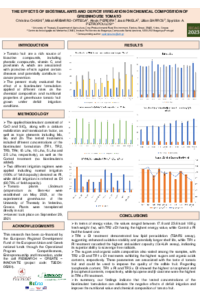
Tomato fruit are a rich source of bioactive compounds, including phenolic compounds, vitamin C, and provitamin A, which are associated with protection against certain diseases and potentially contribute to cancer prevention. The present study evaluated the effect of a biostimulant formulation applied at different concentrations on the chemical composition and nutritional properties of greenhouse tomato fruit grown under deficit irrigation conditions. The applied biostimulant consisted of CaO and SiO2, along with a calcium mobilization and translocation factor, as well as trace elements including Mo, Bo, and Zn. The tested treatments included different concentrations of the biostimulant formulation (TR1, TR2, TR3, TR4), as well as the Control treatment (no biostimulants added). Additionally, two different irrigation regimes were applied including normal irrigation denoted as RI, while deficit irrigation is referred to as DI. Tomato plants of the variety Ben-Hur were established on May 2021, at the experimental greenhouse of the University of Thessaly in Velestino, Greece. Harvest took place on September 29, 2021. The analysis revealed significant variations in total phenolic and flavonoid contents, antioxidant activity, fatty acid composition, tocopherol levels, and sugar and organic acid composition among the studied treatments. In terms of energy value, the values ranged between 17.8 and 23.6 kcal/100 g fw, with TR2 x DI having the highest energy value, while Control x RI had the lowest one. TR4 x DI treatment demonstrated low lipid peroxidation, suggesting enhanced oxidative stability and potentially longer shelf life, while TR4 x RI treatment recorded the highest antioxidant capacity, indicating its superior ability to scavenge free radicals. The sugar and organic acid composition also varied among the samples, with TR1 x DI and TR3 x DI treatments exhibiting higher sugar and organic acid contents in relation to the control of regular irrigation, respectively. These parameters are associated with the taste of tomato fruit and could be used to improve the quality of the edible product. Regarding tocopherol levels, TR1 x DI and TR2 x DI showed higher α-tocopherol and β-tocopherol contents, respectively, while Control x RI displayed relatively lower levels. In conclusion, our findings indicaten that the tested concentrations of the biostimulant formulation can alleviate the negative effects of deficit irrigation and improve the nutritional value and chemical composition of tomato fruit.
Keywords
Fruit quality
Lycopersicum esculentum
water stress
antioxidant activity
nutritional value
Manuscript
ABSTRACT (1).pdf
Poster
Chaski et al. poster.pdf
Grassland Crops as Drivers for the Improvement of Soil Fertility
Precision Agriculture in Rice (Oryza sativa L.) Biofortified with Selenium