Event submissions
Published
This submission belongs to the session S7. Food Quality and Safety of the event The 4th International Electronic Conference on Foods
Published date
13 Oct, 2023
Academic Editor
'%3e%3cpath%20d='M12.6657%2010.9104C12.4185%2010.325%2012.0599%209.79327%2011.6097%209.34482C11.1609%208.89508%2010.6293%208.5365%2010.0442%208.28888C10.0389%208.28626%2010.0337%208.28495%2010.0285%208.28233C10.8446%207.69279%2011.3752%206.73249%2011.3752%205.64904C11.3752%203.8542%209.92103%202.39999%208.1262%202.39999C6.33136%202.39999%204.87715%203.8542%204.87715%205.64904C4.87715%206.73249%205.40774%207.69279%206.22393%208.28364C6.21869%208.28626%206.21345%208.28757%206.20821%208.29019C5.62129%208.5378%205.09463%208.89284%204.64265%209.34613C4.1929%209.79493%203.83432%2010.3266%203.58671%2010.9117C3.34345%2011.4845%203.21226%2012.0987%203.20023%2012.7209C3.19988%2012.7349%203.20233%2012.7488%203.20744%2012.7619C3.21255%2012.7749%203.22022%2012.7867%203.22998%2012.7968C3.23975%2012.8068%203.25142%2012.8147%203.26431%2012.8202C3.2772%2012.8256%203.29105%2012.8284%203.30504%2012.8284H4.09109C4.14874%2012.8284%204.19459%2012.7825%204.1959%2012.7262C4.2221%2011.7148%204.62823%2010.7676%205.34617%2010.0497C6.08899%209.30683%207.0755%208.89808%208.1262%208.89808C9.17689%208.89808%2010.1634%209.30683%2010.9062%2010.0497C11.6242%2010.7676%2012.0303%2011.7148%2012.0565%2012.7262C12.0578%2012.7838%2012.1037%2012.8284%2012.1613%2012.8284H12.9474C12.9613%2012.8284%2012.9752%2012.8256%2012.9881%2012.8202C13.001%2012.8147%2013.0126%2012.8068%2013.0224%2012.7968C13.0322%2012.7867%2013.0398%2012.7749%2013.0449%2012.7619C13.0501%2012.7488%2013.0525%2012.7349%2013.0522%2012.7209C13.0391%2012.0947%2012.9094%2011.4855%2012.6657%2010.9104ZM8.1262%207.9024C7.52486%207.9024%206.9589%207.6679%206.53312%207.24211C6.10733%206.81633%205.87283%206.25037%205.87283%205.64904C5.87283%205.0477%206.10733%204.48174%206.53312%204.05596C6.9589%203.63018%207.52486%203.39567%208.1262%203.39567C8.72753%203.39567%209.29349%203.63018%209.71927%204.05596C10.1451%204.48174%2010.3796%205.0477%2010.3796%205.64904C10.3796%206.25037%2010.1451%206.81633%209.71927%207.24211C9.29349%207.6679%208.72753%207.9024%208.1262%207.9024Z'%20fill='%235D1EE1'/%3e%3c/g%3e%3c/svg%3e) Antonio Bevilacqua
Antonio BevilacquaCitation
Ayesha Tajammul, Jan Gabor, Olajumoke Ayomikun Alagbe, Marketa Houdkova, Ladislav Kokoska, In Vitro Growth-Inhibitory Activity of Liquid and Vapour Phases of Essential Oils from Spice Mixtures against Foodborne Bacterial Pathogens, in Proceedings of The 4th International Electronic Conference on Foods, 15 October–30 October 2023, MDPI: Basel, Switzerland
Share
Email
Facebook
Twitter
LinkedIn
In Vitro Growth-Inhibitory Activity of Liquid and Vapour Phases of Essential Oils from Spice Mixtures against Foodborne Bacterial Pathogens
'%3e%3cpath%20d='M12.6647%2010.9104C12.4176%2010.325%2012.0589%209.7933%2011.6088%209.34485C11.16%208.89511%2010.6283%208.53653%2010.0432%208.28891C10.038%208.28629%2010.0327%208.28498%2010.0275%208.28236C10.8437%207.69282%2011.3743%206.73252%2011.3743%205.64907C11.3743%203.85423%209.92005%202.40002%208.12522%202.40002C6.33038%202.40002%204.87618%203.85423%204.87618%205.64907C4.87618%206.73252%205.40677%207.69282%206.22296%208.28367C6.21772%208.28629%206.21248%208.2876%206.20724%208.29022C5.62031%208.53783%205.09365%208.89287%204.64167%209.34616C4.19192%209.79496%203.83334%2010.3266%203.58573%2010.9117C3.34247%2011.4846%203.21128%2012.0987%203.19925%2012.721C3.1989%2012.735%203.20135%2012.7489%203.20646%2012.7619C3.21157%2012.7749%203.21924%2012.7868%203.22901%2012.7968C3.23877%2012.8068%203.25045%2012.8148%203.26334%2012.8202C3.27623%2012.8256%203.29007%2012.8284%203.30406%2012.8284H4.09012C4.14776%2012.8284%204.19362%2012.7825%204.19493%2012.7262C4.22113%2011.7148%204.62726%2010.7676%205.34519%2010.0497C6.08802%209.30686%207.07452%208.89811%208.12522%208.89811C9.17592%208.89811%2010.1624%209.30686%2010.9052%2010.0497C11.6232%2010.7676%2012.0293%2011.7148%2012.0555%2012.7262C12.0568%2012.7839%2012.1027%2012.8284%2012.1603%2012.8284H12.9464C12.9604%2012.8284%2012.9742%2012.8256%2012.9871%2012.8202C13%2012.8148%2013.0117%2012.8068%2013.0214%2012.7968C13.0312%2012.7868%2013.0389%2012.7749%2013.044%2012.7619C13.0491%2012.7489%2013.0515%2012.735%2013.0512%2012.721C13.0381%2012.0947%2012.9084%2011.4856%2012.6647%2010.9104ZM8.12522%207.90243C7.52388%207.90243%206.95792%207.66793%206.53214%207.24215C6.10636%206.81636%205.87185%206.2504%205.87185%205.64907C5.87185%205.04773%206.10636%204.48177%206.53214%204.05599C6.95792%203.63021%207.52388%203.3957%208.12522%203.3957C8.72655%203.3957%209.29252%203.63021%209.7183%204.05599C10.1441%204.48177%2010.3786%205.04773%2010.3786%205.64907C10.3786%206.2504%2010.1441%206.81636%209.7183%207.24215C9.29252%207.66793%208.72655%207.90243%208.12522%207.90243Z'%20fill='%235D1EE1'/%3e%3c/g%3e%3c/svg%3e)
Ayesha Tajammul 1
Jan Gabor 1
Olajumoke Ayomikun Alagbe 1

Marketa Houdkova 1

Ladislav Kokoska 1
1. Department of Crop Sciences and Agroforestry, Faculty of Tropical AgriSciences, Czech University of Life Sciences Prague, 16500 Prague, Czech Republic
Abstract
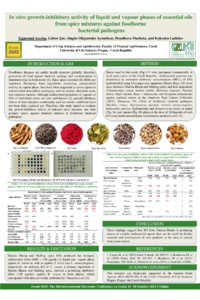
Foodborne diseases are global public health concerns; therefore, food protection against bacterial spoilage and contamination is vital in the food sector [1]. Since spice essential oils (EOs) are necessary flavouring food ingredients possessing antimicrobial activity in the vapour phase, they have been suggested as active agents in antimicrobial atmosphere packaging, such as stickers, absorbent pads, and emission sachets. Although the antibacterial properties of vapours of EOs of individual spices are very well-known [2], the growth-inhibitory effects of their mixtures, traditionally used in cousins worldwide, have not been fully explored yet.
The study aimed to determine minimum inhibitory concentrations (MICs) of EOs hydrodistilled from spice mixtures (Tunisia Bharat and Mulling spice) and their ingredients (Cinnamomum cassia, Laurus nobilis, Myristica fragrans, Pimenta dioica, Piper nigrum, Rosa × damascena, and Syzygium aromaticum) against foodborne bacterial pathogens (Bacillus cereus, Enterococcus faecium, Listeria monocytogenes, Salmonella enterica Typhimurium and Streptococcus bovis) in liquid and vapour phase using broth-microdilution volatilization method in vitro [3].
Tunisia Bharat and Mulling spice EOs produced the most potent antibacterial effect (MIC = 256 µg/mL) in liquid and vapour phases against B. cereus as well as against S. bovis and L. monocytogenes, respectively. In addition, EO of C. cassia, a primary ingredient of Tunisia Bharat and Mulling spice, showed an excellent inhibitory effect (128-256 µg/mL) against Bacillus cereus in both phases, which as per our previous findings (≥ 256 µg/mL) [4]. These findings suggest that EO from Tunisia Bharat is a promising source of volatile antibacterial agents that can be used for further research and development of new products in natural food preservatives.
Keywords
Spice mixtures
essential oils
vapour phase
antibacterial activity
Manuscript
sciforum-076034.pdf
Poster
Ayesha Poster for Food 2023 (MDPI).pdf
“Eating with your eyes first”: Cross-cultural evaluation of visual expectations generated by high-end pastry
Evaluating the impact of argan oil, sugar, and peptone concentrations on the survival of Escherichia coli: a response surface methodology approach