Event submissions
Published

This submission belongs to the session S6. Food Analysis, Biotechnology, and Engineering of the event The 4th International Electronic Conference on Foods
Published date
13 Oct, 2023
Academic Editor
'%3e%3cpath%20d='M12.6657%2010.9104C12.4185%2010.325%2012.0599%209.79327%2011.6097%209.34482C11.1609%208.89508%2010.6293%208.5365%2010.0442%208.28888C10.0389%208.28626%2010.0337%208.28495%2010.0285%208.28233C10.8446%207.69279%2011.3752%206.73249%2011.3752%205.64904C11.3752%203.8542%209.92103%202.39999%208.1262%202.39999C6.33136%202.39999%204.87715%203.8542%204.87715%205.64904C4.87715%206.73249%205.40774%207.69279%206.22393%208.28364C6.21869%208.28626%206.21345%208.28757%206.20821%208.29019C5.62129%208.5378%205.09463%208.89284%204.64265%209.34613C4.1929%209.79493%203.83432%2010.3266%203.58671%2010.9117C3.34345%2011.4845%203.21226%2012.0987%203.20023%2012.7209C3.19988%2012.7349%203.20233%2012.7488%203.20744%2012.7619C3.21255%2012.7749%203.22022%2012.7867%203.22998%2012.7968C3.23975%2012.8068%203.25142%2012.8147%203.26431%2012.8202C3.2772%2012.8256%203.29105%2012.8284%203.30504%2012.8284H4.09109C4.14874%2012.8284%204.19459%2012.7825%204.1959%2012.7262C4.2221%2011.7148%204.62823%2010.7676%205.34617%2010.0497C6.08899%209.30683%207.0755%208.89808%208.1262%208.89808C9.17689%208.89808%2010.1634%209.30683%2010.9062%2010.0497C11.6242%2010.7676%2012.0303%2011.7148%2012.0565%2012.7262C12.0578%2012.7838%2012.1037%2012.8284%2012.1613%2012.8284H12.9474C12.9613%2012.8284%2012.9752%2012.8256%2012.9881%2012.8202C13.001%2012.8147%2013.0126%2012.8068%2013.0224%2012.7968C13.0322%2012.7867%2013.0398%2012.7749%2013.0449%2012.7619C13.0501%2012.7488%2013.0525%2012.7349%2013.0522%2012.7209C13.0391%2012.0947%2012.9094%2011.4855%2012.6657%2010.9104ZM8.1262%207.9024C7.52486%207.9024%206.9589%207.6679%206.53312%207.24211C6.10733%206.81633%205.87283%206.25037%205.87283%205.64904C5.87283%205.0477%206.10733%204.48174%206.53312%204.05596C6.9589%203.63018%207.52486%203.39567%208.1262%203.39567C8.72753%203.39567%209.29349%203.63018%209.71927%204.05596C10.1451%204.48174%2010.3796%205.0477%2010.3796%205.64904C10.3796%206.25037%2010.1451%206.81633%209.71927%207.24211C9.29349%207.6679%208.72753%207.9024%208.1262%207.9024Z'%20fill='%235D1EE1'/%3e%3c/g%3e%3c/svg%3e) Qinchun Rao
Qinchun RaoCitation
Chia Hau Lee, Norfadilah Hamdan, Bemgba Bevan Nyakuma, Haryati Jamaluddin, Syie Luing Wong, Keng Yinn Wong, Ting Hun Lee, Characterization of Functional Proteins from Edible Bird’s Nest (EBN) Using Proteomic Techniques in Combination with Bioinformatics Analyses, in Proceedings of The 4th International Electronic Conference on Foods, 15 October–30 October 2023, MDPI: Basel, Switzerland, doi: 10.3390/Foods2023-15008
Share
Email
Facebook
Twitter
LinkedIn
Characterization of Functional Proteins from Edible Bird’s Nest (EBN) Using Proteomic Techniques in Combination with Bioinformatics Analyses

Chia Hau Lee 1
'%3e%3cpath%20d='M12.6647%2010.9104C12.4176%2010.325%2012.0589%209.7933%2011.6088%209.34485C11.16%208.89511%2010.6283%208.53653%2010.0432%208.28891C10.038%208.28629%2010.0327%208.28498%2010.0275%208.28236C10.8437%207.69282%2011.3743%206.73252%2011.3743%205.64907C11.3743%203.85423%209.92005%202.40002%208.12522%202.40002C6.33038%202.40002%204.87618%203.85423%204.87618%205.64907C4.87618%206.73252%205.40677%207.69282%206.22296%208.28367C6.21772%208.28629%206.21248%208.2876%206.20724%208.29022C5.62031%208.53783%205.09365%208.89287%204.64167%209.34616C4.19192%209.79496%203.83334%2010.3266%203.58573%2010.9117C3.34247%2011.4846%203.21128%2012.0987%203.19925%2012.721C3.1989%2012.735%203.20135%2012.7489%203.20646%2012.7619C3.21157%2012.7749%203.21924%2012.7868%203.22901%2012.7968C3.23877%2012.8068%203.25045%2012.8148%203.26334%2012.8202C3.27623%2012.8256%203.29007%2012.8284%203.30406%2012.8284H4.09012C4.14776%2012.8284%204.19362%2012.7825%204.19493%2012.7262C4.22113%2011.7148%204.62726%2010.7676%205.34519%2010.0497C6.08802%209.30686%207.07452%208.89811%208.12522%208.89811C9.17592%208.89811%2010.1624%209.30686%2010.9052%2010.0497C11.6232%2010.7676%2012.0293%2011.7148%2012.0555%2012.7262C12.0568%2012.7839%2012.1027%2012.8284%2012.1603%2012.8284H12.9464C12.9604%2012.8284%2012.9742%2012.8256%2012.9871%2012.8202C13%2012.8148%2013.0117%2012.8068%2013.0214%2012.7968C13.0312%2012.7868%2013.0389%2012.7749%2013.044%2012.7619C13.0491%2012.7489%2013.0515%2012.735%2013.0512%2012.721C13.0381%2012.0947%2012.9084%2011.4856%2012.6647%2010.9104ZM8.12522%207.90243C7.52388%207.90243%206.95792%207.66793%206.53214%207.24215C6.10636%206.81636%205.87185%206.2504%205.87185%205.64907C5.87185%205.04773%206.10636%204.48177%206.53214%204.05599C6.95792%203.63021%207.52388%203.3957%208.12522%203.3957C8.72655%203.3957%209.29252%203.63021%209.7183%204.05599C10.1441%204.48177%2010.3786%205.04773%2010.3786%205.64907C10.3786%206.2504%2010.1441%206.81636%209.7183%207.24215C9.29252%207.66793%208.72655%207.90243%208.12522%207.90243Z'%20fill='%235D1EE1'/%3e%3c/g%3e%3c/svg%3e)
Norfadilah Hamdan 1
Bemgba Bevan Nyakuma 2
Haryati Jamaluddin 3

Syie Luing Wong 4

Keng Yinn Wong 5
Ting Hun Lee 1,6
1. Faculty of Chemical and Energy Engineering, Universiti Teknologi Malaysia, 81310 Skudai, Johor, Malaysia
2. UTM Centre for Low Carbon Transport (LoCARtic), Institute for Vehicle Systems & Engineering (IVeSE), Universiti Teknologi Malaysia, 81310, Skudai, Johor, Malaysia
3. Department of Biosciences, Faculty of Science, Universiti Teknologi Malaysia, 81310 Johor Bahru, Malaysia
4. Department of Chemical Engineering and Chemistry, Eindhoven University of Technology, P.O. Box 513, 5600 MB Eindhoven, the Netherlands
5. Faculty of Mechanical Engineering, Universiti Teknologi Malaysia, 81310 Skudai, Johor, Malaysia
6. Innovation Centre in Agritechnology (ICA), Universiti Teknologi Malaysia, 84600 Muar, Johor, Malaysia
Abstract
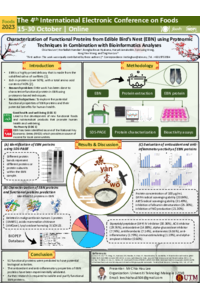
Edible Bird’s Nest (EBN) is a valuable and nutritious food tonic made from the saliva of Swiftlet birds. EBN has been consumed for centuries due to its high nutritional value. Proteins are the main nutrient in EBN. However, studies investigating the functional proteins in EBN are still limited. Therefore, the present study aims to characterize the functional proteins from EBN using proteomic-based techniques. In addition, the molecular characteristics of the functional proteins were analyzed using sodium dodecyl sulfate-polyacrylamide gel electrophoresis (SDS-PAGE). The results showed that 0.951 ± 0.03 mg/mL of functional proteins were successfully extracted from the EBN. Several distinct protein bands in the range of 35–135 kDa were profiled from the EBN. Using ultrahigh performance liquid chromatography coupled with quadrupole time-of-flight tandem mass spectrometry (UHPLC-Q-TOF-MS-MS), a total of 51 proteins were identified from the EBN. The protein sequences were processed in the BIOPEP database to predict the potential biological activity of EBN proteins. The prediction results suggest that the EBN proteins potentially possess antioxidant, anti-inflammatory, immunostimulatory, antitamnestic, antihypertensive (angiotensin converting enzyme (ACE) inhibitors), antidiabetic (alpha-glucosidase inhibitors, alpha-amylase inhibitors, dipeptidyl peptidase IV inhibitors) and antithrombotic properties. The antioxidant properties [DPPH scavenging activity (20.84% ± 3.43) and ABTS scavenging activity (31.49% ± 1.66)] and anti-inflammatory properties [inhibition of nitric oxide (NO) production (21.30% ± 4.41) and inhibition of albumin denaturation (25.30% ± 0.32)] were experimentally validated. In conclusion, the results suggest that functional proteins from EBN are potentially functional ingredients in the nutraceutical and food industries.
Keywords
Edible Bird’s Nest (EBN)
Functional Proteins
Proteomic
Bioinformatics.
Manuscript
sciforum_076444-done.pdf
Poster
sciforum-076444_Poster.pdf
Impact of COVID-19 Lockdowns on Food Security, Sustainable Food Supply, and Health in Italy: Insights from a Study on Eating Habits and Physical Activity
Comparison of Health Benefiting Phytoconstituents of Australian Grown Nigella sativa Genotypes