Event submissions
Published
This submission belongs to the session S9. Functional Foods, Nutrition and Health of the event The 4th International Electronic Conference on Foods
Published date
13 Oct, 2023
Academic Editor
'%3e%3cpath%20d='M12.6657%2010.9104C12.4185%2010.325%2012.0599%209.79327%2011.6097%209.34482C11.1609%208.89508%2010.6293%208.5365%2010.0442%208.28888C10.0389%208.28626%2010.0337%208.28495%2010.0285%208.28233C10.8446%207.69279%2011.3752%206.73249%2011.3752%205.64904C11.3752%203.8542%209.92103%202.39999%208.1262%202.39999C6.33136%202.39999%204.87715%203.8542%204.87715%205.64904C4.87715%206.73249%205.40774%207.69279%206.22393%208.28364C6.21869%208.28626%206.21345%208.28757%206.20821%208.29019C5.62129%208.5378%205.09463%208.89284%204.64265%209.34613C4.1929%209.79493%203.83432%2010.3266%203.58671%2010.9117C3.34345%2011.4845%203.21226%2012.0987%203.20023%2012.7209C3.19988%2012.7349%203.20233%2012.7488%203.20744%2012.7619C3.21255%2012.7749%203.22022%2012.7867%203.22998%2012.7968C3.23975%2012.8068%203.25142%2012.8147%203.26431%2012.8202C3.2772%2012.8256%203.29105%2012.8284%203.30504%2012.8284H4.09109C4.14874%2012.8284%204.19459%2012.7825%204.1959%2012.7262C4.2221%2011.7148%204.62823%2010.7676%205.34617%2010.0497C6.08899%209.30683%207.0755%208.89808%208.1262%208.89808C9.17689%208.89808%2010.1634%209.30683%2010.9062%2010.0497C11.6242%2010.7676%2012.0303%2011.7148%2012.0565%2012.7262C12.0578%2012.7838%2012.1037%2012.8284%2012.1613%2012.8284H12.9474C12.9613%2012.8284%2012.9752%2012.8256%2012.9881%2012.8202C13.001%2012.8147%2013.0126%2012.8068%2013.0224%2012.7968C13.0322%2012.7867%2013.0398%2012.7749%2013.0449%2012.7619C13.0501%2012.7488%2013.0525%2012.7349%2013.0522%2012.7209C13.0391%2012.0947%2012.9094%2011.4855%2012.6657%2010.9104ZM8.1262%207.9024C7.52486%207.9024%206.9589%207.6679%206.53312%207.24211C6.10733%206.81633%205.87283%206.25037%205.87283%205.64904C5.87283%205.0477%206.10733%204.48174%206.53312%204.05596C6.9589%203.63018%207.52486%203.39567%208.1262%203.39567C8.72753%203.39567%209.29349%203.63018%209.71927%204.05596C10.1451%204.48174%2010.3796%205.0477%2010.3796%205.64904C10.3796%206.25037%2010.1451%206.81633%209.71927%207.24211C9.29349%207.6679%208.72753%207.9024%208.1262%207.9024Z'%20fill='%235D1EE1'/%3e%3c/g%3e%3c/svg%3e) Antonello Santini
Antonello SantiniCitation
Houari Benamar, Malika Bennaceur, Phenolic Compounds and Bioactive Properties of Clematis cirrhosa L. (Ranunculaceae): The Pharmacological Potential of an Underexploited Herb, in Proceedings of The 4th International Electronic Conference on Foods, 15 October–30 October 2023, MDPI: Basel, Switzerland
Share
Email
Facebook
Twitter
LinkedIn
Phenolic Compounds and Bioactive Properties of Clematis cirrhosa L. (Ranunculaceae): The Pharmacological Potential of an Underexploited Herb
'%3e%3cpath%20d='M12.6647%2010.9104C12.4176%2010.325%2012.0589%209.7933%2011.6088%209.34485C11.16%208.89511%2010.6283%208.53653%2010.0432%208.28891C10.038%208.28629%2010.0327%208.28498%2010.0275%208.28236C10.8437%207.69282%2011.3743%206.73252%2011.3743%205.64907C11.3743%203.85423%209.92005%202.40002%208.12522%202.40002C6.33038%202.40002%204.87618%203.85423%204.87618%205.64907C4.87618%206.73252%205.40677%207.69282%206.22296%208.28367C6.21772%208.28629%206.21248%208.2876%206.20724%208.29022C5.62031%208.53783%205.09365%208.89287%204.64167%209.34616C4.19192%209.79496%203.83334%2010.3266%203.58573%2010.9117C3.34247%2011.4846%203.21128%2012.0987%203.19925%2012.721C3.1989%2012.735%203.20135%2012.7489%203.20646%2012.7619C3.21157%2012.7749%203.21924%2012.7868%203.22901%2012.7968C3.23877%2012.8068%203.25045%2012.8148%203.26334%2012.8202C3.27623%2012.8256%203.29007%2012.8284%203.30406%2012.8284H4.09012C4.14776%2012.8284%204.19362%2012.7825%204.19493%2012.7262C4.22113%2011.7148%204.62726%2010.7676%205.34519%2010.0497C6.08802%209.30686%207.07452%208.89811%208.12522%208.89811C9.17592%208.89811%2010.1624%209.30686%2010.9052%2010.0497C11.6232%2010.7676%2012.0293%2011.7148%2012.0555%2012.7262C12.0568%2012.7839%2012.1027%2012.8284%2012.1603%2012.8284H12.9464C12.9604%2012.8284%2012.9742%2012.8256%2012.9871%2012.8202C13%2012.8148%2013.0117%2012.8068%2013.0214%2012.7968C13.0312%2012.7868%2013.0389%2012.7749%2013.044%2012.7619C13.0491%2012.7489%2013.0515%2012.735%2013.0512%2012.721C13.0381%2012.0947%2012.9084%2011.4856%2012.6647%2010.9104ZM8.12522%207.90243C7.52388%207.90243%206.95792%207.66793%206.53214%207.24215C6.10636%206.81636%205.87185%206.2504%205.87185%205.64907C5.87185%205.04773%206.10636%204.48177%206.53214%204.05599C6.95792%203.63021%207.52388%203.3957%208.12522%203.3957C8.72655%203.3957%209.29252%203.63021%209.7183%204.05599C10.1441%204.48177%2010.3786%205.04773%2010.3786%205.64907C10.3786%206.2504%2010.1441%206.81636%209.7183%207.24215C9.29252%207.66793%208.72655%207.90243%208.12522%207.90243Z'%20fill='%235D1EE1'/%3e%3c/g%3e%3c/svg%3e)
Houari Benamar 1,2
Malika Bennaceur 1,2
1. Department of Biology, Faculty of Natural Sciences and Life, University of Oran1, PO Box 1524, El M'Naouer, 31000 Oran, Algeria
2. Laboratory of Research in Arid Areas, Faculty of Biological Sciences, University of Science and Technology Houari Boumediene, PO Box 32, El Alia, Bab Ezzouar, 16111 Algiers, Algeria
Abstract
Clematis cirrhosa L. is an Algerian medicinal specie used to treat burns, joint aches, rheumatism pain and sexual dysfunction and as a diuretic agent [1,2,3,4], yet there is little information available concerning its bioactive composition and its potential economic value has not been explored. The aim of this study was to quantify bioactive compounds and to investigate antioxidant and acetylcholinesterase inhibitory activities of extracts obtained from the whole plant of C. cirrhosa in order to prove its possible use as potential natural source for human health. Phenolic compounds were distinctively profiled in the different extracts using TLC and standard phenolics. The antioxidant activity was evaluated by the 1,1-diphenyl-2-picrylhydrazyl (DPPH), 2,2’-azino-bis-3-ethylbenzthiazoline-6-sulphonic acid (ABTS), N,N-dimethyl-p-phenylenediamine (DMPD), nitric, hydroxyl and superoxide radicals, β-carotene bleaching, cupric reducing, ferric reducing, and metal chelating activity methods. Maceration in ethyl acetate and methanol allowed recovering the highest cumulative phenolic (96.13 and 99.98 mg GAE/g DE, respectively), flavonoid (44.90 and 24.62 mg CE/g DE, respectively), flavonol (16.05 and 22.13 mg QE/g DE, respectively), and hydrolyzable (585.21 and 85.54 mg TAE/g DE, respectively) and condensed tannin (3.15 and 6.23 mg CE/g DE, respectively) contents. The phytochemical analysis led to the identification of several phenolic compounds that were dominated by chrysophanol, emodin, caffeic acid, chlorogenic acid and kaempferol-3,7-O-dirhamnoside. The ethyl acetate and methanol extracts showed potential antioxidant activity in the different assays and this could be attributed to their polyphenol, tannin, and flavonoid contents. The ethyl acetate and methanol extracts exhibited also anti-acetylcholinesterase activity (IC50 values of 1.12 and 0.71 mg/mL, respectively). This study provided a fundamental reference for the research of polyphenols in C. cirrhosa and found that this plant has the promising prospects of additives used in food.
Keywords
medicinal plants
phenolic compounds
flavonoids
oxidative stress
neuroprotection
food applications
Manuscript
proceedings-sciforum_076395-done.pdf
Poster
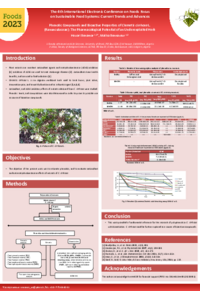
Poster_Houari Benamar_Foods2023.pdf
Evaluation of the anti-cancer activity of goji leaves extracts against HT-29-MTX colon cancer cell line
Effects of a Functional Product derived from Beet Molasses Vinasse on Blood Pressure and Endothelial Function in Hypertensive Rats