Event submissions
Published
This submission belongs to the session S1. Food Security and Sustainable Food Supply of the event The 4th International Electronic Conference on Foods
Published date
13 Oct, 2023
Academic Editor
'%3e%3cpath%20d='M12.6657%2010.9104C12.4185%2010.325%2012.0599%209.79327%2011.6097%209.34482C11.1609%208.89508%2010.6293%208.5365%2010.0442%208.28888C10.0389%208.28626%2010.0337%208.28495%2010.0285%208.28233C10.8446%207.69279%2011.3752%206.73249%2011.3752%205.64904C11.3752%203.8542%209.92103%202.39999%208.1262%202.39999C6.33136%202.39999%204.87715%203.8542%204.87715%205.64904C4.87715%206.73249%205.40774%207.69279%206.22393%208.28364C6.21869%208.28626%206.21345%208.28757%206.20821%208.29019C5.62129%208.5378%205.09463%208.89284%204.64265%209.34613C4.1929%209.79493%203.83432%2010.3266%203.58671%2010.9117C3.34345%2011.4845%203.21226%2012.0987%203.20023%2012.7209C3.19988%2012.7349%203.20233%2012.7488%203.20744%2012.7619C3.21255%2012.7749%203.22022%2012.7867%203.22998%2012.7968C3.23975%2012.8068%203.25142%2012.8147%203.26431%2012.8202C3.2772%2012.8256%203.29105%2012.8284%203.30504%2012.8284H4.09109C4.14874%2012.8284%204.19459%2012.7825%204.1959%2012.7262C4.2221%2011.7148%204.62823%2010.7676%205.34617%2010.0497C6.08899%209.30683%207.0755%208.89808%208.1262%208.89808C9.17689%208.89808%2010.1634%209.30683%2010.9062%2010.0497C11.6242%2010.7676%2012.0303%2011.7148%2012.0565%2012.7262C12.0578%2012.7838%2012.1037%2012.8284%2012.1613%2012.8284H12.9474C12.9613%2012.8284%2012.9752%2012.8256%2012.9881%2012.8202C13.001%2012.8147%2013.0126%2012.8068%2013.0224%2012.7968C13.0322%2012.7867%2013.0398%2012.7749%2013.0449%2012.7619C13.0501%2012.7488%2013.0525%2012.7349%2013.0522%2012.7209C13.0391%2012.0947%2012.9094%2011.4855%2012.6657%2010.9104ZM8.1262%207.9024C7.52486%207.9024%206.9589%207.6679%206.53312%207.24211C6.10733%206.81633%205.87283%206.25037%205.87283%205.64904C5.87283%205.0477%206.10733%204.48174%206.53312%204.05596C6.9589%203.63018%207.52486%203.39567%208.1262%203.39567C8.72753%203.39567%209.29349%203.63018%209.71927%204.05596C10.1451%204.48174%2010.3796%205.0477%2010.3796%205.64904C10.3796%206.25037%2010.1451%206.81633%209.71927%207.24211C9.29349%207.6679%208.72753%207.9024%208.1262%207.9024Z'%20fill='%235D1EE1'/%3e%3c/g%3e%3c/svg%3e) Anet Režek Jambrak
Anet Režek JambrakCitation
Luis Carlos Moran Alarcon, María del Mar Contreras, Ángel Galán-Martín, Eulogio Castro, Avocado peel: potential applications to promote circularity based on its characterization, in Proceedings of The 4th International Electronic Conference on Foods, 15 October–30 October 2023, MDPI: Basel, Switzerland
Share
Email
Facebook
Twitter
LinkedIn
Avocado peel: potential applications to promote circularity based on its characterization
'%3e%3cpath%20d='M12.6647%2010.9104C12.4176%2010.325%2012.0589%209.7933%2011.6088%209.34485C11.16%208.89511%2010.6283%208.53653%2010.0432%208.28891C10.038%208.28629%2010.0327%208.28498%2010.0275%208.28236C10.8437%207.69282%2011.3743%206.73252%2011.3743%205.64907C11.3743%203.85423%209.92005%202.40002%208.12522%202.40002C6.33038%202.40002%204.87618%203.85423%204.87618%205.64907C4.87618%206.73252%205.40677%207.69282%206.22296%208.28367C6.21772%208.28629%206.21248%208.2876%206.20724%208.29022C5.62031%208.53783%205.09365%208.89287%204.64167%209.34616C4.19192%209.79496%203.83334%2010.3266%203.58573%2010.9117C3.34247%2011.4846%203.21128%2012.0987%203.19925%2012.721C3.1989%2012.735%203.20135%2012.7489%203.20646%2012.7619C3.21157%2012.7749%203.21924%2012.7868%203.22901%2012.7968C3.23877%2012.8068%203.25045%2012.8148%203.26334%2012.8202C3.27623%2012.8256%203.29007%2012.8284%203.30406%2012.8284H4.09012C4.14776%2012.8284%204.19362%2012.7825%204.19493%2012.7262C4.22113%2011.7148%204.62726%2010.7676%205.34519%2010.0497C6.08802%209.30686%207.07452%208.89811%208.12522%208.89811C9.17592%208.89811%2010.1624%209.30686%2010.9052%2010.0497C11.6232%2010.7676%2012.0293%2011.7148%2012.0555%2012.7262C12.0568%2012.7839%2012.1027%2012.8284%2012.1603%2012.8284H12.9464C12.9604%2012.8284%2012.9742%2012.8256%2012.9871%2012.8202C13%2012.8148%2013.0117%2012.8068%2013.0214%2012.7968C13.0312%2012.7868%2013.0389%2012.7749%2013.044%2012.7619C13.0491%2012.7489%2013.0515%2012.735%2013.0512%2012.721C13.0381%2012.0947%2012.9084%2011.4856%2012.6647%2010.9104ZM8.12522%207.90243C7.52388%207.90243%206.95792%207.66793%206.53214%207.24215C6.10636%206.81636%205.87185%206.2504%205.87185%205.64907C5.87185%205.04773%206.10636%204.48177%206.53214%204.05599C6.95792%203.63021%207.52388%203.3957%208.12522%203.3957C8.72655%203.3957%209.29252%203.63021%209.7183%204.05599C10.1441%204.48177%2010.3786%205.04773%2010.3786%205.64907C10.3786%206.2504%2010.1441%206.81636%209.7183%207.24215C9.29252%207.66793%208.72655%207.90243%208.12522%207.90243Z'%20fill='%235D1EE1'/%3e%3c/g%3e%3c/svg%3e)
Luis Carlos Moran Alarcon 1

María del Mar Contreras 1,2
Ángel Galán-Martín 1,2
Eulogio Castro 1,2
1. Dept. Chemical, Environmental and Materials Engineering. Universidad de Jaén
2. Centre for Advanced Studies in Earth Sciences, Energy and Environment (CEACTEMA), Universidad de Jaén
Abstract
Avocado peel is usually discarded; however, there is a growing interest in promoting circularity within the value chain, thus contributing to its overall sustainability. To explore potential valorization pathways, gaining a comprehensive understanding of the chemical composition of the peel is essential. In this work, the peel was first subjected to Soxhlet extraction using various solvents, the resulting extracts were evaluated gravimetrically, and the phenolic content was determined by the Folin-Ciocalteu method. The solid fraction was analyzed for glucans, hemicellulose, and lignin content by combining acid-hydrolysis, gravimetric analysis, and liquid chromatography. Moreover, infrared spectroscopy was applied to provide information about chemical features. The results showed that the peel contained mainly extractives (47%) and lignin (30%). The content of fat and polymeric sugars was about 10% of each other. Based on their characterization, a cascading valorization biorefinery scheme can be proposed. First step, phenolic compounds like flavanols can be recovered by water with applications in food, feed, and cosmetics products for antioxidant properties. In the second step, lipids obtained by hexane could be converted via transesterification into biodiesel. Finally, the extracted solid can be pretreated and the sugars solubilized by enzymatic hydrolysis and converted into bioethanol by fermentation. Both, biodiesel and bioethanol, are renewable and cleaner-burning alternatives to fossil fuels in transportation. The solid non-hydrolyzed fraction rich in lignin, can be utilized to generate heating and/or electricity powering the biorefinery processes.
In summary, avocado peel biorefinery offers great opportunities for extracting high-value-added compounds and promoting a more circular and resource-efficient economy.
Keywords
avocado
biorefinery
circular economy
peel
valorization
Manuscript
proceedings-sciforum_078522_clean.pdf
Poster
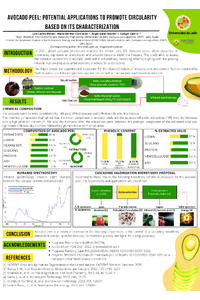
Póster científico The 4rd International Electronic Conference on Foods Focus on Sustainable Food Systems Current Trends and Advances.pdf
Effects of a Functional Product derived from Beet Molasses Vinasse on Blood Pressure and Endothelial Function in Hypertensive Rats
Bovine whey hydrolysis with pancreatin produces a functional ingredient for developing antihypertensive beverages.