Event submissions
Published
 10.3390/Foods2023-15027 (registering DOI)
 This submission belongs to the session S9. Functional Foods, Nutrition and Health of the event The 4th International Electronic Conference on Foods
Published date
14 Oct, 2023
Academic Editor
'%3e%3cpath%20d='M12.6657%2010.9104C12.4185%2010.325%2012.0599%209.79327%2011.6097%209.34482C11.1609%208.89508%2010.6293%208.5365%2010.0442%208.28888C10.0389%208.28626%2010.0337%208.28495%2010.0285%208.28233C10.8446%207.69279%2011.3752%206.73249%2011.3752%205.64904C11.3752%203.8542%209.92103%202.39999%208.1262%202.39999C6.33136%202.39999%204.87715%203.8542%204.87715%205.64904C4.87715%206.73249%205.40774%207.69279%206.22393%208.28364C6.21869%208.28626%206.21345%208.28757%206.20821%208.29019C5.62129%208.5378%205.09463%208.89284%204.64265%209.34613C4.1929%209.79493%203.83432%2010.3266%203.58671%2010.9117C3.34345%2011.4845%203.21226%2012.0987%203.20023%2012.7209C3.19988%2012.7349%203.20233%2012.7488%203.20744%2012.7619C3.21255%2012.7749%203.22022%2012.7867%203.22998%2012.7968C3.23975%2012.8068%203.25142%2012.8147%203.26431%2012.8202C3.2772%2012.8256%203.29105%2012.8284%203.30504%2012.8284H4.09109C4.14874%2012.8284%204.19459%2012.7825%204.1959%2012.7262C4.2221%2011.7148%204.62823%2010.7676%205.34617%2010.0497C6.08899%209.30683%207.0755%208.89808%208.1262%208.89808C9.17689%208.89808%2010.1634%209.30683%2010.9062%2010.0497C11.6242%2010.7676%2012.0303%2011.7148%2012.0565%2012.7262C12.0578%2012.7838%2012.1037%2012.8284%2012.1613%2012.8284H12.9474C12.9613%2012.8284%2012.9752%2012.8256%2012.9881%2012.8202C13.001%2012.8147%2013.0126%2012.8068%2013.0224%2012.7968C13.0322%2012.7867%2013.0398%2012.7749%2013.0449%2012.7619C13.0501%2012.7488%2013.0525%2012.7349%2013.0522%2012.7209C13.0391%2012.0947%2012.9094%2011.4855%2012.6657%2010.9104ZM8.1262%207.9024C7.52486%207.9024%206.9589%207.6679%206.53312%207.24211C6.10733%206.81633%205.87283%206.25037%205.87283%205.64904C5.87283%205.0477%206.10733%204.48174%206.53312%204.05596C6.9589%203.63018%207.52486%203.39567%208.1262%203.39567C8.72753%203.39567%209.29349%203.63018%209.71927%204.05596C10.1451%204.48174%2010.3796%205.0477%2010.3796%205.64904C10.3796%206.25037%2010.1451%206.81633%209.71927%207.24211C9.29349%207.6679%208.72753%207.9024%208.1262%207.9024Z'%20fill='%235D1EE1'/%3e%3c/g%3e%3c/svg%3e) Antonello Santini
Antonello SantiniCitation
Inés Alejandra Cea Pavez, Rosa Quirantes Piné, Alejandro Morillo Gomar, David Manteca Bautista, José Luis Quiles Morales, Design of a microencapsulated propolis extract with controlled release by spray drying, in Proceedings of The 4th International Electronic Conference on Foods, 15 October–30 October 2023, MDPI: Basel, Switzerland, doi: 10.3390/Foods2023-15027
Share
Email
Facebook
Twitter
LinkedIn
Design of a microencapsulated propolis extract with controlled release by spray drying
'%3e%3cpath%20d='M12.6647%2010.9104C12.4176%2010.325%2012.0589%209.7933%2011.6088%209.34485C11.16%208.89511%2010.6283%208.53653%2010.0432%208.28891C10.038%208.28629%2010.0327%208.28498%2010.0275%208.28236C10.8437%207.69282%2011.3743%206.73252%2011.3743%205.64907C11.3743%203.85423%209.92005%202.40002%208.12522%202.40002C6.33038%202.40002%204.87618%203.85423%204.87618%205.64907C4.87618%206.73252%205.40677%207.69282%206.22296%208.28367C6.21772%208.28629%206.21248%208.2876%206.20724%208.29022C5.62031%208.53783%205.09365%208.89287%204.64167%209.34616C4.19192%209.79496%203.83334%2010.3266%203.58573%2010.9117C3.34247%2011.4846%203.21128%2012.0987%203.19925%2012.721C3.1989%2012.735%203.20135%2012.7489%203.20646%2012.7619C3.21157%2012.7749%203.21924%2012.7868%203.22901%2012.7968C3.23877%2012.8068%203.25045%2012.8148%203.26334%2012.8202C3.27623%2012.8256%203.29007%2012.8284%203.30406%2012.8284H4.09012C4.14776%2012.8284%204.19362%2012.7825%204.19493%2012.7262C4.22113%2011.7148%204.62726%2010.7676%205.34519%2010.0497C6.08802%209.30686%207.07452%208.89811%208.12522%208.89811C9.17592%208.89811%2010.1624%209.30686%2010.9052%2010.0497C11.6232%2010.7676%2012.0293%2011.7148%2012.0555%2012.7262C12.0568%2012.7839%2012.1027%2012.8284%2012.1603%2012.8284H12.9464C12.9604%2012.8284%2012.9742%2012.8256%2012.9871%2012.8202C13%2012.8148%2013.0117%2012.8068%2013.0214%2012.7968C13.0312%2012.7868%2013.0389%2012.7749%2013.044%2012.7619C13.0491%2012.7489%2013.0515%2012.735%2013.0512%2012.721C13.0381%2012.0947%2012.9084%2011.4856%2012.6647%2010.9104ZM8.12522%207.90243C7.52388%207.90243%206.95792%207.66793%206.53214%207.24215C6.10636%206.81636%205.87185%206.2504%205.87185%205.64907C5.87185%205.04773%206.10636%204.48177%206.53214%204.05599C6.95792%203.63021%207.52388%203.3957%208.12522%203.3957C8.72655%203.3957%209.29252%203.63021%209.7183%204.05599C10.1441%204.48177%2010.3786%205.04773%2010.3786%205.64907C10.3786%206.2504%2010.1441%206.81636%209.7183%207.24215C9.29252%207.66793%208.72655%207.90243%208.12522%207.90243Z'%20fill='%235D1EE1'/%3e%3c/g%3e%3c/svg%3e)
Inés Alejandra Cea Pavez 1
Rosa Quirantes Piné 2
Alejandro Morillo Gomar 2,3
David Manteca Bautista 2

José Luis Quiles Morales 2,4,5
1. Research and Development Functional Food Centre (CIDAF), Health Science Technological Park, Avenida del Conocimiento 37, 18016 Granada, Spain
2. Research and Development Functional Food Centre (CIDAF), Health Science Technological Park, Avenida del Conocimiento 37, 18016 Granada, Spain.
3. Faculty of Pharmacy, University of Granada, Cartuja Campus, 18071 Granada, Spain.
4. Department of Physiology, Institute of Nutrition and Food Technology “José Mataix Verdú”, Biomedical Research Centre, University of Granada, 18016 Armilla, Spain
5. Research Group on Foods, Nutritional Biochemistry and Health, Universidad Europea del Atlántico, Isabel Torres 21, 39011 Santander, Spain.
Abstract
Aim:
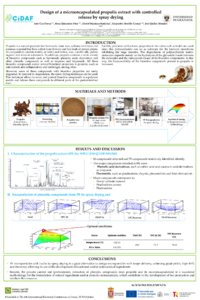
The aim of this work was to optimize the microencapsulation of a propolis extract (PE) with inulin by spray drying to obtain an ingredient (PE-IN) with properties of control release in gastrointestinal tract under in vitro simulated digestion conditions.
Materials and Methods:
A propolis sample was pretreated with hexane for dewaxing and then, the phenolic compounds were extracted by maceration with ethanol:water (70:30, v/v) in agitation during 24 hours at room temperature. The obtained propolis extract (PE) was comprehensively characterize by HPLC-ESI-QTOF-MS/MS. The encapsulation of PE/IN by spray drying was optimized by response surface using a central composite with star points experimental design where the independent variables were inlet air temperature (112.65 to 197.35°C) and PE/IN ratio (1:0.685 to 1: 4.315), while the response variables were yield (Y), Encapsulation Efficiency (EE%) and Recuperation (R%) of total phenolic compounds.
Results:
The profile of the phenolic compounds in PE had a total of 66 detected compounds, 58 of which were tentatively identified, belonging mainly to phenolic acid derivatives and flavonoids. The optimal conditions for PE/IN microencapsulation were an inlet air temperature of 112.65 °C and a PE/IN ratio of 1:4.315, showing a yield of 78.4%, in addition to 71.7% and 95.0% of EE% and R% of total phenolic compounds, respectively.
Conclusions:
PE microparticles with inulin by spray drying is a good alternative to design microparticles with target delivery, achieving good yields, high EE% and R%, allowing its use in the development of functional and/or nutraceutical ingredients.
Keywords
Propolis
bioactive compounds
microencapsulation
spray drying
bioaccessibility
Manuscript
sciforum-076801.pdf
Poster
Poster_Design of a microencapsulated propolis extract with controlled release by spray drying.pdf
Exploring the Bioactive Potential of Gracilaria gracilis: An Extraction Optimization Study Using Response Surface Methodology
Assessment of Nutritional Profile of Sargassum muticum alga from the Spanish Coastline