Event submissions
Published
 10.3390/Foods2023-15051 (registering DOI)
 This submission belongs to the session S6. Food Analysis, Biotechnology, and Engineering of the event The 4th International Electronic Conference on Foods
Published date
14 Oct, 2023
Academic Editor
'%3e%3cpath%20d='M12.6657%2010.9104C12.4185%2010.325%2012.0599%209.79327%2011.6097%209.34482C11.1609%208.89508%2010.6293%208.5365%2010.0442%208.28888C10.0389%208.28626%2010.0337%208.28495%2010.0285%208.28233C10.8446%207.69279%2011.3752%206.73249%2011.3752%205.64904C11.3752%203.8542%209.92103%202.39999%208.1262%202.39999C6.33136%202.39999%204.87715%203.8542%204.87715%205.64904C4.87715%206.73249%205.40774%207.69279%206.22393%208.28364C6.21869%208.28626%206.21345%208.28757%206.20821%208.29019C5.62129%208.5378%205.09463%208.89284%204.64265%209.34613C4.1929%209.79493%203.83432%2010.3266%203.58671%2010.9117C3.34345%2011.4845%203.21226%2012.0987%203.20023%2012.7209C3.19988%2012.7349%203.20233%2012.7488%203.20744%2012.7619C3.21255%2012.7749%203.22022%2012.7867%203.22998%2012.7968C3.23975%2012.8068%203.25142%2012.8147%203.26431%2012.8202C3.2772%2012.8256%203.29105%2012.8284%203.30504%2012.8284H4.09109C4.14874%2012.8284%204.19459%2012.7825%204.1959%2012.7262C4.2221%2011.7148%204.62823%2010.7676%205.34617%2010.0497C6.08899%209.30683%207.0755%208.89808%208.1262%208.89808C9.17689%208.89808%2010.1634%209.30683%2010.9062%2010.0497C11.6242%2010.7676%2012.0303%2011.7148%2012.0565%2012.7262C12.0578%2012.7838%2012.1037%2012.8284%2012.1613%2012.8284H12.9474C12.9613%2012.8284%2012.9752%2012.8256%2012.9881%2012.8202C13.001%2012.8147%2013.0126%2012.8068%2013.0224%2012.7968C13.0322%2012.7867%2013.0398%2012.7749%2013.0449%2012.7619C13.0501%2012.7488%2013.0525%2012.7349%2013.0522%2012.7209C13.0391%2012.0947%2012.9094%2011.4855%2012.6657%2010.9104ZM8.1262%207.9024C7.52486%207.9024%206.9589%207.6679%206.53312%207.24211C6.10733%206.81633%205.87283%206.25037%205.87283%205.64904C5.87283%205.0477%206.10733%204.48174%206.53312%204.05596C6.9589%203.63018%207.52486%203.39567%208.1262%203.39567C8.72753%203.39567%209.29349%203.63018%209.71927%204.05596C10.1451%204.48174%2010.3796%205.0477%2010.3796%205.64904C10.3796%206.25037%2010.1451%206.81633%209.71927%207.24211C9.29349%207.6679%208.72753%207.9024%208.1262%207.9024Z'%20fill='%235D1EE1'/%3e%3c/g%3e%3c/svg%3e) Antonio Bevilacqua
Antonio BevilacquaCitation
Ante Lončarić, Ana-Marija Gotal Skoko, Goran Fruk, Antun Jozinović, Ivana Tomac, Tihomir Kovač, Assessing the quality and patulin contamination in infected traditional and commercial apple fruits, in Proceedings of The 4th International Electronic Conference on Foods, 15 October–30 October 2023, MDPI: Basel, Switzerland, doi: 10.3390/Foods2023-15051
Share
Email
Facebook
Twitter
LinkedIn
Assessing the quality and patulin contamination in infected traditional and commercial apple fruits
'%3e%3cpath%20d='M12.6647%2010.9104C12.4176%2010.325%2012.0589%209.7933%2011.6088%209.34485C11.16%208.89511%2010.6283%208.53653%2010.0432%208.28891C10.038%208.28629%2010.0327%208.28498%2010.0275%208.28236C10.8437%207.69282%2011.3743%206.73252%2011.3743%205.64907C11.3743%203.85423%209.92005%202.40002%208.12522%202.40002C6.33038%202.40002%204.87618%203.85423%204.87618%205.64907C4.87618%206.73252%205.40677%207.69282%206.22296%208.28367C6.21772%208.28629%206.21248%208.2876%206.20724%208.29022C5.62031%208.53783%205.09365%208.89287%204.64167%209.34616C4.19192%209.79496%203.83334%2010.3266%203.58573%2010.9117C3.34247%2011.4846%203.21128%2012.0987%203.19925%2012.721C3.1989%2012.735%203.20135%2012.7489%203.20646%2012.7619C3.21157%2012.7749%203.21924%2012.7868%203.22901%2012.7968C3.23877%2012.8068%203.25045%2012.8148%203.26334%2012.8202C3.27623%2012.8256%203.29007%2012.8284%203.30406%2012.8284H4.09012C4.14776%2012.8284%204.19362%2012.7825%204.19493%2012.7262C4.22113%2011.7148%204.62726%2010.7676%205.34519%2010.0497C6.08802%209.30686%207.07452%208.89811%208.12522%208.89811C9.17592%208.89811%2010.1624%209.30686%2010.9052%2010.0497C11.6232%2010.7676%2012.0293%2011.7148%2012.0555%2012.7262C12.0568%2012.7839%2012.1027%2012.8284%2012.1603%2012.8284H12.9464C12.9604%2012.8284%2012.9742%2012.8256%2012.9871%2012.8202C13%2012.8148%2013.0117%2012.8068%2013.0214%2012.7968C13.0312%2012.7868%2013.0389%2012.7749%2013.044%2012.7619C13.0491%2012.7489%2013.0515%2012.735%2013.0512%2012.721C13.0381%2012.0947%2012.9084%2011.4856%2012.6647%2010.9104ZM8.12522%207.90243C7.52388%207.90243%206.95792%207.66793%206.53214%207.24215C6.10636%206.81636%205.87185%206.2504%205.87185%205.64907C5.87185%205.04773%206.10636%204.48177%206.53214%204.05599C6.95792%203.63021%207.52388%203.3957%208.12522%203.3957C8.72655%203.3957%209.29252%203.63021%209.7183%204.05599C10.1441%204.48177%2010.3786%205.04773%2010.3786%205.64907C10.3786%206.2504%2010.1441%206.81636%209.7183%207.24215C9.29252%207.66793%208.72655%207.90243%208.12522%207.90243Z'%20fill='%235D1EE1'/%3e%3c/g%3e%3c/svg%3e)
Ante Lončarić 1
Ana-Marija Gotal Skoko 2

Goran Fruk 3

Antun Jozinović 4
Ivana Tomac 4

Tihomir Kovač 4
1. Faculty of Food Technology Osijek
2. Josip Juraj Strossmayer University of Osijek, Faculty of Food Technology Osijek, Franje Kuhača 18, 31000 Osijek, Croatia
3. University of Zagreb, Faculty of Agriculture, Svetošimunska cesta 25, 10000 Zagreb, Croatia
4. Faculty of Food Technology Osijek, Josip Juraj Strossmayer University of Osijek, Franje Kuhača 18, HR 31000 Osijek, Croatia
Abstract
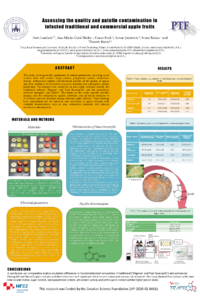
This study investigates the significance of various parameters, including water content, total acid content, sugar content, polyphenol content, antioxidant activity, anthocyanin content, and flavonoid content, on the quality of apples and their resistance to Penicillium expansum infection and subsequent patulin production. The research was conducted on four apple cultivars, namely, the traditional cultivars 'Wagener' and 'Ilzer Rosenapfel', and the commercial cultivars 'Jonagold' and 'Idared'. Among the cultivars, 'Wagener' demonstrated the highest values for total soluble matter (15.9%), sugar content (15.22 ± 0.03%), total polyphenol content (707.63 ± 22.81 mg/kg), and antioxidant activity (0.29 ± 0.00 mmol TE/kg dw). 'Jonagold' exhibited the highest anthocyanin content (5.76 mg/kg) and total flavonoid content (104.74 ± 3.11 g CE/kg), while 'Idared' displayed the highest acid content (0.13 g/100 g). Furthermore, the presence of patulin, a mycotoxin produced by Penicillium expansum in infected apple fruits, was analyzed using liquid chromatography coupled to tandem mass spectrometry. The levels of patulin varied among the cultivars, with 'Wagener' exhibiting the highest concentration (18592 ± 101.82 µg/kg), followed by 'Idared' (4732.4 ± 57.10 µg/kg), 'Jonagold' (292.56 ± 20.93 µg/kg), and 'Ilzer Rosenapfel' (130.92 ± 0.06 µg/kg). In conclusion, the comparative analysis of the data provides valuable insights into the composition, quality attributes, and potential resistance to Penicillium expansum infection among different apple cultivars. These findings have implications for the selection and cultivation of apple varieties with desirable characteristics, such as taste, antioxidant potential, and reduced mycotoxin contamination. This research was funded by the Croatian Science Foundation (UIP-2020-02-8461).
Keywords
apple quality
patulin
Penicillium expansum
food safety
Manuscript
6408.pdf
Poster
Loncaric et al. poster.pdf
Comparison of Green Extraction Techniques for Bioactive Compounds Recover from Grapevine by-Products
Evaluating Contaminants in Fish: Plastic Additives and Pesticides in the Context of Food Safety