Event submissions
Published

This submission belongs to the session S4. Food Physical and Structural Property of the event The 4th International Electronic Conference on Foods
Published date
14 Oct, 2023
Academic Editor
'%3e%3cpath%20d='M12.6657%2010.9104C12.4185%2010.325%2012.0599%209.79327%2011.6097%209.34482C11.1609%208.89508%2010.6293%208.5365%2010.0442%208.28888C10.0389%208.28626%2010.0337%208.28495%2010.0285%208.28233C10.8446%207.69279%2011.3752%206.73249%2011.3752%205.64904C11.3752%203.8542%209.92103%202.39999%208.1262%202.39999C6.33136%202.39999%204.87715%203.8542%204.87715%205.64904C4.87715%206.73249%205.40774%207.69279%206.22393%208.28364C6.21869%208.28626%206.21345%208.28757%206.20821%208.29019C5.62129%208.5378%205.09463%208.89284%204.64265%209.34613C4.1929%209.79493%203.83432%2010.3266%203.58671%2010.9117C3.34345%2011.4845%203.21226%2012.0987%203.20023%2012.7209C3.19988%2012.7349%203.20233%2012.7488%203.20744%2012.7619C3.21255%2012.7749%203.22022%2012.7867%203.22998%2012.7968C3.23975%2012.8068%203.25142%2012.8147%203.26431%2012.8202C3.2772%2012.8256%203.29105%2012.8284%203.30504%2012.8284H4.09109C4.14874%2012.8284%204.19459%2012.7825%204.1959%2012.7262C4.2221%2011.7148%204.62823%2010.7676%205.34617%2010.0497C6.08899%209.30683%207.0755%208.89808%208.1262%208.89808C9.17689%208.89808%2010.1634%209.30683%2010.9062%2010.0497C11.6242%2010.7676%2012.0303%2011.7148%2012.0565%2012.7262C12.0578%2012.7838%2012.1037%2012.8284%2012.1613%2012.8284H12.9474C12.9613%2012.8284%2012.9752%2012.8256%2012.9881%2012.8202C13.001%2012.8147%2013.0126%2012.8068%2013.0224%2012.7968C13.0322%2012.7867%2013.0398%2012.7749%2013.0449%2012.7619C13.0501%2012.7488%2013.0525%2012.7349%2013.0522%2012.7209C13.0391%2012.0947%2012.9094%2011.4855%2012.6657%2010.9104ZM8.1262%207.9024C7.52486%207.9024%206.9589%207.6679%206.53312%207.24211C6.10733%206.81633%205.87283%206.25037%205.87283%205.64904C5.87283%205.0477%206.10733%204.48174%206.53312%204.05596C6.9589%203.63018%207.52486%203.39567%208.1262%203.39567C8.72753%203.39567%209.29349%203.63018%209.71927%204.05596C10.1451%204.48174%2010.3796%205.0477%2010.3796%205.64904C10.3796%206.25037%2010.1451%206.81633%209.71927%207.24211C9.29349%207.6679%208.72753%207.9024%208.1262%207.9024Z'%20fill='%235D1EE1'/%3e%3c/g%3e%3c/svg%3e) Jean-Christophe Jacquier
Jean-Christophe JacquierCitation
Yllka Visoka, Mariem Majadi, Rreze M Gecaj, Kovács Zoltán, Utilizing Near-Infrared Spectroscopy for Discriminant Analysis of Goat Milk Composition across Diverse Breeds and Lactation Seasons, in Proceedings of The 4th International Electronic Conference on Foods, 15 October–30 October 2023, MDPI: Basel, Switzerland, doi: 10.3390/Foods2023-15072
Share
Email
Facebook
Twitter
LinkedIn
Utilizing Near-Infrared Spectroscopy for Discriminant Analysis of Goat Milk Composition across Diverse Breeds and Lactation Seasons
'%3e%3cpath%20d='M12.6647%2010.9104C12.4176%2010.325%2012.0589%209.7933%2011.6088%209.34485C11.16%208.89511%2010.6283%208.53653%2010.0432%208.28891C10.038%208.28629%2010.0327%208.28498%2010.0275%208.28236C10.8437%207.69282%2011.3743%206.73252%2011.3743%205.64907C11.3743%203.85423%209.92005%202.40002%208.12522%202.40002C6.33038%202.40002%204.87618%203.85423%204.87618%205.64907C4.87618%206.73252%205.40677%207.69282%206.22296%208.28367C6.21772%208.28629%206.21248%208.2876%206.20724%208.29022C5.62031%208.53783%205.09365%208.89287%204.64167%209.34616C4.19192%209.79496%203.83334%2010.3266%203.58573%2010.9117C3.34247%2011.4846%203.21128%2012.0987%203.19925%2012.721C3.1989%2012.735%203.20135%2012.7489%203.20646%2012.7619C3.21157%2012.7749%203.21924%2012.7868%203.22901%2012.7968C3.23877%2012.8068%203.25045%2012.8148%203.26334%2012.8202C3.27623%2012.8256%203.29007%2012.8284%203.30406%2012.8284H4.09012C4.14776%2012.8284%204.19362%2012.7825%204.19493%2012.7262C4.22113%2011.7148%204.62726%2010.7676%205.34519%2010.0497C6.08802%209.30686%207.07452%208.89811%208.12522%208.89811C9.17592%208.89811%2010.1624%209.30686%2010.9052%2010.0497C11.6232%2010.7676%2012.0293%2011.7148%2012.0555%2012.7262C12.0568%2012.7839%2012.1027%2012.8284%2012.1603%2012.8284H12.9464C12.9604%2012.8284%2012.9742%2012.8256%2012.9871%2012.8202C13%2012.8148%2013.0117%2012.8068%2013.0214%2012.7968C13.0312%2012.7868%2013.0389%2012.7749%2013.044%2012.7619C13.0491%2012.7489%2013.0515%2012.735%2013.0512%2012.721C13.0381%2012.0947%2012.9084%2011.4856%2012.6647%2010.9104ZM8.12522%207.90243C7.52388%207.90243%206.95792%207.66793%206.53214%207.24215C6.10636%206.81636%205.87185%206.2504%205.87185%205.64907C5.87185%205.04773%206.10636%204.48177%206.53214%204.05599C6.95792%203.63021%207.52388%203.3957%208.12522%203.3957C8.72655%203.3957%209.29252%203.63021%209.7183%204.05599C10.1441%204.48177%2010.3786%205.04773%2010.3786%205.64907C10.3786%206.2504%2010.1441%206.81636%209.7183%207.24215C9.29252%207.66793%208.72655%207.90243%208.12522%207.90243Z'%20fill='%235D1EE1'/%3e%3c/g%3e%3c/svg%3e)
Yllka Visoka 1,2
Mariem Majadi 1

Rreze M Gecaj 2

Kovács Zoltán 1
1. Department of Measurements and Process Control., Institute of Food Science and Technology Hungarian University of Agriculture and Life Sciences, Budapest, Hungary
2. Department of Food Technology and Biotechnology, Faculty of Agriculture and Veterinary, University of Pristina, 10000 Pristina, Kosovo
Abstract
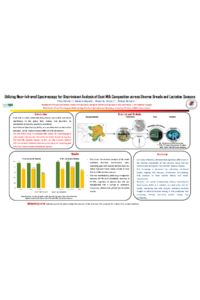
Goat milk is a vital, sustainable dairy product source that contributes significantly to the global dairy market. Different goat breeds may produce milk with varying compositions during different lactation seasons. Therefore, milk composition and quality need to be monitored. As a versatile and non-destructive method, Near Infrared Spectroscopy (NIRS) offers the potential for evaluating various milk parameters. In this study, we aim to establish NIRS models for classifying goat's milk samples between the native Red and Alpine Breeds at the first and fifth lactation seasons. Our objective is to assess the efficacy and cost-effectiveness of NIRS as a viable alternative to traditional laboratory techniques.
Forty-five milk samples were collected from two breeds, French Alpine goats, and native Red goats. Within each breed, half of the samples originated from goats in their first lactation season and the other half from goats in their fifth lactation season. The NIRS measurements were conducted using treated, untreated, and diluted milk samples. The experiment was performed with a benchtop spectrophotometer (740-1700nm).
Qualitative analysis using linear discriminant analysis (LDA) was conducted, demonstrating the feasibility of NIRS in effectively classifying samples. The achieved accuracy ranged between 67.19% to 100%, depending on the breed and lactation period.
These findings underscore the potential of NIRS as a rapid, non-destructive analytical tool for quality monitoring and milk analysis. Its insights guide decision-making in nutrition, agriculture, food production, and public health. By exploiting on the distinct attributes of goat milk originating from various breeds at different lactation periods, we can offer a wide range of appropriate and varied food choices tailored to distinct population groups.
Keywords
Goat milk
Milk composition
Alpine and Red Breeds
NIRS models
Qualitative analysis
Benchtop spectrophotometer
Manuscript
blsf-sciforum_078833_done_Final_Version_Conference.pdf
Poster
FoodsConference_Poster.pdf
Multidrug resistance cases of Listeria monocytogenes isolated from fresh meats
Assessing the Likelihood of Staphylococcus aureus Contamination in Bottled Drinking Water Production