Event submissions
Published

This submission belongs to the session S8. Food Microbiology of the event The 4th International Electronic Conference on Foods
Published date
14 Oct, 2023
Academic Editor
'%3e%3cpath%20d='M12.6657%2010.9104C12.4185%2010.325%2012.0599%209.79327%2011.6097%209.34482C11.1609%208.89508%2010.6293%208.5365%2010.0442%208.28888C10.0389%208.28626%2010.0337%208.28495%2010.0285%208.28233C10.8446%207.69279%2011.3752%206.73249%2011.3752%205.64904C11.3752%203.8542%209.92103%202.39999%208.1262%202.39999C6.33136%202.39999%204.87715%203.8542%204.87715%205.64904C4.87715%206.73249%205.40774%207.69279%206.22393%208.28364C6.21869%208.28626%206.21345%208.28757%206.20821%208.29019C5.62129%208.5378%205.09463%208.89284%204.64265%209.34613C4.1929%209.79493%203.83432%2010.3266%203.58671%2010.9117C3.34345%2011.4845%203.21226%2012.0987%203.20023%2012.7209C3.19988%2012.7349%203.20233%2012.7488%203.20744%2012.7619C3.21255%2012.7749%203.22022%2012.7867%203.22998%2012.7968C3.23975%2012.8068%203.25142%2012.8147%203.26431%2012.8202C3.2772%2012.8256%203.29105%2012.8284%203.30504%2012.8284H4.09109C4.14874%2012.8284%204.19459%2012.7825%204.1959%2012.7262C4.2221%2011.7148%204.62823%2010.7676%205.34617%2010.0497C6.08899%209.30683%207.0755%208.89808%208.1262%208.89808C9.17689%208.89808%2010.1634%209.30683%2010.9062%2010.0497C11.6242%2010.7676%2012.0303%2011.7148%2012.0565%2012.7262C12.0578%2012.7838%2012.1037%2012.8284%2012.1613%2012.8284H12.9474C12.9613%2012.8284%2012.9752%2012.8256%2012.9881%2012.8202C13.001%2012.8147%2013.0126%2012.8068%2013.0224%2012.7968C13.0322%2012.7867%2013.0398%2012.7749%2013.0449%2012.7619C13.0501%2012.7488%2013.0525%2012.7349%2013.0522%2012.7209C13.0391%2012.0947%2012.9094%2011.4855%2012.6657%2010.9104ZM8.1262%207.9024C7.52486%207.9024%206.9589%207.6679%206.53312%207.24211C6.10733%206.81633%205.87283%206.25037%205.87283%205.64904C5.87283%205.0477%206.10733%204.48174%206.53312%204.05596C6.9589%203.63018%207.52486%203.39567%208.1262%203.39567C8.72753%203.39567%209.29349%203.63018%209.71927%204.05596C10.1451%204.48174%2010.3796%205.0477%2010.3796%205.64904C10.3796%206.25037%2010.1451%206.81633%209.71927%207.24211C9.29349%207.6679%208.72753%207.9024%208.1262%207.9024Z'%20fill='%235D1EE1'/%3e%3c/g%3e%3c/svg%3e) Antonio Bevilacqua
Antonio BevilacquaCitation
Dimitra Kostoglou, Athina Vass, Efstathios Giaouris, Investigating the inhibitory effect of lactic acid on biofilm production by raw chicken Campylobacter spp. isolates in pure and mixed cultures., in Proceedings of The 4th International Electronic Conference on Foods, 15 October–30 October 2023, MDPI: Basel, Switzerland, doi: 10.3390/Foods2023-15078
Share
Email
Facebook
Twitter
LinkedIn
Investigating the inhibitory effect of lactic acid on biofilm production by raw chicken Campylobacter spp. isolates in pure and mixed cultures.

Dimitra Kostoglou 1
'%3e%3cpath%20d='M12.6647%2010.9104C12.4176%2010.325%2012.0589%209.7933%2011.6088%209.34485C11.16%208.89511%2010.6283%208.53653%2010.0432%208.28891C10.038%208.28629%2010.0327%208.28498%2010.0275%208.28236C10.8437%207.69282%2011.3743%206.73252%2011.3743%205.64907C11.3743%203.85423%209.92005%202.40002%208.12522%202.40002C6.33038%202.40002%204.87618%203.85423%204.87618%205.64907C4.87618%206.73252%205.40677%207.69282%206.22296%208.28367C6.21772%208.28629%206.21248%208.2876%206.20724%208.29022C5.62031%208.53783%205.09365%208.89287%204.64167%209.34616C4.19192%209.79496%203.83334%2010.3266%203.58573%2010.9117C3.34247%2011.4846%203.21128%2012.0987%203.19925%2012.721C3.1989%2012.735%203.20135%2012.7489%203.20646%2012.7619C3.21157%2012.7749%203.21924%2012.7868%203.22901%2012.7968C3.23877%2012.8068%203.25045%2012.8148%203.26334%2012.8202C3.27623%2012.8256%203.29007%2012.8284%203.30406%2012.8284H4.09012C4.14776%2012.8284%204.19362%2012.7825%204.19493%2012.7262C4.22113%2011.7148%204.62726%2010.7676%205.34519%2010.0497C6.08802%209.30686%207.07452%208.89811%208.12522%208.89811C9.17592%208.89811%2010.1624%209.30686%2010.9052%2010.0497C11.6232%2010.7676%2012.0293%2011.7148%2012.0555%2012.7262C12.0568%2012.7839%2012.1027%2012.8284%2012.1603%2012.8284H12.9464C12.9604%2012.8284%2012.9742%2012.8256%2012.9871%2012.8202C13%2012.8148%2013.0117%2012.8068%2013.0214%2012.7968C13.0312%2012.7868%2013.0389%2012.7749%2013.044%2012.7619C13.0491%2012.7489%2013.0515%2012.735%2013.0512%2012.721C13.0381%2012.0947%2012.9084%2011.4856%2012.6647%2010.9104ZM8.12522%207.90243C7.52388%207.90243%206.95792%207.66793%206.53214%207.24215C6.10636%206.81636%205.87185%206.2504%205.87185%205.64907C5.87185%205.04773%206.10636%204.48177%206.53214%204.05599C6.95792%203.63021%207.52388%203.3957%208.12522%203.3957C8.72655%203.3957%209.29252%203.63021%209.7183%204.05599C10.1441%204.48177%2010.3786%205.04773%2010.3786%205.64907C10.3786%206.2504%2010.1441%206.81636%209.7183%207.24215C9.29252%207.66793%208.72655%207.90243%208.12522%207.90243Z'%20fill='%235D1EE1'/%3e%3c/g%3e%3c/svg%3e)
Athina Vass 1

Efstathios Giaouris 1
1. Laboratory of Food Microbiology and Hygiene, Department of Food Science and Nutrition, School of the Environment, University of the Aegean, 81400 Myrina, Lemnos, Greece
Abstract
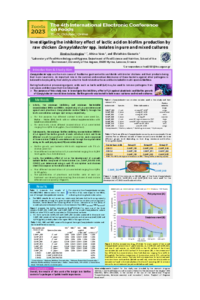
Campylobacter infection is the leading cause of foodborne gastroenteritis worldwide and chicken meat is the main reservoir of this pathogen. Campylobacter spp. are fragile and fastidious in their growth requirements but, paradoxically, they can be easily transmitted from animals to human through the food production chain. Biofilm formation is suggested as a key survival and persistence mechanism used by campylobacteria. During food animal processing, organic acids may be used to remove pathogens from carcasses and decrease their microbial load. In this work, the effect of lactic acid (LA) on biofilm production by eight Campylobacter spp. raw chicken meat isolates (five C. jejuni and three C. coli), was investigated. Initially, the minimum inhibitory and minimum bactericidal concentrations (MICs and MBCs, respectively) of LA were determined against each Campylobacter isolate, through the broth microdilution and agar spot assays, respectively. Subsequently, the minimum biofilm inhibitory concentrations (MBICs) of LA against the biofilm growth of each isolate were determined, through the crystal violet assay. Lastly, the inhibitory effect of LA on multistrain biofilms (composed of three isolates) was determined using 96-well polystyrene microplates and stainless steel coupons as the abiotic substrata. Results revealed that the MIC, MBC and MBIC values of LA against the eight isolates ranged from 1024 to 2048 μg/mL depending on the isolate and the growth medium. The inhibitory effect of LA on mixed culture biofilm production was higher when SS coupons were used as the abiotic substrata. Taken together, the results of this work offer insight into biofilm management of a pathogen of public health importance.
Keywords
lactic acid
Campylobacter jejuni
Campylobacter coli
biofilms
food safety
polystyrene
stainless steel
Manuscript
blsf-sciforum_078780_original_Manuscript_078780_Kostoglou_et_al_Foods2023_15_30_Oct_2023-done.pdf
Poster
Poster 078780_Kostoglou et al. (Foods 2023).pdf
Calculating the dose rate of natural radioactivity in vegetables from an agricultural area. El Jadida, Morocco
Formulation and Evaluation of Date Syrup Flavored Soy Milk Yogurt, A Novel Plant Based Alternative of Dairy Products