Event submissions
Published

This submission belongs to the session S6. Food Analysis, Biotechnology, and Engineering of the event The 4th International Electronic Conference on Foods
Published date
14 Oct, 2023
Academic Editor
'%3e%3cpath%20d='M12.6657%2010.9104C12.4185%2010.325%2012.0599%209.79327%2011.6097%209.34482C11.1609%208.89508%2010.6293%208.5365%2010.0442%208.28888C10.0389%208.28626%2010.0337%208.28495%2010.0285%208.28233C10.8446%207.69279%2011.3752%206.73249%2011.3752%205.64904C11.3752%203.8542%209.92103%202.39999%208.1262%202.39999C6.33136%202.39999%204.87715%203.8542%204.87715%205.64904C4.87715%206.73249%205.40774%207.69279%206.22393%208.28364C6.21869%208.28626%206.21345%208.28757%206.20821%208.29019C5.62129%208.5378%205.09463%208.89284%204.64265%209.34613C4.1929%209.79493%203.83432%2010.3266%203.58671%2010.9117C3.34345%2011.4845%203.21226%2012.0987%203.20023%2012.7209C3.19988%2012.7349%203.20233%2012.7488%203.20744%2012.7619C3.21255%2012.7749%203.22022%2012.7867%203.22998%2012.7968C3.23975%2012.8068%203.25142%2012.8147%203.26431%2012.8202C3.2772%2012.8256%203.29105%2012.8284%203.30504%2012.8284H4.09109C4.14874%2012.8284%204.19459%2012.7825%204.1959%2012.7262C4.2221%2011.7148%204.62823%2010.7676%205.34617%2010.0497C6.08899%209.30683%207.0755%208.89808%208.1262%208.89808C9.17689%208.89808%2010.1634%209.30683%2010.9062%2010.0497C11.6242%2010.7676%2012.0303%2011.7148%2012.0565%2012.7262C12.0578%2012.7838%2012.1037%2012.8284%2012.1613%2012.8284H12.9474C12.9613%2012.8284%2012.9752%2012.8256%2012.9881%2012.8202C13.001%2012.8147%2013.0126%2012.8068%2013.0224%2012.7968C13.0322%2012.7867%2013.0398%2012.7749%2013.0449%2012.7619C13.0501%2012.7488%2013.0525%2012.7349%2013.0522%2012.7209C13.0391%2012.0947%2012.9094%2011.4855%2012.6657%2010.9104ZM8.1262%207.9024C7.52486%207.9024%206.9589%207.6679%206.53312%207.24211C6.10733%206.81633%205.87283%206.25037%205.87283%205.64904C5.87283%205.0477%206.10733%204.48174%206.53312%204.05596C6.9589%203.63018%207.52486%203.39567%208.1262%203.39567C8.72753%203.39567%209.29349%203.63018%209.71927%204.05596C10.1451%204.48174%2010.3796%205.0477%2010.3796%205.64904C10.3796%206.25037%2010.1451%206.81633%209.71927%207.24211C9.29349%207.6679%208.72753%207.9024%208.1262%207.9024Z'%20fill='%235D1EE1'/%3e%3c/g%3e%3c/svg%3e) Efstathios Giaouris
Efstathios GiaourisCitation
Evelyn Quispe-Rivera, Franz Tucta-Huillca, Vasco Cadavez, Ursula Gonzales-Barron, Marcial Silva-Jaimes, COLORIMETRIC EVALUATION OF QUINOA FLOUR FERMENTED BY Monascus purpureus ENRICHED WITH MONOSODIUM GLUTAMATE AND SODIUM CHLORIDE, in Proceedings of The 4th International Electronic Conference on Foods, 15 October–30 October 2023, MDPI: Basel, Switzerland, doi: 10.3390/Foods2023-15082
Share
Email
Facebook
Twitter
LinkedIn
COLORIMETRIC EVALUATION OF QUINOA FLOUR FERMENTED BY Monascus purpureus ENRICHED WITH MONOSODIUM GLUTAMATE AND SODIUM CHLORIDE

Evelyn Quispe-Rivera 1
'%3e%3cpath%20d='M12.6647%2010.9104C12.4176%2010.325%2012.0589%209.7933%2011.6088%209.34485C11.16%208.89511%2010.6283%208.53653%2010.0432%208.28891C10.038%208.28629%2010.0327%208.28498%2010.0275%208.28236C10.8437%207.69282%2011.3743%206.73252%2011.3743%205.64907C11.3743%203.85423%209.92005%202.40002%208.12522%202.40002C6.33038%202.40002%204.87618%203.85423%204.87618%205.64907C4.87618%206.73252%205.40677%207.69282%206.22296%208.28367C6.21772%208.28629%206.21248%208.2876%206.20724%208.29022C5.62031%208.53783%205.09365%208.89287%204.64167%209.34616C4.19192%209.79496%203.83334%2010.3266%203.58573%2010.9117C3.34247%2011.4846%203.21128%2012.0987%203.19925%2012.721C3.1989%2012.735%203.20135%2012.7489%203.20646%2012.7619C3.21157%2012.7749%203.21924%2012.7868%203.22901%2012.7968C3.23877%2012.8068%203.25045%2012.8148%203.26334%2012.8202C3.27623%2012.8256%203.29007%2012.8284%203.30406%2012.8284H4.09012C4.14776%2012.8284%204.19362%2012.7825%204.19493%2012.7262C4.22113%2011.7148%204.62726%2010.7676%205.34519%2010.0497C6.08802%209.30686%207.07452%208.89811%208.12522%208.89811C9.17592%208.89811%2010.1624%209.30686%2010.9052%2010.0497C11.6232%2010.7676%2012.0293%2011.7148%2012.0555%2012.7262C12.0568%2012.7839%2012.1027%2012.8284%2012.1603%2012.8284H12.9464C12.9604%2012.8284%2012.9742%2012.8256%2012.9871%2012.8202C13%2012.8148%2013.0117%2012.8068%2013.0214%2012.7968C13.0312%2012.7868%2013.0389%2012.7749%2013.044%2012.7619C13.0491%2012.7489%2013.0515%2012.735%2013.0512%2012.721C13.0381%2012.0947%2012.9084%2011.4856%2012.6647%2010.9104ZM8.12522%207.90243C7.52388%207.90243%206.95792%207.66793%206.53214%207.24215C6.10636%206.81636%205.87185%206.2504%205.87185%205.64907C5.87185%205.04773%206.10636%204.48177%206.53214%204.05599C6.95792%203.63021%207.52388%203.3957%208.12522%203.3957C8.72655%203.3957%209.29252%203.63021%209.7183%204.05599C10.1441%204.48177%2010.3786%205.04773%2010.3786%205.64907C10.3786%206.2504%2010.1441%206.81636%209.7183%207.24215C9.29252%207.66793%208.72655%207.90243%208.12522%207.90243Z'%20fill='%235D1EE1'/%3e%3c/g%3e%3c/svg%3e)
Franz Tucta-Huillca 1
Vasco Cadavez 2

Ursula Gonzales-Barron 2

Marcial Silva-Jaimes 1
1. Universidad Nacional Agraria La Molina (UNALM), Av. La Molina s/n La Molina, Lima, Peru
2. Centro de Investigação de Montanha (CIMO), Instituto Politécnico de Bragança, Campus de Santa Apolónia, Bragança, Portugal.
Abstract
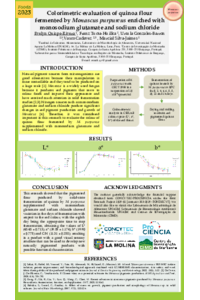
Natural pigments in foodstuffs are important when it comes to their choice. A good biotechnological alternative is to produce red pigmented flour by fermentation on solid substrate for use as an input in the food industry. In the present study, the colour and carbon:nitrogen ratio of M. purpureus pigmented quinoa flours supplemented with monosodium glutamate (MSG) and sodium chloride were evaluated during 14 days of fermentation. The MSG concentration was 1.0%, and the salt levels were 0.05, 0.1, 0.2 and 0.4%. Flour colour was analysed with a colourimeter (CM-5, Konica Minolta, Japan) for L*, a* and b* values. A completely randomised statistical design with n=4 was used to compare the data and the results obtained were evaluated by analysis of variance (ANOVA) with an α = 0.05 using the R software. The best values corresponded to the eighth day, with L*, a*, b* and C:N of 49.55±1.684, 19.85±1.174, 19.90±0.775 and 11.306±0.258 respectively. This research demonstrated that the pigmented flour produced by solid-state fermentation of quinoa by M. purpureus supplemented with monosodium glutamate and sodium chloride showed variations of red colour along with C:N ratio during the fermentation time, resulting in a product with good visual sensory attribute that can be used to develop new naturally pigmented products with possible functional characteristics.
Keywords
Chenopodium quinoa
CIELAB
pseudocereal
carbon:nitrogen ratio.
Manuscript
blsf-sciforum_078731_original_Proceedings_paper_Evelyn -done.pdf
Poster
Evelyn_poster_2023.pdf
The potential use of synbiotic combinations in bread- A review
Promoting Legume Consumption: Strategies for Health, Nutrition, and Culinary Applications