Event submissions
Published

This submission belongs to the session S6. Food Analysis, Biotechnology, and Engineering of the event The 4th International Electronic Conference on Foods
Published date
14 Oct, 2023
Academic Editor
'%3e%3cpath%20d='M12.6657%2010.9104C12.4185%2010.325%2012.0599%209.79327%2011.6097%209.34482C11.1609%208.89508%2010.6293%208.5365%2010.0442%208.28888C10.0389%208.28626%2010.0337%208.28495%2010.0285%208.28233C10.8446%207.69279%2011.3752%206.73249%2011.3752%205.64904C11.3752%203.8542%209.92103%202.39999%208.1262%202.39999C6.33136%202.39999%204.87715%203.8542%204.87715%205.64904C4.87715%206.73249%205.40774%207.69279%206.22393%208.28364C6.21869%208.28626%206.21345%208.28757%206.20821%208.29019C5.62129%208.5378%205.09463%208.89284%204.64265%209.34613C4.1929%209.79493%203.83432%2010.3266%203.58671%2010.9117C3.34345%2011.4845%203.21226%2012.0987%203.20023%2012.7209C3.19988%2012.7349%203.20233%2012.7488%203.20744%2012.7619C3.21255%2012.7749%203.22022%2012.7867%203.22998%2012.7968C3.23975%2012.8068%203.25142%2012.8147%203.26431%2012.8202C3.2772%2012.8256%203.29105%2012.8284%203.30504%2012.8284H4.09109C4.14874%2012.8284%204.19459%2012.7825%204.1959%2012.7262C4.2221%2011.7148%204.62823%2010.7676%205.34617%2010.0497C6.08899%209.30683%207.0755%208.89808%208.1262%208.89808C9.17689%208.89808%2010.1634%209.30683%2010.9062%2010.0497C11.6242%2010.7676%2012.0303%2011.7148%2012.0565%2012.7262C12.0578%2012.7838%2012.1037%2012.8284%2012.1613%2012.8284H12.9474C12.9613%2012.8284%2012.9752%2012.8256%2012.9881%2012.8202C13.001%2012.8147%2013.0126%2012.8068%2013.0224%2012.7968C13.0322%2012.7867%2013.0398%2012.7749%2013.0449%2012.7619C13.0501%2012.7488%2013.0525%2012.7349%2013.0522%2012.7209C13.0391%2012.0947%2012.9094%2011.4855%2012.6657%2010.9104ZM8.1262%207.9024C7.52486%207.9024%206.9589%207.6679%206.53312%207.24211C6.10733%206.81633%205.87283%206.25037%205.87283%205.64904C5.87283%205.0477%206.10733%204.48174%206.53312%204.05596C6.9589%203.63018%207.52486%203.39567%208.1262%203.39567C8.72753%203.39567%209.29349%203.63018%209.71927%204.05596C10.1451%204.48174%2010.3796%205.0477%2010.3796%205.64904C10.3796%206.25037%2010.1451%206.81633%209.71927%207.24211C9.29349%207.6679%208.72753%207.9024%208.1262%207.9024Z'%20fill='%235D1EE1'/%3e%3c/g%3e%3c/svg%3e) Antonio Bevilacqua
Antonio BevilacquaCitation
Franz Tucta-Huillca, Evelyn Quispe-Rivera, Ursula Gonzales-Barron, Vasco Cadavez, Marcial Silva-Jaimes, EFFECT OF FISH HYDROLYSATE AND SODIUM CHLORIDE ON THE COLOUR OF QUINOA FLOUR FERMENTED BY Monascus purpureus, in Proceedings of The 4th International Electronic Conference on Foods, 15 October–30 October 2023, MDPI: Basel, Switzerland, doi: 10.3390/Foods2023-15086
Share
Email
Facebook
Twitter
LinkedIn
EFFECT OF FISH HYDROLYSATE AND SODIUM CHLORIDE ON THE COLOUR OF QUINOA FLOUR FERMENTED BY Monascus purpureus
'%3e%3cpath%20d='M12.6647%2010.9104C12.4176%2010.325%2012.0589%209.7933%2011.6088%209.34485C11.16%208.89511%2010.6283%208.53653%2010.0432%208.28891C10.038%208.28629%2010.0327%208.28498%2010.0275%208.28236C10.8437%207.69282%2011.3743%206.73252%2011.3743%205.64907C11.3743%203.85423%209.92005%202.40002%208.12522%202.40002C6.33038%202.40002%204.87618%203.85423%204.87618%205.64907C4.87618%206.73252%205.40677%207.69282%206.22296%208.28367C6.21772%208.28629%206.21248%208.2876%206.20724%208.29022C5.62031%208.53783%205.09365%208.89287%204.64167%209.34616C4.19192%209.79496%203.83334%2010.3266%203.58573%2010.9117C3.34247%2011.4846%203.21128%2012.0987%203.19925%2012.721C3.1989%2012.735%203.20135%2012.7489%203.20646%2012.7619C3.21157%2012.7749%203.21924%2012.7868%203.22901%2012.7968C3.23877%2012.8068%203.25045%2012.8148%203.26334%2012.8202C3.27623%2012.8256%203.29007%2012.8284%203.30406%2012.8284H4.09012C4.14776%2012.8284%204.19362%2012.7825%204.19493%2012.7262C4.22113%2011.7148%204.62726%2010.7676%205.34519%2010.0497C6.08802%209.30686%207.07452%208.89811%208.12522%208.89811C9.17592%208.89811%2010.1624%209.30686%2010.9052%2010.0497C11.6232%2010.7676%2012.0293%2011.7148%2012.0555%2012.7262C12.0568%2012.7839%2012.1027%2012.8284%2012.1603%2012.8284H12.9464C12.9604%2012.8284%2012.9742%2012.8256%2012.9871%2012.8202C13%2012.8148%2013.0117%2012.8068%2013.0214%2012.7968C13.0312%2012.7868%2013.0389%2012.7749%2013.044%2012.7619C13.0491%2012.7489%2013.0515%2012.735%2013.0512%2012.721C13.0381%2012.0947%2012.9084%2011.4856%2012.6647%2010.9104ZM8.12522%207.90243C7.52388%207.90243%206.95792%207.66793%206.53214%207.24215C6.10636%206.81636%205.87185%206.2504%205.87185%205.64907C5.87185%205.04773%206.10636%204.48177%206.53214%204.05599C6.95792%203.63021%207.52388%203.3957%208.12522%203.3957C8.72655%203.3957%209.29252%203.63021%209.7183%204.05599C10.1441%204.48177%2010.3786%205.04773%2010.3786%205.64907C10.3786%206.2504%2010.1441%206.81636%209.7183%207.24215C9.29252%207.66793%208.72655%207.90243%208.12522%207.90243Z'%20fill='%235D1EE1'/%3e%3c/g%3e%3c/svg%3e)
Franz Tucta-Huillca 1

Evelyn Quispe-Rivera 1

Ursula Gonzales-Barron 2
Vasco Cadavez 2

Marcial Silva-Jaimes 1
1. Universidad Nacional Agraria La Molina (UNALM), Av. La Molina s/n La Molina, Lima, Peru
2. Centro de Investigação de Montanha (CIMO), Instituto Politécnico de Bragança, Campus de Santa Apolónia, Bragança, Portugal
Abstract
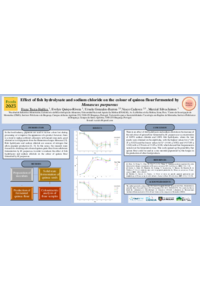
Monascus purpureus is a fungus that has been of interest to the food industry for several centuries due to its pigment production, which in turn is related to different environmental parameters, including the supplements added to the fermentation. In the present study, the effect of fish hydrolysate and sodium chloride on the colour of flour from quinoa grains fermented with M. purpureus was analysed. The colour of each flour sample produced in the fermentation was evaluated by colorimetry in CIELAB space (L*, a*, b*), and the carbon:nitrogen ratio was also analysed. The levels used for the sodium chloride factor were 0.05, 0.10, 0.20 and 0.40% and fish hydrolysate at 1.0%. The values obtained were compared with a completely randomised design (CRD) and analysed by ANOVA with a significance level of 0.05 using the R software. The minimum solid fermentation time was found to be eight days, since by then the results of L* (44.66±0.532), a* (20.27±0.323), b* (17.89±1.342), C:N (11.047±0.240) yielded the best values for the production of red flour, using a concentration of 0.05% NaCl and 1.0% fish hydrolysate. The results showed that there is an effect of fish hydrolysate and sodium chloride in increasing the red colour of quinoa flour fermented by M. purpureus. This work opened up the possibility that quinoa flour, as a substrate pigmented by this fungus, could be used as raw material in the elaboration of other food products.
Keywords
Nitrogen source
salts
novel foods.
Manuscript
blsf-sciforum_078728_original_Proceedings_paper_Franz-done.pdf
Poster
Franz_poster_2023.pdf
Functional foods or over-hyped? Observations on the antioxidant and phenolic content of Australian foodstuffs
Physicochemical and sensory properties of high-fiber yogurt by regenerated pomelo albedo fiber