Event submissions
Published
This submission belongs to the session S7. Poster session of the event The 3rd International Electronic Conference on Agronomy
Published date
16 Oct, 2023
Academic Editor
'%3e%3cpath%20d='M12.6657%2010.9104C12.4185%2010.325%2012.0599%209.79327%2011.6097%209.34482C11.1609%208.89508%2010.6293%208.5365%2010.0442%208.28888C10.0389%208.28626%2010.0337%208.28495%2010.0285%208.28233C10.8446%207.69279%2011.3752%206.73249%2011.3752%205.64904C11.3752%203.8542%209.92103%202.39999%208.1262%202.39999C6.33136%202.39999%204.87715%203.8542%204.87715%205.64904C4.87715%206.73249%205.40774%207.69279%206.22393%208.28364C6.21869%208.28626%206.21345%208.28757%206.20821%208.29019C5.62129%208.5378%205.09463%208.89284%204.64265%209.34613C4.1929%209.79493%203.83432%2010.3266%203.58671%2010.9117C3.34345%2011.4845%203.21226%2012.0987%203.20023%2012.7209C3.19988%2012.7349%203.20233%2012.7488%203.20744%2012.7619C3.21255%2012.7749%203.22022%2012.7867%203.22998%2012.7968C3.23975%2012.8068%203.25142%2012.8147%203.26431%2012.8202C3.2772%2012.8256%203.29105%2012.8284%203.30504%2012.8284H4.09109C4.14874%2012.8284%204.19459%2012.7825%204.1959%2012.7262C4.2221%2011.7148%204.62823%2010.7676%205.34617%2010.0497C6.08899%209.30683%207.0755%208.89808%208.1262%208.89808C9.17689%208.89808%2010.1634%209.30683%2010.9062%2010.0497C11.6242%2010.7676%2012.0303%2011.7148%2012.0565%2012.7262C12.0578%2012.7838%2012.1037%2012.8284%2012.1613%2012.8284H12.9474C12.9613%2012.8284%2012.9752%2012.8256%2012.9881%2012.8202C13.001%2012.8147%2013.0126%2012.8068%2013.0224%2012.7968C13.0322%2012.7867%2013.0398%2012.7749%2013.0449%2012.7619C13.0501%2012.7488%2013.0525%2012.7349%2013.0522%2012.7209C13.0391%2012.0947%2012.9094%2011.4855%2012.6657%2010.9104ZM8.1262%207.9024C7.52486%207.9024%206.9589%207.6679%206.53312%207.24211C6.10733%206.81633%205.87283%206.25037%205.87283%205.64904C5.87283%205.0477%206.10733%204.48174%206.53312%204.05596C6.9589%203.63018%207.52486%203.39567%208.1262%203.39567C8.72753%203.39567%209.29349%203.63018%209.71927%204.05596C10.1451%204.48174%2010.3796%205.0477%2010.3796%205.64904C10.3796%206.25037%2010.1451%206.81633%209.71927%207.24211C9.29349%207.6679%208.72753%207.9024%208.1262%207.9024Z'%20fill='%235D1EE1'/%3e%3c/g%3e%3c/svg%3e) Gianni Bellocchi
Gianni BellocchiCitation
Alvaro Cervantes-Diaz, Pilar Sandín-España, José-Luis Alonso-Prados, Inés Santín-Montanyá, Effect of the application of biochar organic amendment on the herbicide efficacy in rice cultivation, in Proceedings of The 3rd International Electronic Conference on Agronomy, 15 October–30 October 2023, MDPI: Basel, Switzerland
Share
Email
Facebook
Twitter
LinkedIn
Effect of the application of biochar organic amendment on the herbicide efficacy in rice cultivation
'%3e%3cpath%20d='M12.6647%2010.9104C12.4176%2010.325%2012.0589%209.7933%2011.6088%209.34485C11.16%208.89511%2010.6283%208.53653%2010.0432%208.28891C10.038%208.28629%2010.0327%208.28498%2010.0275%208.28236C10.8437%207.69282%2011.3743%206.73252%2011.3743%205.64907C11.3743%203.85423%209.92005%202.40002%208.12522%202.40002C6.33038%202.40002%204.87618%203.85423%204.87618%205.64907C4.87618%206.73252%205.40677%207.69282%206.22296%208.28367C6.21772%208.28629%206.21248%208.2876%206.20724%208.29022C5.62031%208.53783%205.09365%208.89287%204.64167%209.34616C4.19192%209.79496%203.83334%2010.3266%203.58573%2010.9117C3.34247%2011.4846%203.21128%2012.0987%203.19925%2012.721C3.1989%2012.735%203.20135%2012.7489%203.20646%2012.7619C3.21157%2012.7749%203.21924%2012.7868%203.22901%2012.7968C3.23877%2012.8068%203.25045%2012.8148%203.26334%2012.8202C3.27623%2012.8256%203.29007%2012.8284%203.30406%2012.8284H4.09012C4.14776%2012.8284%204.19362%2012.7825%204.19493%2012.7262C4.22113%2011.7148%204.62726%2010.7676%205.34519%2010.0497C6.08802%209.30686%207.07452%208.89811%208.12522%208.89811C9.17592%208.89811%2010.1624%209.30686%2010.9052%2010.0497C11.6232%2010.7676%2012.0293%2011.7148%2012.0555%2012.7262C12.0568%2012.7839%2012.1027%2012.8284%2012.1603%2012.8284H12.9464C12.9604%2012.8284%2012.9742%2012.8256%2012.9871%2012.8202C13%2012.8148%2013.0117%2012.8068%2013.0214%2012.7968C13.0312%2012.7868%2013.0389%2012.7749%2013.044%2012.7619C13.0491%2012.7489%2013.0515%2012.735%2013.0512%2012.721C13.0381%2012.0947%2012.9084%2011.4856%2012.6647%2010.9104ZM8.12522%207.90243C7.52388%207.90243%206.95792%207.66793%206.53214%207.24215C6.10636%206.81636%205.87185%206.2504%205.87185%205.64907C5.87185%205.04773%206.10636%204.48177%206.53214%204.05599C6.95792%203.63021%207.52388%203.3957%208.12522%203.3957C8.72655%203.3957%209.29252%203.63021%209.7183%204.05599C10.1441%204.48177%2010.3786%205.04773%2010.3786%205.64907C10.3786%206.2504%2010.1441%206.81636%209.7183%207.24215C9.29252%207.66793%208.72655%207.90243%208.12522%207.90243Z'%20fill='%235D1EE1'/%3e%3c/g%3e%3c/svg%3e)
Alvaro Cervantes-Diaz 1
Pilar Sandín-España 1
José-Luis Alonso-Prados 1
Inés Santín-Montanyá 2
1. Plant Protection Products Unit, INIA-CSIC, Crta. La Coruña, km 7.5, 28040 Madrid, Spain
2. Environment and Agronomy Departments, INIA-CSIC, Crta. La Coruña, km 7.5, 28040 Madrid, Spain
Abstract
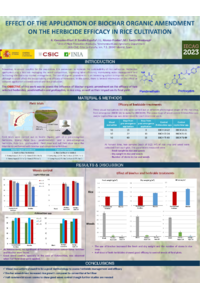
Nowadays, to ensure supplies for the population, it is paramount to maintain the sustainability of rice cultivation. Herbicides application play a key role managing the weed competition, improving labour efficiency, maintaining water management and facilitating effective crop residue management. Recent use of organic amendments in the rice cultivation process presents both benefits and drawbacks. However, a lack of information and understanding exists regarding this technique. Our objective was to assess the influence of an organic amendment (biochar) on the efficacy of two selected herbicides in rice farming, as well as their impact on its final yield.
A field trial set up on the ‘El Coronil’ farm (BASF Company, Seville, Spain) was carried out to compare combined efficacy of a pre-emergence herbicide, Stomp Aqua (active substance: Pendimethalin), and a post-emergence herbicide, Aura (active substance.: Profoxydim), at two different doses, with a conventional fertiliser or biochar (organic amendment).
The percentage of weed control (Echinochloa spp. and/or Leptochloa spp.) was calculated throughout the crop cycle by three visual assessments. At rice harvest, the number of stems, fresh and dry final biomass from weeds and crop were determined.
Our results highlighted that all treatments employed had a significant influence on weed control. The highest control was observed with the commercial doses of both herbicides. The application of biochar increased the number of stems, and fresh and dry biomass in rice crop compared to conventional fertiliser. Biochar increased rice growth compared to conventional fertiliser, but no differences in crop yields were observed.
Keywords
profoxydim
pendimethalin
biochar
rice crop
Manuscript
Poster MDPI_ACD.pdf
Poster
Poster MDPI_ACD.pdf
Evaluation of stomatal density and leaf venation of mango cultivars with agronomic interest in the Canary Islands
Mediterranean fig culture (Ficus carica L.) in northern Morocco : Resilience of caprifig and female fig trees to climate change