Event submissions
Published

This submission belongs to the session S5. Plant breeding, genetics, genomics and biotechnology of the event The 3rd International Electronic Conference on Agronomy
Published date
18 Oct, 2023
Academic Editor
'%3e%3cpath%20d='M12.6657%2010.9104C12.4185%2010.325%2012.0599%209.79327%2011.6097%209.34482C11.1609%208.89508%2010.6293%208.5365%2010.0442%208.28888C10.0389%208.28626%2010.0337%208.28495%2010.0285%208.28233C10.8446%207.69279%2011.3752%206.73249%2011.3752%205.64904C11.3752%203.8542%209.92103%202.39999%208.1262%202.39999C6.33136%202.39999%204.87715%203.8542%204.87715%205.64904C4.87715%206.73249%205.40774%207.69279%206.22393%208.28364C6.21869%208.28626%206.21345%208.28757%206.20821%208.29019C5.62129%208.5378%205.09463%208.89284%204.64265%209.34613C4.1929%209.79493%203.83432%2010.3266%203.58671%2010.9117C3.34345%2011.4845%203.21226%2012.0987%203.20023%2012.7209C3.19988%2012.7349%203.20233%2012.7488%203.20744%2012.7619C3.21255%2012.7749%203.22022%2012.7867%203.22998%2012.7968C3.23975%2012.8068%203.25142%2012.8147%203.26431%2012.8202C3.2772%2012.8256%203.29105%2012.8284%203.30504%2012.8284H4.09109C4.14874%2012.8284%204.19459%2012.7825%204.1959%2012.7262C4.2221%2011.7148%204.62823%2010.7676%205.34617%2010.0497C6.08899%209.30683%207.0755%208.89808%208.1262%208.89808C9.17689%208.89808%2010.1634%209.30683%2010.9062%2010.0497C11.6242%2010.7676%2012.0303%2011.7148%2012.0565%2012.7262C12.0578%2012.7838%2012.1037%2012.8284%2012.1613%2012.8284H12.9474C12.9613%2012.8284%2012.9752%2012.8256%2012.9881%2012.8202C13.001%2012.8147%2013.0126%2012.8068%2013.0224%2012.7968C13.0322%2012.7867%2013.0398%2012.7749%2013.0449%2012.7619C13.0501%2012.7488%2013.0525%2012.7349%2013.0522%2012.7209C13.0391%2012.0947%2012.9094%2011.4855%2012.6657%2010.9104ZM8.1262%207.9024C7.52486%207.9024%206.9589%207.6679%206.53312%207.24211C6.10733%206.81633%205.87283%206.25037%205.87283%205.64904C5.87283%205.0477%206.10733%204.48174%206.53312%204.05596C6.9589%203.63018%207.52486%203.39567%208.1262%203.39567C8.72753%203.39567%209.29349%203.63018%209.71927%204.05596C10.1451%204.48174%2010.3796%205.0477%2010.3796%205.64904C10.3796%206.25037%2010.1451%206.81633%209.71927%207.24211C9.29349%207.6679%208.72753%207.9024%208.1262%207.9024Z'%20fill='%235D1EE1'/%3e%3c/g%3e%3c/svg%3e) Gianni Bellocchi
Gianni BellocchiCitation
Mariola Dreger, Aleksandra Deja, Milena Szalata, Ryszard Słomski, In vitro preservation of somatic seeds and nonencapsulated hemp explants, in Proceedings of The 3rd International Electronic Conference on Agronomy, 15 October–30 October 2023, MDPI: Basel, Switzerland, doi: 10.3390/IECAG2023-15146
Share
Email
Facebook
Twitter
LinkedIn
In vitro preservation of somatic seeds and nonencapsulated hemp explants
'%3e%3cpath%20d='M12.6647%2010.9104C12.4176%2010.325%2012.0589%209.7933%2011.6088%209.34485C11.16%208.89511%2010.6283%208.53653%2010.0432%208.28891C10.038%208.28629%2010.0327%208.28498%2010.0275%208.28236C10.8437%207.69282%2011.3743%206.73252%2011.3743%205.64907C11.3743%203.85423%209.92005%202.40002%208.12522%202.40002C6.33038%202.40002%204.87618%203.85423%204.87618%205.64907C4.87618%206.73252%205.40677%207.69282%206.22296%208.28367C6.21772%208.28629%206.21248%208.2876%206.20724%208.29022C5.62031%208.53783%205.09365%208.89287%204.64167%209.34616C4.19192%209.79496%203.83334%2010.3266%203.58573%2010.9117C3.34247%2011.4846%203.21128%2012.0987%203.19925%2012.721C3.1989%2012.735%203.20135%2012.7489%203.20646%2012.7619C3.21157%2012.7749%203.21924%2012.7868%203.22901%2012.7968C3.23877%2012.8068%203.25045%2012.8148%203.26334%2012.8202C3.27623%2012.8256%203.29007%2012.8284%203.30406%2012.8284H4.09012C4.14776%2012.8284%204.19362%2012.7825%204.19493%2012.7262C4.22113%2011.7148%204.62726%2010.7676%205.34519%2010.0497C6.08802%209.30686%207.07452%208.89811%208.12522%208.89811C9.17592%208.89811%2010.1624%209.30686%2010.9052%2010.0497C11.6232%2010.7676%2012.0293%2011.7148%2012.0555%2012.7262C12.0568%2012.7839%2012.1027%2012.8284%2012.1603%2012.8284H12.9464C12.9604%2012.8284%2012.9742%2012.8256%2012.9871%2012.8202C13%2012.8148%2013.0117%2012.8068%2013.0214%2012.7968C13.0312%2012.7868%2013.0389%2012.7749%2013.044%2012.7619C13.0491%2012.7489%2013.0515%2012.735%2013.0512%2012.721C13.0381%2012.0947%2012.9084%2011.4856%2012.6647%2010.9104ZM8.12522%207.90243C7.52388%207.90243%206.95792%207.66793%206.53214%207.24215C6.10636%206.81636%205.87185%206.2504%205.87185%205.64907C5.87185%205.04773%206.10636%204.48177%206.53214%204.05599C6.95792%203.63021%207.52388%203.3957%208.12522%203.3957C8.72655%203.3957%209.29252%203.63021%209.7183%204.05599C10.1441%204.48177%2010.3786%205.04773%2010.3786%205.64907C10.3786%206.2504%2010.1441%206.81636%209.7183%207.24215C9.29252%207.66793%208.72655%207.90243%208.12522%207.90243Z'%20fill='%235D1EE1'/%3e%3c/g%3e%3c/svg%3e)
Mariola Dreger 1
Aleksandra Deja 2
Milena Szalata 2
Ryszard Słomski 2
1. Institute of Natural Fibres & Medicinal Plants National Research Institute, Department of Biotechnology, Wojska Polskiego 71b, 60-630 Poznan, Poland
2. Institute of Natural Fibres & Medicinal Plants National Research Institute, Department of Biotechnology, Wojska Polskiego 71b, 60-630 Poznan, Poland
Abstract
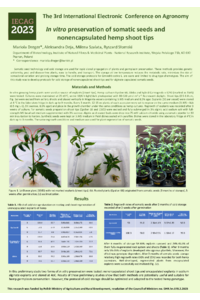
Somatic seed technology and cold storage are used for rapid clonal propagation of plants and germplasm preservation. These methods provides genetic uniformity, pest and disease-free plants, easy to handle, and transport. The storage at low temperature reduces the metabolic rate, minimizes the risk of somaclonal variation and prolong storage time. The cold storage protocols of somatic seeds for Cannabis sativa L. are scare and limited to drug type chemotypes. The aim of this study was to develop protocols for nonencapsulated shoot tips and for alginate-encapsulated somatic seeds of industrial hemp genotypes. Aseptic axillary shoot tips derived from in vitro grown plants were used as explants and storage up to 6 months at 4 °C in the dark. Somatic seeds were produced in 3% sodium alginate and Murashige and Skoog (MS) medium salts with addition of sucrose or mannitol. Synthetic seeds were stored at 4 °C in the dark up to 6 months. The effect of the bead composition, and the time of storage on plant regeneration was investigated. After 6 months of cold storage the highest regrowth 45% was recorded for the nonencapsulated explants. Recovery of somatic seeds was 90% under the same storage condition after 3 months. Well-developed, rooted plants regenerated from encapsulated, stored explants were successfully acclimatized.
Keywords
Cannabis sativa L.
synthetic seeds
cold storage
micropropagation
Manuscript
078963-layout.pdf
Poster
MD.pdf
Essential oil composition and glandular trichome structure of the weather prophet Dimorphoteca pluvialis
Can long photoperiods be utilized to integrate Cichorium spinosum L. into vertical farms?