Event submissions
Published

This submission belongs to the session S3. Building Materials, and Repair & Renovation of the event The 1st International Online Conference on Buildings
Published date
24 Oct, 2023
Academic Editor
'%3e%3cpath%20d='M12.6657%2010.9104C12.4185%2010.325%2012.0599%209.79327%2011.6097%209.34482C11.1609%208.89508%2010.6293%208.5365%2010.0442%208.28888C10.0389%208.28626%2010.0337%208.28495%2010.0285%208.28233C10.8446%207.69279%2011.3752%206.73249%2011.3752%205.64904C11.3752%203.8542%209.92103%202.39999%208.1262%202.39999C6.33136%202.39999%204.87715%203.8542%204.87715%205.64904C4.87715%206.73249%205.40774%207.69279%206.22393%208.28364C6.21869%208.28626%206.21345%208.28757%206.20821%208.29019C5.62129%208.5378%205.09463%208.89284%204.64265%209.34613C4.1929%209.79493%203.83432%2010.3266%203.58671%2010.9117C3.34345%2011.4845%203.21226%2012.0987%203.20023%2012.7209C3.19988%2012.7349%203.20233%2012.7488%203.20744%2012.7619C3.21255%2012.7749%203.22022%2012.7867%203.22998%2012.7968C3.23975%2012.8068%203.25142%2012.8147%203.26431%2012.8202C3.2772%2012.8256%203.29105%2012.8284%203.30504%2012.8284H4.09109C4.14874%2012.8284%204.19459%2012.7825%204.1959%2012.7262C4.2221%2011.7148%204.62823%2010.7676%205.34617%2010.0497C6.08899%209.30683%207.0755%208.89808%208.1262%208.89808C9.17689%208.89808%2010.1634%209.30683%2010.9062%2010.0497C11.6242%2010.7676%2012.0303%2011.7148%2012.0565%2012.7262C12.0578%2012.7838%2012.1037%2012.8284%2012.1613%2012.8284H12.9474C12.9613%2012.8284%2012.9752%2012.8256%2012.9881%2012.8202C13.001%2012.8147%2013.0126%2012.8068%2013.0224%2012.7968C13.0322%2012.7867%2013.0398%2012.7749%2013.0449%2012.7619C13.0501%2012.7488%2013.0525%2012.7349%2013.0522%2012.7209C13.0391%2012.0947%2012.9094%2011.4855%2012.6657%2010.9104ZM8.1262%207.9024C7.52486%207.9024%206.9589%207.6679%206.53312%207.24211C6.10733%206.81633%205.87283%206.25037%205.87283%205.64904C5.87283%205.0477%206.10733%204.48174%206.53312%204.05596C6.9589%203.63018%207.52486%203.39567%208.1262%203.39567C8.72753%203.39567%209.29349%203.63018%209.71927%204.05596C10.1451%204.48174%2010.3796%205.0477%2010.3796%205.64904C10.3796%206.25037%2010.1451%206.81633%209.71927%207.24211C9.29349%207.6679%208.72753%207.9024%208.1262%207.9024Z'%20fill='%235D1EE1'/%3e%3c/g%3e%3c/svg%3e) Antonio Formisano
Antonio FormisanoCitation
Beatriz Zapico Blanco, José Daniel Rodriguez Mariscal, Elena Zapata Rodriguez, José Antonio Romero Arroyo, Fernando Fernandez Ancio, Mario Solís Muñiz, Preserving The Great Mosque of Cordoba (Spain): A Preliminary Mechanical Characterization of its Original Natural Stone, in Proceedings of The 1st International Online Conference on Buildings, 24 October–26 October 2023, MDPI: Basel, Switzerland, doi: 10.3390/IOCBD2023-15180
Share
Email
Facebook
Twitter
LinkedIn
Preserving The Great Mosque of Cordoba (Spain): A Preliminary Mechanical Characterization of its Original Natural Stone
'%3e%3cpath%20d='M12.6647%2010.9104C12.4176%2010.325%2012.0589%209.7933%2011.6088%209.34485C11.16%208.89511%2010.6283%208.53653%2010.0432%208.28891C10.038%208.28629%2010.0327%208.28498%2010.0275%208.28236C10.8437%207.69282%2011.3743%206.73252%2011.3743%205.64907C11.3743%203.85423%209.92005%202.40002%208.12522%202.40002C6.33038%202.40002%204.87618%203.85423%204.87618%205.64907C4.87618%206.73252%205.40677%207.69282%206.22296%208.28367C6.21772%208.28629%206.21248%208.2876%206.20724%208.29022C5.62031%208.53783%205.09365%208.89287%204.64167%209.34616C4.19192%209.79496%203.83334%2010.3266%203.58573%2010.9117C3.34247%2011.4846%203.21128%2012.0987%203.19925%2012.721C3.1989%2012.735%203.20135%2012.7489%203.20646%2012.7619C3.21157%2012.7749%203.21924%2012.7868%203.22901%2012.7968C3.23877%2012.8068%203.25045%2012.8148%203.26334%2012.8202C3.27623%2012.8256%203.29007%2012.8284%203.30406%2012.8284H4.09012C4.14776%2012.8284%204.19362%2012.7825%204.19493%2012.7262C4.22113%2011.7148%204.62726%2010.7676%205.34519%2010.0497C6.08802%209.30686%207.07452%208.89811%208.12522%208.89811C9.17592%208.89811%2010.1624%209.30686%2010.9052%2010.0497C11.6232%2010.7676%2012.0293%2011.7148%2012.0555%2012.7262C12.0568%2012.7839%2012.1027%2012.8284%2012.1603%2012.8284H12.9464C12.9604%2012.8284%2012.9742%2012.8256%2012.9871%2012.8202C13%2012.8148%2013.0117%2012.8068%2013.0214%2012.7968C13.0312%2012.7868%2013.0389%2012.7749%2013.044%2012.7619C13.0491%2012.7489%2013.0515%2012.735%2013.0512%2012.721C13.0381%2012.0947%2012.9084%2011.4856%2012.6647%2010.9104ZM8.12522%207.90243C7.52388%207.90243%206.95792%207.66793%206.53214%207.24215C6.10636%206.81636%205.87185%206.2504%205.87185%205.64907C5.87185%205.04773%206.10636%204.48177%206.53214%204.05599C6.95792%203.63021%207.52388%203.3957%208.12522%203.3957C8.72655%203.3957%209.29252%203.63021%209.7183%204.05599C10.1441%204.48177%2010.3786%205.04773%2010.3786%205.64907C10.3786%206.2504%2010.1441%206.81636%209.7183%207.24215C9.29252%207.66793%208.72655%207.90243%208.12522%207.90243Z'%20fill='%235D1EE1'/%3e%3c/g%3e%3c/svg%3e)
Beatriz Zapico Blanco 1
José Daniel Rodriguez Mariscal 1
Elena Zapata Rodriguez 1
José Antonio Romero Arroyo 1
Fernando Fernandez Ancio 1
Mario Solís Muñiz 1
1. University of Seville
Abstract
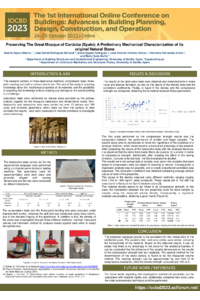
The Great Mosque of Cordoba in Spain stands as a testament to the rich cultural heritage of Western Andalusia. This research undertakes a mechanical analysis of the natural stone present in the mosque, aiming to comprehensively understand its mechanical properties and facilitate future assessments of its structural behaviour.
To achieve this goal, an experimental series of mechanical tests, including compression, indirect tensile, and bending evaluations, was executed. The mosque's biocalcarenite stone originates from various local quarries. For this study, stone samples were acquired from one of the surviving quarries, presently the primary material source for mosque restoration works. Ashlar blocks, sized 10x30x40 cm, were meticulously divided into over 100 cubic and prismatic specimens. Each individual specimen was meticulously gauged, weighed, and systematically labelled in accordance with its corresponding parent ashlar, dimensional attributes, and cutting orientation.
The diverse testing configurations conducted on these specimens enabled sensitivity analyses, accounting for stone anisotropy and sample dimensions. The results indicated that the outcomes were insensitive to specimen size within the utilized ranges and that loading directions had negligible effects, suggesting material isotropy for the investigated properties.
Further analysis was conducted on the campaign results to establish correlations between the stone's compressive strength (averaging 6 MPa) and its other mechanical attributes. The flexural strength was approximately 30% of the compressive strength, while tensile strength was roughly one-tenth of that. This unveils the possibility of enhancing mechanical characterization through non-destructive in situ methods, which conventionally offer insights into compressive properties but not flexural or tensile properties.
The campaign effectively provided an initial characterization of the stone, offering valuable input for shaping a second phase encompassing in situ testing and more advanced laboratory techniques to refine the outcomes.
Keywords
Mosque of Cordoba
Natural Stone
Compressive Strength
Tensile Strength
Anisotropy
Manuscript
engproc-sciforum_078315_original_Proceedings_Paper_DT_iocbd2023_sciforum_078315-done.pdf
Poster
POSTER DT.pdf
Composition of Engineered Cementitious Composite with Local Materials, Composite Properties and its Utilization for Structures in Developing Countries. †
Evaluation of the structural behavior of composite slim-floor beams with openings in the web