Event submissions
Published

This submission belongs to the session S3. Building Materials, and Repair & Renovation of the event The 1st International Online Conference on Buildings
Published date
24 Oct, 2023
Academic Editor
'%3e%3cpath%20d='M12.6657%2010.9104C12.4185%2010.325%2012.0599%209.79327%2011.6097%209.34482C11.1609%208.89508%2010.6293%208.5365%2010.0442%208.28888C10.0389%208.28626%2010.0337%208.28495%2010.0285%208.28233C10.8446%207.69279%2011.3752%206.73249%2011.3752%205.64904C11.3752%203.8542%209.92103%202.39999%208.1262%202.39999C6.33136%202.39999%204.87715%203.8542%204.87715%205.64904C4.87715%206.73249%205.40774%207.69279%206.22393%208.28364C6.21869%208.28626%206.21345%208.28757%206.20821%208.29019C5.62129%208.5378%205.09463%208.89284%204.64265%209.34613C4.1929%209.79493%203.83432%2010.3266%203.58671%2010.9117C3.34345%2011.4845%203.21226%2012.0987%203.20023%2012.7209C3.19988%2012.7349%203.20233%2012.7488%203.20744%2012.7619C3.21255%2012.7749%203.22022%2012.7867%203.22998%2012.7968C3.23975%2012.8068%203.25142%2012.8147%203.26431%2012.8202C3.2772%2012.8256%203.29105%2012.8284%203.30504%2012.8284H4.09109C4.14874%2012.8284%204.19459%2012.7825%204.1959%2012.7262C4.2221%2011.7148%204.62823%2010.7676%205.34617%2010.0497C6.08899%209.30683%207.0755%208.89808%208.1262%208.89808C9.17689%208.89808%2010.1634%209.30683%2010.9062%2010.0497C11.6242%2010.7676%2012.0303%2011.7148%2012.0565%2012.7262C12.0578%2012.7838%2012.1037%2012.8284%2012.1613%2012.8284H12.9474C12.9613%2012.8284%2012.9752%2012.8256%2012.9881%2012.8202C13.001%2012.8147%2013.0126%2012.8068%2013.0224%2012.7968C13.0322%2012.7867%2013.0398%2012.7749%2013.0449%2012.7619C13.0501%2012.7488%2013.0525%2012.7349%2013.0522%2012.7209C13.0391%2012.0947%2012.9094%2011.4855%2012.6657%2010.9104ZM8.1262%207.9024C7.52486%207.9024%206.9589%207.6679%206.53312%207.24211C6.10733%206.81633%205.87283%206.25037%205.87283%205.64904C5.87283%205.0477%206.10733%204.48174%206.53312%204.05596C6.9589%203.63018%207.52486%203.39567%208.1262%203.39567C8.72753%203.39567%209.29349%203.63018%209.71927%204.05596C10.1451%204.48174%2010.3796%205.0477%2010.3796%205.64904C10.3796%206.25037%2010.1451%206.81633%209.71927%207.24211C9.29349%207.6679%208.72753%207.9024%208.1262%207.9024Z'%20fill='%235D1EE1'/%3e%3c/g%3e%3c/svg%3e) Antonio Formisano
Antonio FormisanoCitation
Abraham Fernández Del Rey, Josué Aranda Ruiz, José Antonio Loya Lorenzo, Numerical calibration of constitutive models for construction materials against blast threat by means of ballistics tests, in Proceedings of The 1st International Online Conference on Buildings, 24 October–26 October 2023, MDPI: Basel, Switzerland, doi: 10.3390/IOCBD2023-15208
Share
Email
Facebook
Twitter
LinkedIn
Numerical calibration of constitutive models for construction materials against blast threat by means of ballistics tests
'%3e%3cpath%20d='M12.6647%2010.9104C12.4176%2010.325%2012.0589%209.7933%2011.6088%209.34485C11.16%208.89511%2010.6283%208.53653%2010.0432%208.28891C10.038%208.28629%2010.0327%208.28498%2010.0275%208.28236C10.8437%207.69282%2011.3743%206.73252%2011.3743%205.64907C11.3743%203.85423%209.92005%202.40002%208.12522%202.40002C6.33038%202.40002%204.87618%203.85423%204.87618%205.64907C4.87618%206.73252%205.40677%207.69282%206.22296%208.28367C6.21772%208.28629%206.21248%208.2876%206.20724%208.29022C5.62031%208.53783%205.09365%208.89287%204.64167%209.34616C4.19192%209.79496%203.83334%2010.3266%203.58573%2010.9117C3.34247%2011.4846%203.21128%2012.0987%203.19925%2012.721C3.1989%2012.735%203.20135%2012.7489%203.20646%2012.7619C3.21157%2012.7749%203.21924%2012.7868%203.22901%2012.7968C3.23877%2012.8068%203.25045%2012.8148%203.26334%2012.8202C3.27623%2012.8256%203.29007%2012.8284%203.30406%2012.8284H4.09012C4.14776%2012.8284%204.19362%2012.7825%204.19493%2012.7262C4.22113%2011.7148%204.62726%2010.7676%205.34519%2010.0497C6.08802%209.30686%207.07452%208.89811%208.12522%208.89811C9.17592%208.89811%2010.1624%209.30686%2010.9052%2010.0497C11.6232%2010.7676%2012.0293%2011.7148%2012.0555%2012.7262C12.0568%2012.7839%2012.1027%2012.8284%2012.1603%2012.8284H12.9464C12.9604%2012.8284%2012.9742%2012.8256%2012.9871%2012.8202C13%2012.8148%2013.0117%2012.8068%2013.0214%2012.7968C13.0312%2012.7868%2013.0389%2012.7749%2013.044%2012.7619C13.0491%2012.7489%2013.0515%2012.735%2013.0512%2012.721C13.0381%2012.0947%2012.9084%2011.4856%2012.6647%2010.9104ZM8.12522%207.90243C7.52388%207.90243%206.95792%207.66793%206.53214%207.24215C6.10636%206.81636%205.87185%206.2504%205.87185%205.64907C5.87185%205.04773%206.10636%204.48177%206.53214%204.05599C6.95792%203.63021%207.52388%203.3957%208.12522%203.3957C8.72655%203.3957%209.29252%203.63021%209.7183%204.05599C10.1441%204.48177%2010.3786%205.04773%2010.3786%205.64907C10.3786%206.2504%2010.1441%206.81636%209.7183%207.24215C9.29252%207.66793%208.72655%207.90243%208.12522%207.90243Z'%20fill='%235D1EE1'/%3e%3c/g%3e%3c/svg%3e)
Abraham Fernández Del Rey 1
Josué Aranda Ruiz 1

José Antonio Loya Lorenzo 1,2
1. Continuum Mechanics and Structures Department, Universidad Carlos III Madrid
2. Centro Universitario de la Guardia Civil
Abstract
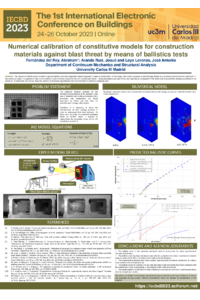
Safeguarding infrastructures from ballistic and blast fragment impacts requires a series of tests that are both expensive and time-consuming. Considering the magnitude of such events, this article aims to propose cost-effective assumptions that still hold their relevance in the face of moderate costs. In other words, the objective is to develop a methodology and set of criteria that strike a balance between accuracy and resource efficiency, enabling a practical yet reliable solution to protect infrastructures against potential ballistic and blast threats.
Recent advancements in numerical codes using the Finite Elements methodology have paved the way for more intricate models, yielding highly precise results. In this context, the authors present a practical approach that streamlines the determination of constitutive model parameters, which govern the behavior of key structural materials, such as clay or concrete.
To achieve this goal, the authors center around interpolating the parameters of the material under investigation. The interpolation process is based on ballistics tests conducted on the aforementioned relevant materials, and the results are then compared with existing data from the literature. By leveraging this methodology, a more efficient characterization of the target material can be attained.
The presented results comprise ballistics curves for materials, utilizing the interpolated parameters, which demonstrate their consistency with other well-established materials of similar nature. These ballistics curves serve as evidence indicating that the proposed methodology effectively captures and represents the behavior of the target material in line with well-known characteristics of similar materials.
In conclusion, for researchers whose primary focus is not centered on material characterization, this methodology offers a valuable opportunity to access reliable material properties. By adopting this approach, researchers can obtain accurate material parameters without being extensively engaged in the detailed characterization process. This empowers them to confidently incorporate material data into their studies and simulations, facilitating robust analyses.
Keywords
ballistic limit
Finite Elements
building materials modelling
Manuscript
engproc-sciforum_077883_original_Numerical_calibration_of_by_means_of_ballistics_review01-done.pdf
Poster
Numerical calibration of constitutive models for construction materials against blast threat by means of ballistics_F01.pdf
Early-Age Properties of Cement Paste Prepared Using Seawater
Design, Environment, Energy and Comfort in Buildings Equipped with a PMV-Controlled HVAC System