Event submissions
Published

This submission belongs to the session S4. Building Energy, Physics, Environment, and Systems of the event The 1st International Online Conference on Buildings
Published date
24 Oct, 2023
Academic Editor
'%3e%3cpath%20d='M12.6657%2010.9104C12.4185%2010.325%2012.0599%209.79327%2011.6097%209.34482C11.1609%208.89508%2010.6293%208.5365%2010.0442%208.28888C10.0389%208.28626%2010.0337%208.28495%2010.0285%208.28233C10.8446%207.69279%2011.3752%206.73249%2011.3752%205.64904C11.3752%203.8542%209.92103%202.39999%208.1262%202.39999C6.33136%202.39999%204.87715%203.8542%204.87715%205.64904C4.87715%206.73249%205.40774%207.69279%206.22393%208.28364C6.21869%208.28626%206.21345%208.28757%206.20821%208.29019C5.62129%208.5378%205.09463%208.89284%204.64265%209.34613C4.1929%209.79493%203.83432%2010.3266%203.58671%2010.9117C3.34345%2011.4845%203.21226%2012.0987%203.20023%2012.7209C3.19988%2012.7349%203.20233%2012.7488%203.20744%2012.7619C3.21255%2012.7749%203.22022%2012.7867%203.22998%2012.7968C3.23975%2012.8068%203.25142%2012.8147%203.26431%2012.8202C3.2772%2012.8256%203.29105%2012.8284%203.30504%2012.8284H4.09109C4.14874%2012.8284%204.19459%2012.7825%204.1959%2012.7262C4.2221%2011.7148%204.62823%2010.7676%205.34617%2010.0497C6.08899%209.30683%207.0755%208.89808%208.1262%208.89808C9.17689%208.89808%2010.1634%209.30683%2010.9062%2010.0497C11.6242%2010.7676%2012.0303%2011.7148%2012.0565%2012.7262C12.0578%2012.7838%2012.1037%2012.8284%2012.1613%2012.8284H12.9474C12.9613%2012.8284%2012.9752%2012.8256%2012.9881%2012.8202C13.001%2012.8147%2013.0126%2012.8068%2013.0224%2012.7968C13.0322%2012.7867%2013.0398%2012.7749%2013.0449%2012.7619C13.0501%2012.7488%2013.0525%2012.7349%2013.0522%2012.7209C13.0391%2012.0947%2012.9094%2011.4855%2012.6657%2010.9104ZM8.1262%207.9024C7.52486%207.9024%206.9589%207.6679%206.53312%207.24211C6.10733%206.81633%205.87283%206.25037%205.87283%205.64904C5.87283%205.0477%206.10733%204.48174%206.53312%204.05596C6.9589%203.63018%207.52486%203.39567%208.1262%203.39567C8.72753%203.39567%209.29349%203.63018%209.71927%204.05596C10.1451%204.48174%2010.3796%205.0477%2010.3796%205.64904C10.3796%206.25037%2010.1451%206.81633%209.71927%207.24211C9.29349%207.6679%208.72753%207.9024%208.1262%207.9024Z'%20fill='%235D1EE1'/%3e%3c/g%3e%3c/svg%3e) Alessandro Cannavale
Alessandro CannavaleCitation
Hilmy Allamsyah, Salsabella Tazkia, Luthfiyati Halimatussya'diyah, Beta Paramita, Natural Lighting Evaluation of MAN Cimahi Using Sefaira, in Proceedings of The 1st International Online Conference on Buildings, 24 October–26 October 2023, MDPI: Basel, Switzerland, doi: 10.3390/IOCBD2023-15211
Share
Email
Facebook
Twitter
LinkedIn
Natural Lighting Evaluation of MAN Cimahi Using Sefaira
'%3e%3cpath%20d='M12.6647%2010.9104C12.4176%2010.325%2012.0589%209.7933%2011.6088%209.34485C11.16%208.89511%2010.6283%208.53653%2010.0432%208.28891C10.038%208.28629%2010.0327%208.28498%2010.0275%208.28236C10.8437%207.69282%2011.3743%206.73252%2011.3743%205.64907C11.3743%203.85423%209.92005%202.40002%208.12522%202.40002C6.33038%202.40002%204.87618%203.85423%204.87618%205.64907C4.87618%206.73252%205.40677%207.69282%206.22296%208.28367C6.21772%208.28629%206.21248%208.2876%206.20724%208.29022C5.62031%208.53783%205.09365%208.89287%204.64167%209.34616C4.19192%209.79496%203.83334%2010.3266%203.58573%2010.9117C3.34247%2011.4846%203.21128%2012.0987%203.19925%2012.721C3.1989%2012.735%203.20135%2012.7489%203.20646%2012.7619C3.21157%2012.7749%203.21924%2012.7868%203.22901%2012.7968C3.23877%2012.8068%203.25045%2012.8148%203.26334%2012.8202C3.27623%2012.8256%203.29007%2012.8284%203.30406%2012.8284H4.09012C4.14776%2012.8284%204.19362%2012.7825%204.19493%2012.7262C4.22113%2011.7148%204.62726%2010.7676%205.34519%2010.0497C6.08802%209.30686%207.07452%208.89811%208.12522%208.89811C9.17592%208.89811%2010.1624%209.30686%2010.9052%2010.0497C11.6232%2010.7676%2012.0293%2011.7148%2012.0555%2012.7262C12.0568%2012.7839%2012.1027%2012.8284%2012.1603%2012.8284H12.9464C12.9604%2012.8284%2012.9742%2012.8256%2012.9871%2012.8202C13%2012.8148%2013.0117%2012.8068%2013.0214%2012.7968C13.0312%2012.7868%2013.0389%2012.7749%2013.044%2012.7619C13.0491%2012.7489%2013.0515%2012.735%2013.0512%2012.721C13.0381%2012.0947%2012.9084%2011.4856%2012.6647%2010.9104ZM8.12522%207.90243C7.52388%207.90243%206.95792%207.66793%206.53214%207.24215C6.10636%206.81636%205.87185%206.2504%205.87185%205.64907C5.87185%205.04773%206.10636%204.48177%206.53214%204.05599C6.95792%203.63021%207.52388%203.3957%208.12522%203.3957C8.72655%203.3957%209.29252%203.63021%209.7183%204.05599C10.1441%204.48177%2010.3786%205.04773%2010.3786%205.64907C10.3786%206.2504%2010.1441%206.81636%209.7183%207.24215C9.29252%207.66793%208.72655%207.90243%208.12522%207.90243Z'%20fill='%235D1EE1'/%3e%3c/g%3e%3c/svg%3e)
Hilmy Allamsyah 1
Salsabella Tazkia 1
Luthfiyati Halimatussya'diyah 1

Beta Paramita 1
1. Universitas Pendidikan Indonesia
Abstract
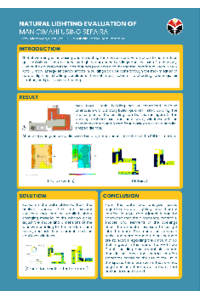
Research conducted by Energy Efficiency and Conservation Clearing House Indonesia (EECCHI) in 2012 showed that the building sector contributes 40% of carbon emissions to the atmosphere. Several studies show that designing high-performance buildings contributes to reducing carbon emissions and preventing global warming. Other studies posit that good educational building design can contribute to a maximum learning atmosphere. This study discusses the evaluation of natural lighting in educational buildings, namely the Cimahi City MAN building. The research was conducted using field survey methods by measuring the volume and recording the use of materials in buildings. After the visit, depictions and simulations were carried out on the building using Sefaira to determine the distribution of natural lighting in the building. Then, simulations were carried out on design changes that contributed to natural lighting in the building. The simulation results show that natural lighting in the Cimahi City MAN building has not met the educational building lumination standard of 250–300 lx (SNI, 2000). This article concludes that the addition of dimensions to the roof overhang, the area of openings, additional elements of the façade, and shading strategies are factors that affect natural lighting in MAN Kota Cimahi buildings. Thus, changes to these architectural elements are expected to maximize thermal comfort, which affects student performance. In conclusion, the design change improves the energy efficiency such that the buildings conform to Indonesian National Standards.
Keywords
Natural Lighting
Thermal Comfort
Sefaira
Educational Building
Manuscript
engproc-sciforum_078176_original_Sciforum_078176_Doc-done.pdf
Poster
Sciforum-078176_Poster.pdf
Learning from Past Researches for Green Future: Harnessing Organic & Genetically Enhanced Trees to Reduce Construction-Induced CO2 Emissions
Analysis of Suitable Roof Designs for PV Panel: Case Study of Housing Roof in Gorontalo