Event submissions
Published

This submission belongs to the session S3. Food Sensory and Consumer Choices of the event The 4th International Electronic Conference on Foods
Published date
24 Oct, 2023
Academic Editor
'%3e%3cpath%20d='M12.6657%2010.9104C12.4185%2010.325%2012.0599%209.79327%2011.6097%209.34482C11.1609%208.89508%2010.6293%208.5365%2010.0442%208.28888C10.0389%208.28626%2010.0337%208.28495%2010.0285%208.28233C10.8446%207.69279%2011.3752%206.73249%2011.3752%205.64904C11.3752%203.8542%209.92103%202.39999%208.1262%202.39999C6.33136%202.39999%204.87715%203.8542%204.87715%205.64904C4.87715%206.73249%205.40774%207.69279%206.22393%208.28364C6.21869%208.28626%206.21345%208.28757%206.20821%208.29019C5.62129%208.5378%205.09463%208.89284%204.64265%209.34613C4.1929%209.79493%203.83432%2010.3266%203.58671%2010.9117C3.34345%2011.4845%203.21226%2012.0987%203.20023%2012.7209C3.19988%2012.7349%203.20233%2012.7488%203.20744%2012.7619C3.21255%2012.7749%203.22022%2012.7867%203.22998%2012.7968C3.23975%2012.8068%203.25142%2012.8147%203.26431%2012.8202C3.2772%2012.8256%203.29105%2012.8284%203.30504%2012.8284H4.09109C4.14874%2012.8284%204.19459%2012.7825%204.1959%2012.7262C4.2221%2011.7148%204.62823%2010.7676%205.34617%2010.0497C6.08899%209.30683%207.0755%208.89808%208.1262%208.89808C9.17689%208.89808%2010.1634%209.30683%2010.9062%2010.0497C11.6242%2010.7676%2012.0303%2011.7148%2012.0565%2012.7262C12.0578%2012.7838%2012.1037%2012.8284%2012.1613%2012.8284H12.9474C12.9613%2012.8284%2012.9752%2012.8256%2012.9881%2012.8202C13.001%2012.8147%2013.0126%2012.8068%2013.0224%2012.7968C13.0322%2012.7867%2013.0398%2012.7749%2013.0449%2012.7619C13.0501%2012.7488%2013.0525%2012.7349%2013.0522%2012.7209C13.0391%2012.0947%2012.9094%2011.4855%2012.6657%2010.9104ZM8.1262%207.9024C7.52486%207.9024%206.9589%207.6679%206.53312%207.24211C6.10733%206.81633%205.87283%206.25037%205.87283%205.64904C5.87283%205.0477%206.10733%204.48174%206.53312%204.05596C6.9589%203.63018%207.52486%203.39567%208.1262%203.39567C8.72753%203.39567%209.29349%203.63018%209.71927%204.05596C10.1451%204.48174%2010.3796%205.0477%2010.3796%205.64904C10.3796%206.25037%2010.1451%206.81633%209.71927%207.24211C9.29349%207.6679%208.72753%207.9024%208.1262%207.9024Z'%20fill='%235D1EE1'/%3e%3c/g%3e%3c/svg%3e) Koushik Adhikari
Koushik AdhikariCitation
Karen Florencia Irigoytia, Maria Belen Parodi, Nancy Noemí Espósito, Marina de Escalada Pla, Carolina Elizabeth Genevois, Sensory profile of gluten-free breads based on alternative commercial flours, in Proceedings of The 4th International Electronic Conference on Foods, 15 October–30 October 2023, MDPI: Basel, Switzerland, doi: 10.3390/Foods2023-15217
Share
Email
Facebook
Twitter
LinkedIn
Sensory profile of gluten-free breads based on alternative commercial flours
'%3e%3cpath%20d='M12.6647%2010.9104C12.4176%2010.325%2012.0589%209.7933%2011.6088%209.34485C11.16%208.89511%2010.6283%208.53653%2010.0432%208.28891C10.038%208.28629%2010.0327%208.28498%2010.0275%208.28236C10.8437%207.69282%2011.3743%206.73252%2011.3743%205.64907C11.3743%203.85423%209.92005%202.40002%208.12522%202.40002C6.33038%202.40002%204.87618%203.85423%204.87618%205.64907C4.87618%206.73252%205.40677%207.69282%206.22296%208.28367C6.21772%208.28629%206.21248%208.2876%206.20724%208.29022C5.62031%208.53783%205.09365%208.89287%204.64167%209.34616C4.19192%209.79496%203.83334%2010.3266%203.58573%2010.9117C3.34247%2011.4846%203.21128%2012.0987%203.19925%2012.721C3.1989%2012.735%203.20135%2012.7489%203.20646%2012.7619C3.21157%2012.7749%203.21924%2012.7868%203.22901%2012.7968C3.23877%2012.8068%203.25045%2012.8148%203.26334%2012.8202C3.27623%2012.8256%203.29007%2012.8284%203.30406%2012.8284H4.09012C4.14776%2012.8284%204.19362%2012.7825%204.19493%2012.7262C4.22113%2011.7148%204.62726%2010.7676%205.34519%2010.0497C6.08802%209.30686%207.07452%208.89811%208.12522%208.89811C9.17592%208.89811%2010.1624%209.30686%2010.9052%2010.0497C11.6232%2010.7676%2012.0293%2011.7148%2012.0555%2012.7262C12.0568%2012.7839%2012.1027%2012.8284%2012.1603%2012.8284H12.9464C12.9604%2012.8284%2012.9742%2012.8256%2012.9871%2012.8202C13%2012.8148%2013.0117%2012.8068%2013.0214%2012.7968C13.0312%2012.7868%2013.0389%2012.7749%2013.044%2012.7619C13.0491%2012.7489%2013.0515%2012.735%2013.0512%2012.721C13.0381%2012.0947%2012.9084%2011.4856%2012.6647%2010.9104ZM8.12522%207.90243C7.52388%207.90243%206.95792%207.66793%206.53214%207.24215C6.10636%206.81636%205.87185%206.2504%205.87185%205.64907C5.87185%205.04773%206.10636%204.48177%206.53214%204.05599C6.95792%203.63021%207.52388%203.3957%208.12522%203.3957C8.72655%203.3957%209.29252%203.63021%209.7183%204.05599C10.1441%204.48177%2010.3786%205.04773%2010.3786%205.64907C10.3786%206.2504%2010.1441%206.81636%209.7183%207.24215C9.29252%207.66793%208.72655%207.90243%208.12522%207.90243Z'%20fill='%235D1EE1'/%3e%3c/g%3e%3c/svg%3e)
Karen Florencia Irigoytia 1,2
Maria Belen Parodi 3
Nancy Noemí Espósito 1,2
Marina de Escalada Pla 2,4
Carolina Elizabeth Genevois 1,2
1. Institute of Food Science and Technology of Entre Ríos (ICTAER-UNER-CONICET), Gualeguaychú, Entre Ríos, Argentina.
2. National Research Council of Argentina (CONICET)
3. Faculty of Bromatology, National University of Entre Ríos (UNER), Gualeguaychú, Entre Ríos, Argentina
4. Institute of Food Technology and Chemical Processes (ITAPROQ-UBA), Buenos Aires, Argentina.
Abstract
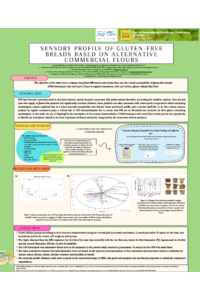
Gluten-free breads (GFB) are based mainly on refined flours, being characterised by a poor nutritional profile. The use of alternative flours, rich in protein and dietary fibre in the design of GFB could improve either technological or nutritional properties. The objective of the study was to evaluate the global differences/similarities, and the overall acceptability of GFB formulated with alternative flours in regular consumers and with gluten-related disorders. A projective mapping and hedonic test were used to describe the sensory profile and to assess the liking of products in untrained panellists (N=34). GFB were formulated using a traditional recipe, where 20% of refined flours were replaced by: brown rice, rice bran, lupin, millet, carob, quinoa, sorghum, teff or buckwheat. The hydration level and fermentation time were previously optimised to maximise the GFB specific volume. The relationship between products and descriptors was analysed by a multiple factor analysis (MFA) using XLSTAT software. The results showed four different groups of GFB based on (1) carob which was described as acid, (2) millet as white crumb, (3) rice bran, sorghum, lupin and buckwheat as crumbly and smelly, and (4) teff, quinoa and brown rice as sweet, springy and crispy. GFB received a punctuation of 5.9-7.3 in a 9-point scale, being the GFB based on carob flour the less accepted (2.9±2.5). These flours could contribute to enhancing the nutritional profile and could be a useful tool for the food industry. GFB formulations should be optimised for improving the consumer acceptability according to the flour selected.
Keywords
Gluten-free bread
alternative flours
sensory profile
consumers.
Manuscript
sciforum-078054.pdf
Poster
Conference Irigoytia.pdf
INSTRUMENTAL EVALUATION OF SELECTED PROPERTIES OF OIL EXTRACTED FROM WALNUTS BEFORE AND AFTER THE ROASTING PROCESS
Evaluation of DNA extraction methods for PCR analysis of maize and sunflower oils