Event submissions
Published

This submission belongs to the session F. Energy, Environmental and Earth Science of the event The 4th International Electronic Conference on Applied Sciences
Published date
26 Oct, 2023
Academic Editor
'%3e%3cpath%20d='M12.6657%2010.9104C12.4185%2010.325%2012.0599%209.79327%2011.6097%209.34482C11.1609%208.89508%2010.6293%208.5365%2010.0442%208.28888C10.0389%208.28626%2010.0337%208.28495%2010.0285%208.28233C10.8446%207.69279%2011.3752%206.73249%2011.3752%205.64904C11.3752%203.8542%209.92103%202.39999%208.1262%202.39999C6.33136%202.39999%204.87715%203.8542%204.87715%205.64904C4.87715%206.73249%205.40774%207.69279%206.22393%208.28364C6.21869%208.28626%206.21345%208.28757%206.20821%208.29019C5.62129%208.5378%205.09463%208.89284%204.64265%209.34613C4.1929%209.79493%203.83432%2010.3266%203.58671%2010.9117C3.34345%2011.4845%203.21226%2012.0987%203.20023%2012.7209C3.19988%2012.7349%203.20233%2012.7488%203.20744%2012.7619C3.21255%2012.7749%203.22022%2012.7867%203.22998%2012.7968C3.23975%2012.8068%203.25142%2012.8147%203.26431%2012.8202C3.2772%2012.8256%203.29105%2012.8284%203.30504%2012.8284H4.09109C4.14874%2012.8284%204.19459%2012.7825%204.1959%2012.7262C4.2221%2011.7148%204.62823%2010.7676%205.34617%2010.0497C6.08899%209.30683%207.0755%208.89808%208.1262%208.89808C9.17689%208.89808%2010.1634%209.30683%2010.9062%2010.0497C11.6242%2010.7676%2012.0303%2011.7148%2012.0565%2012.7262C12.0578%2012.7838%2012.1037%2012.8284%2012.1613%2012.8284H12.9474C12.9613%2012.8284%2012.9752%2012.8256%2012.9881%2012.8202C13.001%2012.8147%2013.0126%2012.8068%2013.0224%2012.7968C13.0322%2012.7867%2013.0398%2012.7749%2013.0449%2012.7619C13.0501%2012.7488%2013.0525%2012.7349%2013.0522%2012.7209C13.0391%2012.0947%2012.9094%2011.4855%2012.6657%2010.9104ZM8.1262%207.9024C7.52486%207.9024%206.9589%207.6679%206.53312%207.24211C6.10733%206.81633%205.87283%206.25037%205.87283%205.64904C5.87283%205.0477%206.10733%204.48174%206.53312%204.05596C6.9589%203.63018%207.52486%203.39567%208.1262%203.39567C8.72753%203.39567%209.29349%203.63018%209.71927%204.05596C10.1451%204.48174%2010.3796%205.0477%2010.3796%205.64904C10.3796%206.25037%2010.1451%206.81633%209.71927%207.24211C9.29349%207.6679%208.72753%207.9024%208.1262%207.9024Z'%20fill='%235D1EE1'/%3e%3c/g%3e%3c/svg%3e) Simeone Chianese
Simeone ChianeseCitation
Fayiz Amin, Yasir zaman, Shiraz Ahmed, FEM Modelling for Optimal Tack Coat Layer Insertion to Increase Fatigue Strength of Asphalt Pavements, in Proceedings of The 4th International Electronic Conference on Applied Sciences, 27 October–10 November 2023, MDPI: Basel, Switzerland, doi: 10.3390/ASEC2023-15351
Share
Email
Facebook
Twitter
LinkedIn
FEM Modelling for Optimal Tack Coat Layer Insertion to Increase Fatigue Strength of Asphalt Pavements

Fayiz Amin 1

Yasir zaman 2
'%3e%3cpath%20d='M12.6647%2010.9104C12.4176%2010.325%2012.0589%209.7933%2011.6088%209.34485C11.16%208.89511%2010.6283%208.53653%2010.0432%208.28891C10.038%208.28629%2010.0327%208.28498%2010.0275%208.28236C10.8437%207.69282%2011.3743%206.73252%2011.3743%205.64907C11.3743%203.85423%209.92005%202.40002%208.12522%202.40002C6.33038%202.40002%204.87618%203.85423%204.87618%205.64907C4.87618%206.73252%205.40677%207.69282%206.22296%208.28367C6.21772%208.28629%206.21248%208.2876%206.20724%208.29022C5.62031%208.53783%205.09365%208.89287%204.64167%209.34616C4.19192%209.79496%203.83334%2010.3266%203.58573%2010.9117C3.34247%2011.4846%203.21128%2012.0987%203.19925%2012.721C3.1989%2012.735%203.20135%2012.7489%203.20646%2012.7619C3.21157%2012.7749%203.21924%2012.7868%203.22901%2012.7968C3.23877%2012.8068%203.25045%2012.8148%203.26334%2012.8202C3.27623%2012.8256%203.29007%2012.8284%203.30406%2012.8284H4.09012C4.14776%2012.8284%204.19362%2012.7825%204.19493%2012.7262C4.22113%2011.7148%204.62726%2010.7676%205.34519%2010.0497C6.08802%209.30686%207.07452%208.89811%208.12522%208.89811C9.17592%208.89811%2010.1624%209.30686%2010.9052%2010.0497C11.6232%2010.7676%2012.0293%2011.7148%2012.0555%2012.7262C12.0568%2012.7839%2012.1027%2012.8284%2012.1603%2012.8284H12.9464C12.9604%2012.8284%2012.9742%2012.8256%2012.9871%2012.8202C13%2012.8148%2013.0117%2012.8068%2013.0214%2012.7968C13.0312%2012.7868%2013.0389%2012.7749%2013.044%2012.7619C13.0491%2012.7489%2013.0515%2012.735%2013.0512%2012.721C13.0381%2012.0947%2012.9084%2011.4856%2012.6647%2010.9104ZM8.12522%207.90243C7.52388%207.90243%206.95792%207.66793%206.53214%207.24215C6.10636%206.81636%205.87185%206.2504%205.87185%205.64907C5.87185%205.04773%206.10636%204.48177%206.53214%204.05599C6.95792%203.63021%207.52388%203.3957%208.12522%203.3957C8.72655%203.3957%209.29252%203.63021%209.7183%204.05599C10.1441%204.48177%2010.3786%205.04773%2010.3786%205.64907C10.3786%206.2504%2010.1441%206.81636%209.7183%207.24215C9.29252%207.66793%208.72655%207.90243%208.12522%207.90243Z'%20fill='%235D1EE1'/%3e%3c/g%3e%3c/svg%3e)
Shiraz Ahmed 3
1. Department of Civil Engineering, GIK Institute, Topi 23640, KP, Pakistan; fayizamin092@gmail.com (F.A.)
2. Faculty of Mechanical Engineering, GIK Institute, Topi 23640, KP, Pakistan; iamyasirzaman@gmail.com (Y.Z.);
3. Department of Civil Engineering, GIK Institute, Topi 23640, KP, Pakistan
Abstract
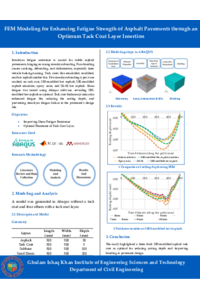
A key factor in ensuring the stability and ductility of asphalt pavements is interlayer fatigue resistance. interlayer bonding characteristic is one of important factors that impacts the asphalt pavements service life. Poor bonding properties frequently result in de-bonding, slippage cracking, and pavement deformation. Interlayer slippage cracking commonly develops from a lack of interface bonding between an asphalt overlay and underlayer, which is typically due to the braking and turning of the vehicle. Emulsified asphalt, modified asphalt, and hot asphalt are just a few of the compounds that are utilized as tack coatings to fix the problem. In this paper, five distinct bonding types between interlayers are examined—a model with no tack coat, with SBS-modified hot asphalt, with SBS-modified asphalt emulsion, with an epoxy resin binder and with SK-90 hot asphalt. This study evaluates cyclic load, tension damage under the asphalt pavement, and shear fatigue at various load cycles to examine the shear fatigue. A model is created using the Abaqus software to anticipate fatigue life while taking into account the various tack coat materials listed above, and from there, the best bonding type for asphalt pavement is selected. After choosing the material, various take-coat thicknesses were used until the optimum size was decided upon for pavement design. The suggested model can withstand more cycles of the load, sustain less tension damage, and respond well to cyclic loading to prevent interlayer fatigue failure over the course of a pavement's design life.
Keywords
Fem modeling of Asphalt Pavements
FEM
Finite Element modeling
Asphalt Pavements
Fatigue Strength of Asphalt Pavements
Take Coat
Manuscript
sciforum-075475.pdf
Poster
Poster.pdf
Some microbiological characteristics of the biofilm on the surface of pre-production pellets of polypropylene microplastics after short exposure in the soil
Modeling and simulation of chemical absorption methods for CO2 separation from cement plant flue gases