Event submissions
Published
This submission belongs to the session J. Poster Session of the event The 4th International Electronic Conference on Applied Sciences
Published date
27 Oct, 2023
Academic Editor
'%3e%3cpath%20d='M12.6657%2010.9104C12.4185%2010.325%2012.0599%209.79327%2011.6097%209.34482C11.1609%208.89508%2010.6293%208.5365%2010.0442%208.28888C10.0389%208.28626%2010.0337%208.28495%2010.0285%208.28233C10.8446%207.69279%2011.3752%206.73249%2011.3752%205.64904C11.3752%203.8542%209.92103%202.39999%208.1262%202.39999C6.33136%202.39999%204.87715%203.8542%204.87715%205.64904C4.87715%206.73249%205.40774%207.69279%206.22393%208.28364C6.21869%208.28626%206.21345%208.28757%206.20821%208.29019C5.62129%208.5378%205.09463%208.89284%204.64265%209.34613C4.1929%209.79493%203.83432%2010.3266%203.58671%2010.9117C3.34345%2011.4845%203.21226%2012.0987%203.20023%2012.7209C3.19988%2012.7349%203.20233%2012.7488%203.20744%2012.7619C3.21255%2012.7749%203.22022%2012.7867%203.22998%2012.7968C3.23975%2012.8068%203.25142%2012.8147%203.26431%2012.8202C3.2772%2012.8256%203.29105%2012.8284%203.30504%2012.8284H4.09109C4.14874%2012.8284%204.19459%2012.7825%204.1959%2012.7262C4.2221%2011.7148%204.62823%2010.7676%205.34617%2010.0497C6.08899%209.30683%207.0755%208.89808%208.1262%208.89808C9.17689%208.89808%2010.1634%209.30683%2010.9062%2010.0497C11.6242%2010.7676%2012.0303%2011.7148%2012.0565%2012.7262C12.0578%2012.7838%2012.1037%2012.8284%2012.1613%2012.8284H12.9474C12.9613%2012.8284%2012.9752%2012.8256%2012.9881%2012.8202C13.001%2012.8147%2013.0126%2012.8068%2013.0224%2012.7968C13.0322%2012.7867%2013.0398%2012.7749%2013.0449%2012.7619C13.0501%2012.7488%2013.0525%2012.7349%2013.0522%2012.7209C13.0391%2012.0947%2012.9094%2011.4855%2012.6657%2010.9104ZM8.1262%207.9024C7.52486%207.9024%206.9589%207.6679%206.53312%207.24211C6.10733%206.81633%205.87283%206.25037%205.87283%205.64904C5.87283%205.0477%206.10733%204.48174%206.53312%204.05596C6.9589%203.63018%207.52486%203.39567%208.1262%203.39567C8.72753%203.39567%209.29349%203.63018%209.71927%204.05596C10.1451%204.48174%2010.3796%205.0477%2010.3796%205.64904C10.3796%206.25037%2010.1451%206.81633%209.71927%207.24211C9.29349%207.6679%208.72753%207.9024%208.1262%207.9024Z'%20fill='%235D1EE1'/%3e%3c/g%3e%3c/svg%3e) Cosimo Trono
Cosimo TronoCitation
Jana Pisk, Josipa Sarjanović, Edi Topić, Mirta Rubčić, Luka Pavić, Catalytic potential and electrical properties of molybdenum and vanadium coordination complexes derived from acetic acid hydrazide, in Proceedings of The 4th International Electronic Conference on Applied Sciences, 27 October–10 November 2023, MDPI: Basel, Switzerland
Share
Email
Facebook
Twitter
LinkedIn
Catalytic potential and electrical properties of molybdenum and vanadium coordination complexes derived from acetic acid hydrazide

Jana Pisk 1
'%3e%3cpath%20d='M12.6647%2010.9104C12.4176%2010.325%2012.0589%209.7933%2011.6088%209.34485C11.16%208.89511%2010.6283%208.53653%2010.0432%208.28891C10.038%208.28629%2010.0327%208.28498%2010.0275%208.28236C10.8437%207.69282%2011.3743%206.73252%2011.3743%205.64907C11.3743%203.85423%209.92005%202.40002%208.12522%202.40002C6.33038%202.40002%204.87618%203.85423%204.87618%205.64907C4.87618%206.73252%205.40677%207.69282%206.22296%208.28367C6.21772%208.28629%206.21248%208.2876%206.20724%208.29022C5.62031%208.53783%205.09365%208.89287%204.64167%209.34616C4.19192%209.79496%203.83334%2010.3266%203.58573%2010.9117C3.34247%2011.4846%203.21128%2012.0987%203.19925%2012.721C3.1989%2012.735%203.20135%2012.7489%203.20646%2012.7619C3.21157%2012.7749%203.21924%2012.7868%203.22901%2012.7968C3.23877%2012.8068%203.25045%2012.8148%203.26334%2012.8202C3.27623%2012.8256%203.29007%2012.8284%203.30406%2012.8284H4.09012C4.14776%2012.8284%204.19362%2012.7825%204.19493%2012.7262C4.22113%2011.7148%204.62726%2010.7676%205.34519%2010.0497C6.08802%209.30686%207.07452%208.89811%208.12522%208.89811C9.17592%208.89811%2010.1624%209.30686%2010.9052%2010.0497C11.6232%2010.7676%2012.0293%2011.7148%2012.0555%2012.7262C12.0568%2012.7839%2012.1027%2012.8284%2012.1603%2012.8284H12.9464C12.9604%2012.8284%2012.9742%2012.8256%2012.9871%2012.8202C13%2012.8148%2013.0117%2012.8068%2013.0214%2012.7968C13.0312%2012.7868%2013.0389%2012.7749%2013.044%2012.7619C13.0491%2012.7489%2013.0515%2012.735%2013.0512%2012.721C13.0381%2012.0947%2012.9084%2011.4856%2012.6647%2010.9104ZM8.12522%207.90243C7.52388%207.90243%206.95792%207.66793%206.53214%207.24215C6.10636%206.81636%205.87185%206.2504%205.87185%205.64907C5.87185%205.04773%206.10636%204.48177%206.53214%204.05599C6.95792%203.63021%207.52388%203.3957%208.12522%203.3957C8.72655%203.3957%209.29252%203.63021%209.7183%204.05599C10.1441%204.48177%2010.3786%205.04773%2010.3786%205.64907C10.3786%206.2504%2010.1441%206.81636%209.7183%207.24215C9.29252%207.66793%208.72655%207.90243%208.12522%207.90243Z'%20fill='%235D1EE1'/%3e%3c/g%3e%3c/svg%3e)
Josipa Sarjanović 1
Edi Topić 1
Mirta Rubčić 1

Luka Pavić 2
1. Faculty of Science, Department of Chemistry, University of Zagreb, Horvatovac 102a, 10000 Zagreb, Croatia
2. Ruđer Bošković Institute, Bijenička cesta 54, 10000 Zagreb, Croatia
Abstract
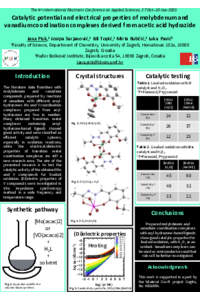
The literature data flourishes with molybdenum and vanadium compounds prepared by reactions of vanadium with different aroyl-hydrazones. Coordination complexes of molybdenum and vanadium, prepared from simple hydrazones, specifically acyl-hydrazones, are few in number. Having it in mind, the aim of this work was the preparation of molybdenum and vanadium complexes prepared by reactions with hydrazones, derivatives of acetic acid hydrazide, with general formula [MoO2(L)(D)] or [VO2(HL)], where D=solvent, L2-, HL-= deprotonated form of ligands. Furthermore, many obtained transition metal complexes containing aroyl-hydrazone-based ligands showed good activity and were classified as efficient catalytic systems, especially in oxidation reactions. The presented research considers oxidation of terpenes (limonene and linalool), which due to their diverse structures, represent an interesting source for diverse chemical transformations. Corresponding oxides and diols, as desired oxidation products, are value-added bio-renewable-based compounds, have versatile applications in many industries. On the other hand, electrical/dielectric properties of transition metal coordination complexes are still a new research area, being very limited to Cu/Zn systems. For that reason, the aim of the electrical characterization of the prepared vanadium complexes was to examine their (di)electric properties using the in situ method of impedance spectroscopy (IS) in a wide frequency and temperature range and to study how possible structural changes affect the electrical conductivity.
Keywords
molybdenum
vanadium
acyl-hydrazones
limonene oxidation
impedance spectroscopy
Manuscript
PISK_Abstract_Scif.pdf
Poster
PISK_POSTER.pdf
Characterizing the biological behavior of Fe3O4 nanoparticles conjugated with acridine orange using in vitro co-culture systems relevant to skin, lung and gut barrier models
Consumer Attitude Towards Food Additives – A Case Study