Event submissions
Published
This submission belongs to the session S7. Food Quality and Safety of the event The 4th International Electronic Conference on Foods
Published date
31 Oct, 2023
Academic Editor
'%3e%3cpath%20d='M12.6657%2010.9104C12.4185%2010.325%2012.0599%209.79327%2011.6097%209.34482C11.1609%208.89508%2010.6293%208.5365%2010.0442%208.28888C10.0389%208.28626%2010.0337%208.28495%2010.0285%208.28233C10.8446%207.69279%2011.3752%206.73249%2011.3752%205.64904C11.3752%203.8542%209.92103%202.39999%208.1262%202.39999C6.33136%202.39999%204.87715%203.8542%204.87715%205.64904C4.87715%206.73249%205.40774%207.69279%206.22393%208.28364C6.21869%208.28626%206.21345%208.28757%206.20821%208.29019C5.62129%208.5378%205.09463%208.89284%204.64265%209.34613C4.1929%209.79493%203.83432%2010.3266%203.58671%2010.9117C3.34345%2011.4845%203.21226%2012.0987%203.20023%2012.7209C3.19988%2012.7349%203.20233%2012.7488%203.20744%2012.7619C3.21255%2012.7749%203.22022%2012.7867%203.22998%2012.7968C3.23975%2012.8068%203.25142%2012.8147%203.26431%2012.8202C3.2772%2012.8256%203.29105%2012.8284%203.30504%2012.8284H4.09109C4.14874%2012.8284%204.19459%2012.7825%204.1959%2012.7262C4.2221%2011.7148%204.62823%2010.7676%205.34617%2010.0497C6.08899%209.30683%207.0755%208.89808%208.1262%208.89808C9.17689%208.89808%2010.1634%209.30683%2010.9062%2010.0497C11.6242%2010.7676%2012.0303%2011.7148%2012.0565%2012.7262C12.0578%2012.7838%2012.1037%2012.8284%2012.1613%2012.8284H12.9474C12.9613%2012.8284%2012.9752%2012.8256%2012.9881%2012.8202C13.001%2012.8147%2013.0126%2012.8068%2013.0224%2012.7968C13.0322%2012.7867%2013.0398%2012.7749%2013.0449%2012.7619C13.0501%2012.7488%2013.0525%2012.7349%2013.0522%2012.7209C13.0391%2012.0947%2012.9094%2011.4855%2012.6657%2010.9104ZM8.1262%207.9024C7.52486%207.9024%206.9589%207.6679%206.53312%207.24211C6.10733%206.81633%205.87283%206.25037%205.87283%205.64904C5.87283%205.0477%206.10733%204.48174%206.53312%204.05596C6.9589%203.63018%207.52486%203.39567%208.1262%203.39567C8.72753%203.39567%209.29349%203.63018%209.71927%204.05596C10.1451%204.48174%2010.3796%205.0477%2010.3796%205.64904C10.3796%206.25037%2010.1451%206.81633%209.71927%207.24211C9.29349%207.6679%208.72753%207.9024%208.1262%207.9024Z'%20fill='%235D1EE1'/%3e%3c/g%3e%3c/svg%3e) Manuel Viuda-Martos
Manuel Viuda-MartosCitation
Mala M Parab, Pooja Jain, Nirali Bhanushali, Pramodkumar P Gupta, Sheetal Sonawdekar, Function And Toxicity Study of Vegetable Preservatives, in Proceedings of The 4th International Electronic Conference on Foods, 15 October–30 October 2023, MDPI: Basel, Switzerland
Share
Email
Facebook
Twitter
LinkedIn
Function And Toxicity Study of Vegetable Preservatives

Mala M Parab 1
'%3e%3cpath%20d='M12.6647%2010.9104C12.4176%2010.325%2012.0589%209.7933%2011.6088%209.34485C11.16%208.89511%2010.6283%208.53653%2010.0432%208.28891C10.038%208.28629%2010.0327%208.28498%2010.0275%208.28236C10.8437%207.69282%2011.3743%206.73252%2011.3743%205.64907C11.3743%203.85423%209.92005%202.40002%208.12522%202.40002C6.33038%202.40002%204.87618%203.85423%204.87618%205.64907C4.87618%206.73252%205.40677%207.69282%206.22296%208.28367C6.21772%208.28629%206.21248%208.2876%206.20724%208.29022C5.62031%208.53783%205.09365%208.89287%204.64167%209.34616C4.19192%209.79496%203.83334%2010.3266%203.58573%2010.9117C3.34247%2011.4846%203.21128%2012.0987%203.19925%2012.721C3.1989%2012.735%203.20135%2012.7489%203.20646%2012.7619C3.21157%2012.7749%203.21924%2012.7868%203.22901%2012.7968C3.23877%2012.8068%203.25045%2012.8148%203.26334%2012.8202C3.27623%2012.8256%203.29007%2012.8284%203.30406%2012.8284H4.09012C4.14776%2012.8284%204.19362%2012.7825%204.19493%2012.7262C4.22113%2011.7148%204.62726%2010.7676%205.34519%2010.0497C6.08802%209.30686%207.07452%208.89811%208.12522%208.89811C9.17592%208.89811%2010.1624%209.30686%2010.9052%2010.0497C11.6232%2010.7676%2012.0293%2011.7148%2012.0555%2012.7262C12.0568%2012.7839%2012.1027%2012.8284%2012.1603%2012.8284H12.9464C12.9604%2012.8284%2012.9742%2012.8256%2012.9871%2012.8202C13%2012.8148%2013.0117%2012.8068%2013.0214%2012.7968C13.0312%2012.7868%2013.0389%2012.7749%2013.044%2012.7619C13.0491%2012.7489%2013.0515%2012.735%2013.0512%2012.721C13.0381%2012.0947%2012.9084%2011.4856%2012.6647%2010.9104ZM8.12522%207.90243C7.52388%207.90243%206.95792%207.66793%206.53214%207.24215C6.10636%206.81636%205.87185%206.2504%205.87185%205.64907C5.87185%205.04773%206.10636%204.48177%206.53214%204.05599C6.95792%203.63021%207.52388%203.3957%208.12522%203.3957C8.72655%203.3957%209.29252%203.63021%209.7183%204.05599C10.1441%204.48177%2010.3786%205.04773%2010.3786%205.64907C10.3786%206.2504%2010.1441%206.81636%209.7183%207.24215C9.29252%207.66793%208.72655%207.90243%208.12522%207.90243Z'%20fill='%235D1EE1'/%3e%3c/g%3e%3c/svg%3e)
Pooja Jain 1
Nirali Bhanushali 1

Pramodkumar P Gupta 1

Sheetal Sonawdekar 1
1. School of Biotechnology and Bioinformatics, D Y Patil Deemed to be University, Navi Mumbai, Maharashtra, India
Abstract
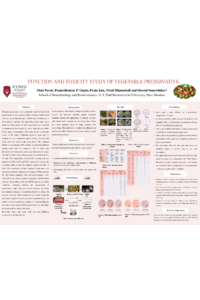
Chemical preservatives are remarkably used for fresh food preservation. The use of food preservatives has augmented enormously in modern food technology but they have adverse effects on human health. Food additives are in high demand to inhibit the contamination of fresh and raw vegetables. The aim of the present study was to probe the effectiveness of food preservatives on microbial contaminants in fresh vegetables and to study the toxic effect of the same on mammalian cells using in-vitro cytotoxicity assays. In this study, cauliflower, mushroom, potato, capsicum, and carrots were used for isolation of the contaminants against which citric acid and acetic acid were tested as the preservatives. The minimum inhibitory concentration (MIC) of these food additives was found for different isolates taken from the above-mentioned vegetables. Three main contaminants were isolated for the present study and two of them were identified to be Salmonella enterica and Enterobacter tabaci. The MIC of Citric acid on these isolates was found to be 1%, 1% and >15% respectively, and the MIC of acetic acid was found to be 0.6%, 0.6%, and 0.8% respectively whereas, the cumulative effect of both the additives showed the MIC of 0.6%. The cytotoxicity of these chemical preservatives was also guesstimated by employing two human cell lines that are INT 407 (human epithelial cells) and blood peripheral cells. The IC50 values were calculated employing GraphPad Prism software. The goodness of fit and ANOVA analysis revealed a significant correlation between the concentration of preservatives under study and cellular response. Moreover, non-significant changes in morphological patterns, cell growth patterns, and other cellular properties were scored among the cells under analysis. However, few cellular abnormalities at higher concentrations of acetic acid were recorded with INT 407. In this study, the preservation potential, as well as the anti-cancer potential of both citric acid and acetic acid, was analyzed using Human fibro-sarcoma cells. The IC50 values were estimated using GraphPad prism (V.7.0). It can be said that the present study thus endeavors to lay a preliminary platform for understanding the spectrum of applications of food preservatives and their effect on the gut cells through in-vitro mode.
Keywords
citric acid
acetic acid
minimum inhibitory concentration
in-vitro toxicity
Poster
MDPI poster FINAL 2.pdf
Comparative Cytotoxic Assessment of Hydro-methanolic Extracts Derived from Ripe Morinda citrifolia L. Fruit (Fresh, Dried, Pasteurized Juice) and Dried Seeds on Eukaryotic Normal and Carcinogenic Cellular Models
Characterization and quantification of phenolic compounds of honeys from Sierra Nevada (Granada)