Event submissions
Published
This submission belongs to the session S10. Poster Session. of the event 2nd International Online Conference on Agriculture
Published date
31 Oct, 2023
Academic Editor
'%3e%3cpath%20d='M12.6657%2010.9104C12.4185%2010.325%2012.0599%209.79327%2011.6097%209.34482C11.1609%208.89508%2010.6293%208.5365%2010.0442%208.28888C10.0389%208.28626%2010.0337%208.28495%2010.0285%208.28233C10.8446%207.69279%2011.3752%206.73249%2011.3752%205.64904C11.3752%203.8542%209.92103%202.39999%208.1262%202.39999C6.33136%202.39999%204.87715%203.8542%204.87715%205.64904C4.87715%206.73249%205.40774%207.69279%206.22393%208.28364C6.21869%208.28626%206.21345%208.28757%206.20821%208.29019C5.62129%208.5378%205.09463%208.89284%204.64265%209.34613C4.1929%209.79493%203.83432%2010.3266%203.58671%2010.9117C3.34345%2011.4845%203.21226%2012.0987%203.20023%2012.7209C3.19988%2012.7349%203.20233%2012.7488%203.20744%2012.7619C3.21255%2012.7749%203.22022%2012.7867%203.22998%2012.7968C3.23975%2012.8068%203.25142%2012.8147%203.26431%2012.8202C3.2772%2012.8256%203.29105%2012.8284%203.30504%2012.8284H4.09109C4.14874%2012.8284%204.19459%2012.7825%204.1959%2012.7262C4.2221%2011.7148%204.62823%2010.7676%205.34617%2010.0497C6.08899%209.30683%207.0755%208.89808%208.1262%208.89808C9.17689%208.89808%2010.1634%209.30683%2010.9062%2010.0497C11.6242%2010.7676%2012.0303%2011.7148%2012.0565%2012.7262C12.0578%2012.7838%2012.1037%2012.8284%2012.1613%2012.8284H12.9474C12.9613%2012.8284%2012.9752%2012.8256%2012.9881%2012.8202C13.001%2012.8147%2013.0126%2012.8068%2013.0224%2012.7968C13.0322%2012.7867%2013.0398%2012.7749%2013.0449%2012.7619C13.0501%2012.7488%2013.0525%2012.7349%2013.0522%2012.7209C13.0391%2012.0947%2012.9094%2011.4855%2012.6657%2010.9104ZM8.1262%207.9024C7.52486%207.9024%206.9589%207.6679%206.53312%207.24211C6.10733%206.81633%205.87283%206.25037%205.87283%205.64904C5.87283%205.0477%206.10733%204.48174%206.53312%204.05596C6.9589%203.63018%207.52486%203.39567%208.1262%203.39567C8.72753%203.39567%209.29349%203.63018%209.71927%204.05596C10.1451%204.48174%2010.3796%205.0477%2010.3796%205.64904C10.3796%206.25037%2010.1451%206.81633%209.71927%207.24211C9.29349%207.6679%208.72753%207.9024%208.1262%207.9024Z'%20fill='%235D1EE1'/%3e%3c/g%3e%3c/svg%3e) Maria Martínez Mena
Maria Martínez MenaCitation
Katarzyna Włodarczyk, Beata Smolińska, Variable impacts of two various nano-ZnO application techniques on selected growth parameters of tomato (Solanum lycopersicum L.), in Proceedings of 2nd International Online Conference on Agriculture, 1 November–15 November 2023, MDPI: Basel, Switzerland
Share
Email
Facebook
Twitter
LinkedIn
Variable impacts of two various nano-ZnO application techniques on selected growth parameters of tomato (Solanum lycopersicum L.)

Katarzyna Włodarczyk 1

Beata Smolińska 1
1. Institute of Natural Products and Cosmetics, Department of Biotechnology and Food Sciences, Technical University of Lodz
Abstract
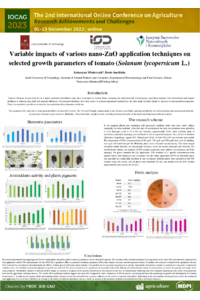
Tomato (Solanum lycopersicum L.) is a highly esteemed horticultural crop that is consumed in various forms, including raw and processed. Contemporary agriculture employs both conventional and organic fertilizers to enhance crop yield and optimize efficiency. Conventional fertilizers have been shown to enhance agricultural productivity, but their usage has been linked to negative environmental consequences. Those circumstances provide motivation for the exploration of an alternative resolution.
The purpose of this study was to investigate the effects of nano-ZnO (at conc. 50, 150 and 250 mg/L) administered in two distinct ways (foliar spraying and directly into the soil) along with conventional fertilizer on tomatoes. After cultivation, the plant tissues, including aboveground parts of the plants and fruits were analyzed in detail. The findings indicate that the utilization of nano-ZnO in tomato plants had an impact on the plant's biometric parameters and its antioxidant capacity. The outcomes of the performed analyses were dependent upon the concentrations of nano-ZnO utilized or the method of their administration. Further investigations revealed that the utilization of nano ZnO resulted in an elevation of malondialdehyde (MDA) levels and other chosen antioxidants’ activities in the aerial parts of the plant. On the other hand, the utilization of nano-ZnO resulted in a slight reduction in the levels of chlorophyll and carotenoid in the chosen plants, along with a decrease in the quantity and mass of the harvested fruits. However, a reduction in fruit weight aside, the application of nano-ZnO resulted in an elevation of lycopene and β-carotene levels in the fruit of chosen plants.
Keywords
nanoparticles
fertilization
tomatoes
nano-ZnO
foliar spraying
antioxidants
Manuscript
Poster - K.Wlodarczyk (1).pdf
Poster
Poster - K.Wlodarczyk.pdf
Machine learning for the prediction of high Andean crop yields in the Ancash Region – Peru
GELLAN GUM BASED HYDROGELS AS POTENTIAL SYSTEM FOR PLANT GROWTH