Event submissions
Published
 10.3390/ECMC2023-15589 (registering DOI)
 This submission belongs to the session S4. New Small molecules as drug candidates of the event 9th International Electronic Conference on Medicinal Chemistry
Published date
01 Nov, 2023
Academic Editor
'%3e%3cpath%20d='M12.6657%2010.9104C12.4185%2010.325%2012.0599%209.79327%2011.6097%209.34482C11.1609%208.89508%2010.6293%208.5365%2010.0442%208.28888C10.0389%208.28626%2010.0337%208.28495%2010.0285%208.28233C10.8446%207.69279%2011.3752%206.73249%2011.3752%205.64904C11.3752%203.8542%209.92103%202.39999%208.1262%202.39999C6.33136%202.39999%204.87715%203.8542%204.87715%205.64904C4.87715%206.73249%205.40774%207.69279%206.22393%208.28364C6.21869%208.28626%206.21345%208.28757%206.20821%208.29019C5.62129%208.5378%205.09463%208.89284%204.64265%209.34613C4.1929%209.79493%203.83432%2010.3266%203.58671%2010.9117C3.34345%2011.4845%203.21226%2012.0987%203.20023%2012.7209C3.19988%2012.7349%203.20233%2012.7488%203.20744%2012.7619C3.21255%2012.7749%203.22022%2012.7867%203.22998%2012.7968C3.23975%2012.8068%203.25142%2012.8147%203.26431%2012.8202C3.2772%2012.8256%203.29105%2012.8284%203.30504%2012.8284H4.09109C4.14874%2012.8284%204.19459%2012.7825%204.1959%2012.7262C4.2221%2011.7148%204.62823%2010.7676%205.34617%2010.0497C6.08899%209.30683%207.0755%208.89808%208.1262%208.89808C9.17689%208.89808%2010.1634%209.30683%2010.9062%2010.0497C11.6242%2010.7676%2012.0303%2011.7148%2012.0565%2012.7262C12.0578%2012.7838%2012.1037%2012.8284%2012.1613%2012.8284H12.9474C12.9613%2012.8284%2012.9752%2012.8256%2012.9881%2012.8202C13.001%2012.8147%2013.0126%2012.8068%2013.0224%2012.7968C13.0322%2012.7867%2013.0398%2012.7749%2013.0449%2012.7619C13.0501%2012.7488%2013.0525%2012.7349%2013.0522%2012.7209C13.0391%2012.0947%2012.9094%2011.4855%2012.6657%2010.9104ZM8.1262%207.9024C7.52486%207.9024%206.9589%207.6679%206.53312%207.24211C6.10733%206.81633%205.87283%206.25037%205.87283%205.64904C5.87283%205.0477%206.10733%204.48174%206.53312%204.05596C6.9589%203.63018%207.52486%203.39567%208.1262%203.39567C8.72753%203.39567%209.29349%203.63018%209.71927%204.05596C10.1451%204.48174%2010.3796%205.0477%2010.3796%205.64904C10.3796%206.25037%2010.1451%206.81633%209.71927%207.24211C9.29349%207.6679%208.72753%207.9024%208.1262%207.9024Z'%20fill='%235D1EE1'/%3e%3c/g%3e%3c/svg%3e) Alfredo Berzal-Herranz
Alfredo Berzal-HerranzCitation
Reinier Lemos, Luis Almagro, Marcos Muñoz-Arias, Alicia Diaz-García, Margarita Suárez, Synthesis and in silico evaluation of new 3,4-dihydro-2(1H)-pyridones as SARS-CoV-2 inhibitors., in Proceedings of 9th International Electronic Conference on Medicinal Chemistry, 1 November–30 November 2023, MDPI: Basel, Switzerland, doi: 10.3390/ECMC2023-15589
Share
Email
Facebook
Twitter
LinkedIn
Synthesis and in silico evaluation of new 3,4-dihydro-2(1H)-pyridones as SARS-CoV-2 inhibitors.
'%3e%3cpath%20d='M12.6647%2010.9104C12.4176%2010.325%2012.0589%209.7933%2011.6088%209.34485C11.16%208.89511%2010.6283%208.53653%2010.0432%208.28891C10.038%208.28629%2010.0327%208.28498%2010.0275%208.28236C10.8437%207.69282%2011.3743%206.73252%2011.3743%205.64907C11.3743%203.85423%209.92005%202.40002%208.12522%202.40002C6.33038%202.40002%204.87618%203.85423%204.87618%205.64907C4.87618%206.73252%205.40677%207.69282%206.22296%208.28367C6.21772%208.28629%206.21248%208.2876%206.20724%208.29022C5.62031%208.53783%205.09365%208.89287%204.64167%209.34616C4.19192%209.79496%203.83334%2010.3266%203.58573%2010.9117C3.34247%2011.4846%203.21128%2012.0987%203.19925%2012.721C3.1989%2012.735%203.20135%2012.7489%203.20646%2012.7619C3.21157%2012.7749%203.21924%2012.7868%203.22901%2012.7968C3.23877%2012.8068%203.25045%2012.8148%203.26334%2012.8202C3.27623%2012.8256%203.29007%2012.8284%203.30406%2012.8284H4.09012C4.14776%2012.8284%204.19362%2012.7825%204.19493%2012.7262C4.22113%2011.7148%204.62726%2010.7676%205.34519%2010.0497C6.08802%209.30686%207.07452%208.89811%208.12522%208.89811C9.17592%208.89811%2010.1624%209.30686%2010.9052%2010.0497C11.6232%2010.7676%2012.0293%2011.7148%2012.0555%2012.7262C12.0568%2012.7839%2012.1027%2012.8284%2012.1603%2012.8284H12.9464C12.9604%2012.8284%2012.9742%2012.8256%2012.9871%2012.8202C13%2012.8148%2013.0117%2012.8068%2013.0214%2012.7968C13.0312%2012.7868%2013.0389%2012.7749%2013.044%2012.7619C13.0491%2012.7489%2013.0515%2012.735%2013.0512%2012.721C13.0381%2012.0947%2012.9084%2011.4856%2012.6647%2010.9104ZM8.12522%207.90243C7.52388%207.90243%206.95792%207.66793%206.53214%207.24215C6.10636%206.81636%205.87185%206.2504%205.87185%205.64907C5.87185%205.04773%206.10636%204.48177%206.53214%204.05599C6.95792%203.63021%207.52388%203.3957%208.12522%203.3957C8.72655%203.3957%209.29252%203.63021%209.7183%204.05599C10.1441%204.48177%2010.3786%205.04773%2010.3786%205.64907C10.3786%206.2504%2010.1441%206.81636%209.7183%207.24215C9.29252%207.66793%208.72655%207.90243%208.12522%207.90243Z'%20fill='%235D1EE1'/%3e%3c/g%3e%3c/svg%3e)
Reinier Lemos 1
Luis Almagro 1
Marcos Muñoz-Arias 2
Alicia Diaz-García 2
Margarita Suárez 1
1. Laboratorio de Síntesis Orgánica, Facultad de Química, Universidad de la Habana, 10400 La Habana, Cuba
2. Departamento de Química Inorgánica, Facultad de Química, Universidad de la Habana, 10400 La Habana, Cuba
Abstract
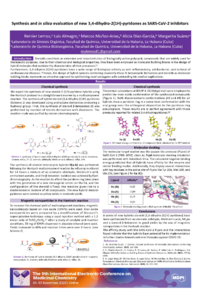
The structural and biological importance of steroids makes them ideal molecular building blocks for obtaining molecules of greater complexity and lipophilicity. Hence, its conjugation to other molecules of chemical or biological relevance is a current approach in the search for interesting biomedical and chemical applications. On the other hand, 3,4-dihydro-2(1H)-pyridones are compounds derived from 1,4-dihydropyridines, so they could be used for the treatment of cardiovascular diseases and as antivirals. The search for new compounds for the treatment of this type of disease continues to be of interest. In the present work, the synthesis of new compounds of the steroid-[3,4-dihydro-2(1H)-pyridone] type is reported, using a multicomponent methodology starting from steroidal β-ketoesters. Taking into account that magnetic nanoparticles can be used to activate functional groups such as carbonyls and carboxyls, these were used as heterogeneous catalysts to increase the synthesis yield by 10-25%. To determine the possible application of 3,4-dihydro-2(1H)-pyridones in medicinal chemistry as antivirals, a molecular anchoring study was carried out. The enzymes used were the protease (PLpro) and the 3-chymotrypsin-like protease (3CLpro) of SARS-Cov-2. These cysteine proteases play a crucial role in the virus life cycle. The study carried out shows that the affinity of the ligand-enzyme complexes obtained was negative in all clusters (-8 to -10 kcal/mol), which indicates that ligand-enzyme binding is favored. All conjugates form hydrogen bonds with proteases and hydrophobic interactions through the steroidal backbone. The functionalization with steroid moiety is a way to increase the biomolecular recognition areas and increase the strength of the union with the enzymatic receptors.
Keywords
steroids
pyridones
SARS-CoV-2 inhibitors
Manuscript
Reinier Lemos.pdf
Poster
Reinier Lemos.pdf
Design of nanostructured systems for detection of Alzheimer´s disease, an experimental and theoretical approach
Preformulation studies of polymeric hydrogels with insulin for pharmaceutical applications