Event submissions
Published
 10.3390/ECMC2023-15615 (registering DOI)
 This submission belongs to the session S3. General of the event 9th International Electronic Conference on Medicinal Chemistry
Published date
01 Nov, 2023
Academic Editor
'%3e%3cpath%20d='M12.6657%2010.9104C12.4185%2010.325%2012.0599%209.79327%2011.6097%209.34482C11.1609%208.89508%2010.6293%208.5365%2010.0442%208.28888C10.0389%208.28626%2010.0337%208.28495%2010.0285%208.28233C10.8446%207.69279%2011.3752%206.73249%2011.3752%205.64904C11.3752%203.8542%209.92103%202.39999%208.1262%202.39999C6.33136%202.39999%204.87715%203.8542%204.87715%205.64904C4.87715%206.73249%205.40774%207.69279%206.22393%208.28364C6.21869%208.28626%206.21345%208.28757%206.20821%208.29019C5.62129%208.5378%205.09463%208.89284%204.64265%209.34613C4.1929%209.79493%203.83432%2010.3266%203.58671%2010.9117C3.34345%2011.4845%203.21226%2012.0987%203.20023%2012.7209C3.19988%2012.7349%203.20233%2012.7488%203.20744%2012.7619C3.21255%2012.7749%203.22022%2012.7867%203.22998%2012.7968C3.23975%2012.8068%203.25142%2012.8147%203.26431%2012.8202C3.2772%2012.8256%203.29105%2012.8284%203.30504%2012.8284H4.09109C4.14874%2012.8284%204.19459%2012.7825%204.1959%2012.7262C4.2221%2011.7148%204.62823%2010.7676%205.34617%2010.0497C6.08899%209.30683%207.0755%208.89808%208.1262%208.89808C9.17689%208.89808%2010.1634%209.30683%2010.9062%2010.0497C11.6242%2010.7676%2012.0303%2011.7148%2012.0565%2012.7262C12.0578%2012.7838%2012.1037%2012.8284%2012.1613%2012.8284H12.9474C12.9613%2012.8284%2012.9752%2012.8256%2012.9881%2012.8202C13.001%2012.8147%2013.0126%2012.8068%2013.0224%2012.7968C13.0322%2012.7867%2013.0398%2012.7749%2013.0449%2012.7619C13.0501%2012.7488%2013.0525%2012.7349%2013.0522%2012.7209C13.0391%2012.0947%2012.9094%2011.4855%2012.6657%2010.9104ZM8.1262%207.9024C7.52486%207.9024%206.9589%207.6679%206.53312%207.24211C6.10733%206.81633%205.87283%206.25037%205.87283%205.64904C5.87283%205.0477%206.10733%204.48174%206.53312%204.05596C6.9589%203.63018%207.52486%203.39567%208.1262%203.39567C8.72753%203.39567%209.29349%203.63018%209.71927%204.05596C10.1451%204.48174%2010.3796%205.0477%2010.3796%205.64904C10.3796%206.25037%2010.1451%206.81633%209.71927%207.24211C9.29349%207.6679%208.72753%207.9024%208.1262%207.9024Z'%20fill='%235D1EE1'/%3e%3c/g%3e%3c/svg%3e) Alfredo Berzal-Herranz
Alfredo Berzal-HerranzCitation
Rosalía Ayala Gómez, María Cecilia Becerra, Graciela Pinto Vitorino, Antibiofilm Activity of Ciprofloxacin and Sulfadiazine Combination Against Escherichia coli Biofilms: A Scanning Electron Microscopy Analysis, in Proceedings of 9th International Electronic Conference on Medicinal Chemistry, 1 November–30 November 2023, MDPI: Basel, Switzerland, doi: 10.3390/ECMC2023-15615
Share
Email
Facebook
Twitter
LinkedIn
Antibiofilm Activity of Ciprofloxacin and Sulfadiazine Combination Against Escherichia coli Biofilms: A Scanning Electron Microscopy Analysis
'%3e%3cpath%20d='M12.6647%2010.9104C12.4176%2010.325%2012.0589%209.7933%2011.6088%209.34485C11.16%208.89511%2010.6283%208.53653%2010.0432%208.28891C10.038%208.28629%2010.0327%208.28498%2010.0275%208.28236C10.8437%207.69282%2011.3743%206.73252%2011.3743%205.64907C11.3743%203.85423%209.92005%202.40002%208.12522%202.40002C6.33038%202.40002%204.87618%203.85423%204.87618%205.64907C4.87618%206.73252%205.40677%207.69282%206.22296%208.28367C6.21772%208.28629%206.21248%208.2876%206.20724%208.29022C5.62031%208.53783%205.09365%208.89287%204.64167%209.34616C4.19192%209.79496%203.83334%2010.3266%203.58573%2010.9117C3.34247%2011.4846%203.21128%2012.0987%203.19925%2012.721C3.1989%2012.735%203.20135%2012.7489%203.20646%2012.7619C3.21157%2012.7749%203.21924%2012.7868%203.22901%2012.7968C3.23877%2012.8068%203.25045%2012.8148%203.26334%2012.8202C3.27623%2012.8256%203.29007%2012.8284%203.30406%2012.8284H4.09012C4.14776%2012.8284%204.19362%2012.7825%204.19493%2012.7262C4.22113%2011.7148%204.62726%2010.7676%205.34519%2010.0497C6.08802%209.30686%207.07452%208.89811%208.12522%208.89811C9.17592%208.89811%2010.1624%209.30686%2010.9052%2010.0497C11.6232%2010.7676%2012.0293%2011.7148%2012.0555%2012.7262C12.0568%2012.7839%2012.1027%2012.8284%2012.1603%2012.8284H12.9464C12.9604%2012.8284%2012.9742%2012.8256%2012.9871%2012.8202C13%2012.8148%2013.0117%2012.8068%2013.0214%2012.7968C13.0312%2012.7868%2013.0389%2012.7749%2013.044%2012.7619C13.0491%2012.7489%2013.0515%2012.735%2013.0512%2012.721C13.0381%2012.0947%2012.9084%2011.4856%2012.6647%2010.9104ZM8.12522%207.90243C7.52388%207.90243%206.95792%207.66793%206.53214%207.24215C6.10636%206.81636%205.87185%206.2504%205.87185%205.64907C5.87185%205.04773%206.10636%204.48177%206.53214%204.05599C6.95792%203.63021%207.52388%203.3957%208.12522%203.3957C8.72655%203.3957%209.29252%203.63021%209.7183%204.05599C10.1441%204.48177%2010.3786%205.04773%2010.3786%205.64907C10.3786%206.2504%2010.1441%206.81636%209.7183%207.24215C9.29252%207.66793%208.72655%207.90243%208.12522%207.90243Z'%20fill='%235D1EE1'/%3e%3c/g%3e%3c/svg%3e)
Rosalía Ayala Gómez 1
María Cecilia Becerra 2
Graciela Pinto Vitorino 1
1. Departamento de Farmacia y Centro Regional de Investigación y Desarrollo Científico Tecnológico, Facultad de Ciencias Naturales y Ciencias de la Salud, Universidad Nacional de la Patagonia San Juan Bosco, Km. 4, Comodoro Rivadavia 9000, Argentina.
2. Departamento de Ciencias Farmacéuticas, Unidad de Investigación y Desarrollo en Tecnología Farmacéutica-Consejo Nacional de Investigaciones Científicas y Técnicas, Facultad de Ciencias Químicas, Universidad Nacional de Córdoba, Córdoba 5000, Argentina
Abstract
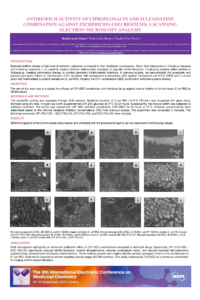
Bacteria within biofilms display remarkable antibiotic resistance compared to planktonic bacteria. Given their implications in infectious diseases and multidrug resistance, exploring effective antimicrobial strategies to regulate biofilm formation is urgent. Eradicating bacteria within biofilms is challenging, needing combination therapy to combat persistent biofilm-related infections. In previous studies, we demonstrated the synergistic and partially synergistic effects of Ciprofloxacin (CIP) combined with antibacterial sulfonamides (SA) against Escherichia coli reference and clinical strains with intermediate quinolone resistance (E. coli IRQ). Notably, the CIP+ sulfadiazine (SDZ) combination exhibited superior efficacy. In this study, we assessed the antibiofilm activity of CIP and SDZ combinations on mature biofilms formed on glass discs using scanning electron microscopy (SEM), focusing on the E. coli IRQ strain. Mature biofilms (48-hour growth) were treated with individual antibiotics (CIP and SDZ) and their combinations (CIP+SDZ), considering minimal fractional inhibitory concentrations (FIC) from previous studies. The experiment was performed in triplicate. Treatments included: CIP (FICx100) + SDZ (FICx10), CIP (FICx100), and SDZ (FICx10). SEM micrographs highlighted an enhanced antibiofilm effect of CIP+SDZ combinations compared to individual drugs. Specifically, CIP (FICx100) + SDZ (FICx10) significantly reduced biofilm formation, caused disorganization, reduced extracellular matrix, and induced bacterial cell destruction, outperforming untreated and individually treated biofilms. These findings provide insights into the partially synergistic effect of this combination on E. coli IRQ, attributed to cooperative actions targeting diverse stages of DNA synthesis. The study underscores CIP+SDZ as a promising combination for treating biofilm-related infections.
Keywords
Ciprofloxacin
Sulfadiazine
Synergism
Biofilm
SEM
Manuscript
Ayala Gómez et al.pdf
Poster
Ayala Gómez et al.pdf
The novel combination based on Aloe vera extract and trimethylglycine for targeted AQP3 stimulation and skin hydration
New Insights into Proteasome Inhibition Strategy for Enhanced Specificity and Cellular Toxicity