Event submissions
Published
 10.3390/ECMC2023-15617 (registering DOI)
 This submission belongs to the session S7. Emerging technologies in drug discovery of the event 9th International Electronic Conference on Medicinal Chemistry
Published date
01 Nov, 2023
Academic Editor
'%3e%3cpath%20d='M12.6657%2010.9104C12.4185%2010.325%2012.0599%209.79327%2011.6097%209.34482C11.1609%208.89508%2010.6293%208.5365%2010.0442%208.28888C10.0389%208.28626%2010.0337%208.28495%2010.0285%208.28233C10.8446%207.69279%2011.3752%206.73249%2011.3752%205.64904C11.3752%203.8542%209.92103%202.39999%208.1262%202.39999C6.33136%202.39999%204.87715%203.8542%204.87715%205.64904C4.87715%206.73249%205.40774%207.69279%206.22393%208.28364C6.21869%208.28626%206.21345%208.28757%206.20821%208.29019C5.62129%208.5378%205.09463%208.89284%204.64265%209.34613C4.1929%209.79493%203.83432%2010.3266%203.58671%2010.9117C3.34345%2011.4845%203.21226%2012.0987%203.20023%2012.7209C3.19988%2012.7349%203.20233%2012.7488%203.20744%2012.7619C3.21255%2012.7749%203.22022%2012.7867%203.22998%2012.7968C3.23975%2012.8068%203.25142%2012.8147%203.26431%2012.8202C3.2772%2012.8256%203.29105%2012.8284%203.30504%2012.8284H4.09109C4.14874%2012.8284%204.19459%2012.7825%204.1959%2012.7262C4.2221%2011.7148%204.62823%2010.7676%205.34617%2010.0497C6.08899%209.30683%207.0755%208.89808%208.1262%208.89808C9.17689%208.89808%2010.1634%209.30683%2010.9062%2010.0497C11.6242%2010.7676%2012.0303%2011.7148%2012.0565%2012.7262C12.0578%2012.7838%2012.1037%2012.8284%2012.1613%2012.8284H12.9474C12.9613%2012.8284%2012.9752%2012.8256%2012.9881%2012.8202C13.001%2012.8147%2013.0126%2012.8068%2013.0224%2012.7968C13.0322%2012.7867%2013.0398%2012.7749%2013.0449%2012.7619C13.0501%2012.7488%2013.0525%2012.7349%2013.0522%2012.7209C13.0391%2012.0947%2012.9094%2011.4855%2012.6657%2010.9104ZM8.1262%207.9024C7.52486%207.9024%206.9589%207.6679%206.53312%207.24211C6.10733%206.81633%205.87283%206.25037%205.87283%205.64904C5.87283%205.0477%206.10733%204.48174%206.53312%204.05596C6.9589%203.63018%207.52486%203.39567%208.1262%203.39567C8.72753%203.39567%209.29349%203.63018%209.71927%204.05596C10.1451%204.48174%2010.3796%205.0477%2010.3796%205.64904C10.3796%206.25037%2010.1451%206.81633%209.71927%207.24211C9.29349%207.6679%208.72753%207.9024%208.1262%207.9024Z'%20fill='%235D1EE1'/%3e%3c/g%3e%3c/svg%3e) Alfredo Berzal-Herranz
Alfredo Berzal-HerranzCitation
Thanh-An Pham, Tieu-Long Phan, Phuoc-Chung Van Nguyen, Van-Thinh To, Gia-Bao Truong, Anh-Hao Huynh, Ngoc-Tam Nguyen Tran, Tuyen Ngoc Truong, Exploring the Chemical Space of HDAC6 Inhibitors: A deep generative study using a Gradient Ascent Algorithm, in Proceedings of 9th International Electronic Conference on Medicinal Chemistry, 1 November–30 November 2023, MDPI: Basel, Switzerland, doi: 10.3390/ECMC2023-15617
Share
Email
Facebook
Twitter
LinkedIn
Exploring the Chemical Space of HDAC6 Inhibitors: A deep generative study using a Gradient Ascent Algorithm
'%3e%3cpath%20d='M12.6647%2010.9104C12.4176%2010.325%2012.0589%209.7933%2011.6088%209.34485C11.16%208.89511%2010.6283%208.53653%2010.0432%208.28891C10.038%208.28629%2010.0327%208.28498%2010.0275%208.28236C10.8437%207.69282%2011.3743%206.73252%2011.3743%205.64907C11.3743%203.85423%209.92005%202.40002%208.12522%202.40002C6.33038%202.40002%204.87618%203.85423%204.87618%205.64907C4.87618%206.73252%205.40677%207.69282%206.22296%208.28367C6.21772%208.28629%206.21248%208.2876%206.20724%208.29022C5.62031%208.53783%205.09365%208.89287%204.64167%209.34616C4.19192%209.79496%203.83334%2010.3266%203.58573%2010.9117C3.34247%2011.4846%203.21128%2012.0987%203.19925%2012.721C3.1989%2012.735%203.20135%2012.7489%203.20646%2012.7619C3.21157%2012.7749%203.21924%2012.7868%203.22901%2012.7968C3.23877%2012.8068%203.25045%2012.8148%203.26334%2012.8202C3.27623%2012.8256%203.29007%2012.8284%203.30406%2012.8284H4.09012C4.14776%2012.8284%204.19362%2012.7825%204.19493%2012.7262C4.22113%2011.7148%204.62726%2010.7676%205.34519%2010.0497C6.08802%209.30686%207.07452%208.89811%208.12522%208.89811C9.17592%208.89811%2010.1624%209.30686%2010.9052%2010.0497C11.6232%2010.7676%2012.0293%2011.7148%2012.0555%2012.7262C12.0568%2012.7839%2012.1027%2012.8284%2012.1603%2012.8284H12.9464C12.9604%2012.8284%2012.9742%2012.8256%2012.9871%2012.8202C13%2012.8148%2013.0117%2012.8068%2013.0214%2012.7968C13.0312%2012.7868%2013.0389%2012.7749%2013.044%2012.7619C13.0491%2012.7489%2013.0515%2012.735%2013.0512%2012.721C13.0381%2012.0947%2012.9084%2011.4856%2012.6647%2010.9104ZM8.12522%207.90243C7.52388%207.90243%206.95792%207.66793%206.53214%207.24215C6.10636%206.81636%205.87185%206.2504%205.87185%205.64907C5.87185%205.04773%206.10636%204.48177%206.53214%204.05599C6.95792%203.63021%207.52388%203.3957%208.12522%203.3957C8.72655%203.3957%209.29252%203.63021%209.7183%204.05599C10.1441%204.48177%2010.3786%205.04773%2010.3786%205.64907C10.3786%206.2504%2010.1441%206.81636%209.7183%207.24215C9.29252%207.66793%208.72655%207.90243%208.12522%207.90243Z'%20fill='%235D1EE1'/%3e%3c/g%3e%3c/svg%3e)
Thanh-An Pham 1
Tieu-Long Phan 1
Phuoc-Chung Van Nguyen 1
Van-Thinh To 1
Gia-Bao Truong 1
Anh-Hao Huynh 1
Ngoc-Tam Nguyen Tran 1
Tuyen Ngoc Truong 1
1. University of Medicine and Pharmacy at Ho Chi Minh City
Abstract
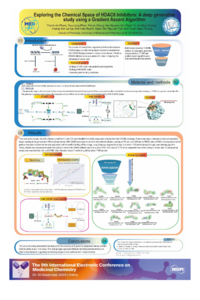
This study aimed to implement the Junction Tree Variational autoencoder (JT-VAE) in conjunction with a gradient ascent algorithm to explore the chemical space of potential inhibitors of Histone deacetylase 6 (HDAC6). In the generation stage, a diverse subset of active compounds was identified using the Butina algorithm. These compounds were then subjected to chemical space exploration employing JT-VAE and a gradient ascent algorithm. The generated substances were subsequently reassessed using an Artificial neural networks model and molecular docking (PDB ID: 6CE6) studies. Thirty-one active compounds with a Tanimoto coefficient under 0.35 were identified from 5225 compounds collected from the ChEMBL database. These compounds underwent a chemical exploration stage, resulting in the generation of 303 novel substances. An artificial neural network-based quantitative structure-activity relationship (ANN-QSAR) model was constructed to predict the inhibitory values of these generated compounds, with external validation yielding an R2 value of 0.595 and an RMSE value of 0.643. Subsequently, a retrospective control protocol was used to determine the scoring function and the cutoff of binding affinity energy, using Deepcoys to generate decoys without bias at a ratio of 1:50 (active:decoys) through deep learning algorithm. Finally, Vinardo was chosen as the preferred scoring function in the GNINA software due to its superior ROC-AUC value of 0.715 when compared to two other scoring functions, and 13 distinguished compounds were identified with a pChEMBL Value threshold above 7 and binding affinity below -7.69 kcal/mol, representing a significant advancement in the field of HDAC6 inhibitor discovery. This multi-pronged approach efficiently identified potential inhibitors of Histone deacetylase 6 (HDAC6), suggesting the following stages involve synthesis and biological testing.
Keywords
HDAC6 inhibitor
JT-VAE
ANN-QSAR
Molecular docking
Virtual screening
Manuscript
9th-ECMC_Poster_template.pdf
Poster
9th-ECMC_Poster_template.pdf
New Insights into Proteasome Inhibition Strategy for Enhanced Specificity and Cellular Toxicity
The prostate cancer-fighting powers of soursop fruit: in silico evaluation to give insight into binding affinity of selected bioactive compounds on selected prostate cancer targets.