Event submissions
Published
 10.3390/ECMC2023-15623 (registering DOI)
 This submission belongs to the session S7. Emerging technologies in drug discovery of the event 9th International Electronic Conference on Medicinal Chemistry
Published date
01 Nov, 2023
Academic Editor
'%3e%3cpath%20d='M12.6657%2010.9104C12.4185%2010.325%2012.0599%209.79327%2011.6097%209.34482C11.1609%208.89508%2010.6293%208.5365%2010.0442%208.28888C10.0389%208.28626%2010.0337%208.28495%2010.0285%208.28233C10.8446%207.69279%2011.3752%206.73249%2011.3752%205.64904C11.3752%203.8542%209.92103%202.39999%208.1262%202.39999C6.33136%202.39999%204.87715%203.8542%204.87715%205.64904C4.87715%206.73249%205.40774%207.69279%206.22393%208.28364C6.21869%208.28626%206.21345%208.28757%206.20821%208.29019C5.62129%208.5378%205.09463%208.89284%204.64265%209.34613C4.1929%209.79493%203.83432%2010.3266%203.58671%2010.9117C3.34345%2011.4845%203.21226%2012.0987%203.20023%2012.7209C3.19988%2012.7349%203.20233%2012.7488%203.20744%2012.7619C3.21255%2012.7749%203.22022%2012.7867%203.22998%2012.7968C3.23975%2012.8068%203.25142%2012.8147%203.26431%2012.8202C3.2772%2012.8256%203.29105%2012.8284%203.30504%2012.8284H4.09109C4.14874%2012.8284%204.19459%2012.7825%204.1959%2012.7262C4.2221%2011.7148%204.62823%2010.7676%205.34617%2010.0497C6.08899%209.30683%207.0755%208.89808%208.1262%208.89808C9.17689%208.89808%2010.1634%209.30683%2010.9062%2010.0497C11.6242%2010.7676%2012.0303%2011.7148%2012.0565%2012.7262C12.0578%2012.7838%2012.1037%2012.8284%2012.1613%2012.8284H12.9474C12.9613%2012.8284%2012.9752%2012.8256%2012.9881%2012.8202C13.001%2012.8147%2013.0126%2012.8068%2013.0224%2012.7968C13.0322%2012.7867%2013.0398%2012.7749%2013.0449%2012.7619C13.0501%2012.7488%2013.0525%2012.7349%2013.0522%2012.7209C13.0391%2012.0947%2012.9094%2011.4855%2012.6657%2010.9104ZM8.1262%207.9024C7.52486%207.9024%206.9589%207.6679%206.53312%207.24211C6.10733%206.81633%205.87283%206.25037%205.87283%205.64904C5.87283%205.0477%206.10733%204.48174%206.53312%204.05596C6.9589%203.63018%207.52486%203.39567%208.1262%203.39567C8.72753%203.39567%209.29349%203.63018%209.71927%204.05596C10.1451%204.48174%2010.3796%205.0477%2010.3796%205.64904C10.3796%206.25037%2010.1451%206.81633%209.71927%207.24211C9.29349%207.6679%208.72753%207.9024%208.1262%207.9024Z'%20fill='%235D1EE1'/%3e%3c/g%3e%3c/svg%3e) Alfredo Berzal-Herranz
Alfredo Berzal-HerranzCitation
Alexander Dombovski, Ruben Steigerwald, Nadine Ritter, Paul Disse, Gunnar Goerges, Jana Osthues, Isabel Aymanns, Carina Dilkaute, Julian Schreiber, Martina Düfer, Guiscard Seebohm, Bernhard Wünsch, Joachim Jose, A novel fluorescent labeling compound for GluN2A containing N-methyl-D-aspartate receptors identified by Autodisplay of GluN1/GluN2A ligand binding domains, in Proceedings of 9th International Electronic Conference on Medicinal Chemistry, 1 November–30 November 2023, MDPI: Basel, Switzerland, doi: 10.3390/ECMC2023-15623
Share
Email
Facebook
Twitter
LinkedIn
A novel fluorescent labeling compound for GluN2A containing N-methyl-D-aspartate receptors identified by Autodisplay of GluN1/GluN2A ligand binding domains
'%3e%3cpath%20d='M12.6647%2010.9104C12.4176%2010.325%2012.0589%209.7933%2011.6088%209.34485C11.16%208.89511%2010.6283%208.53653%2010.0432%208.28891C10.038%208.28629%2010.0327%208.28498%2010.0275%208.28236C10.8437%207.69282%2011.3743%206.73252%2011.3743%205.64907C11.3743%203.85423%209.92005%202.40002%208.12522%202.40002C6.33038%202.40002%204.87618%203.85423%204.87618%205.64907C4.87618%206.73252%205.40677%207.69282%206.22296%208.28367C6.21772%208.28629%206.21248%208.2876%206.20724%208.29022C5.62031%208.53783%205.09365%208.89287%204.64167%209.34616C4.19192%209.79496%203.83334%2010.3266%203.58573%2010.9117C3.34247%2011.4846%203.21128%2012.0987%203.19925%2012.721C3.1989%2012.735%203.20135%2012.7489%203.20646%2012.7619C3.21157%2012.7749%203.21924%2012.7868%203.22901%2012.7968C3.23877%2012.8068%203.25045%2012.8148%203.26334%2012.8202C3.27623%2012.8256%203.29007%2012.8284%203.30406%2012.8284H4.09012C4.14776%2012.8284%204.19362%2012.7825%204.19493%2012.7262C4.22113%2011.7148%204.62726%2010.7676%205.34519%2010.0497C6.08802%209.30686%207.07452%208.89811%208.12522%208.89811C9.17592%208.89811%2010.1624%209.30686%2010.9052%2010.0497C11.6232%2010.7676%2012.0293%2011.7148%2012.0555%2012.7262C12.0568%2012.7839%2012.1027%2012.8284%2012.1603%2012.8284H12.9464C12.9604%2012.8284%2012.9742%2012.8256%2012.9871%2012.8202C13%2012.8148%2013.0117%2012.8068%2013.0214%2012.7968C13.0312%2012.7868%2013.0389%2012.7749%2013.044%2012.7619C13.0491%2012.7489%2013.0515%2012.735%2013.0512%2012.721C13.0381%2012.0947%2012.9084%2011.4856%2012.6647%2010.9104ZM8.12522%207.90243C7.52388%207.90243%206.95792%207.66793%206.53214%207.24215C6.10636%206.81636%205.87185%206.2504%205.87185%205.64907C5.87185%205.04773%206.10636%204.48177%206.53214%204.05599C6.95792%203.63021%207.52388%203.3957%208.12522%203.3957C8.72655%203.3957%209.29252%203.63021%209.7183%204.05599C10.1441%204.48177%2010.3786%205.04773%2010.3786%205.64907C10.3786%206.2504%2010.1441%206.81636%209.7183%207.24215C9.29252%207.66793%208.72655%207.90243%208.12522%207.90243Z'%20fill='%235D1EE1'/%3e%3c/g%3e%3c/svg%3e)
Alexander Dombovski 1
Ruben Steigerwald 1
Nadine Ritter 2
Paul Disse 2
Gunnar Goerges 2
Jana Osthues 1
Isabel Aymanns 2
Carina Dilkaute 1
Julian Schreiber 1,2
Martina Düfer 1
Guiscard Seebohm 2
Bernhard Wünsch 1

Joachim Jose 1
1. University of Münster, Institute of Pharmaceutical and Medicinal Chemistry, PharmaCampus, Corrensstraße 48, D-48149 Münster, Germany
2. University of Münster, Institute for Genetics of Heart Diseases (IfGH), Department of Cardiovascular Medicine, University Hospital Münster, D-48149, Münster, Germany
Abstract
Autodisplay was used for the co-display of GluN1 and GluN2A ligand binding domains (LBDs) of the N‑methyl-D-aspartate (NMDA) receptor in E. coli. LBDs were confirmed to be located at the cell surface and form dimers, similar to local LBD heterodimers present in full-length NMDA receptors. Flow cytometry was used to evaluate binding of fluorescently labeled TCN‑201 derivatives to cells with co-displayed LBDs. TCN-201 is a negative allosteric modulator of GluN2A containing NMDA receptors that binds at the LBD heterodimer interface of GluN1 und GluN2A. Among three TCN-201 derivatives, compound 8 was identified as a novel ligand that bound to cells co-displaying both LBDs but not to cells displaying exclusively one type of LBDs. This was to indicate that compound 8 addressed the same binding site as TCN-201. An apparent dissociation constant of 6.8 ± 1.6 µM for compound 8 was determined. Two-electrode voltage-clamp experiments showed that compound 8 did not inhibit GluN1/GluN2A NMDA receptor-mediated currents. However, compound 8 abolished the current inhibition by TCN-201, indicating competitive binding to the same binding site. Subunit selectivity of compound 8 was evaluated by fluorescence staining of recombinant NMDA receptors in mouse L(tk-) cells. Here, selective staining of GluN2A in contrast to GluN2B containing NMDA receptors with compound 8 was confirmed. Additionally, staining was prevented by preincubation with TCN-201, once more reaffirming the competitive binding mode. This work describes the identification of compound 8 which appears to be the first fluorescent small molecule labeling compound that selectively addresses GluN2A containing NMDA receptors.
Keywords
bacterial surface display
NMDAR
fluorescence labeling
flow cytometry
fluorescence microscopy
Manuscript
20231012_AD_ECMC_2023_Poster_PDF.pdf
Poster
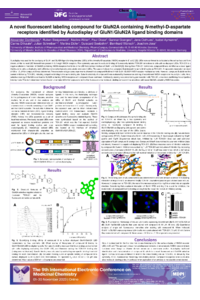
20231012_AD_ECMC_2023_Poster_PDF.pdf
(Q)SAR analysis of a selected group of drugs using retention values from HPLC column chromatography with immobilized plasma proteins
New low molecular weight heterocyclic compounds with antiviral activity