Event submissions
Published
 10.3390/ECMC2023-15627 (registering DOI)
 This submission belongs to the session S4. New Small molecules as drug candidates of the event 9th International Electronic Conference on Medicinal Chemistry
Published date
01 Nov, 2023
Academic Editor
'%3e%3cpath%20d='M12.6657%2010.9104C12.4185%2010.325%2012.0599%209.79327%2011.6097%209.34482C11.1609%208.89508%2010.6293%208.5365%2010.0442%208.28888C10.0389%208.28626%2010.0337%208.28495%2010.0285%208.28233C10.8446%207.69279%2011.3752%206.73249%2011.3752%205.64904C11.3752%203.8542%209.92103%202.39999%208.1262%202.39999C6.33136%202.39999%204.87715%203.8542%204.87715%205.64904C4.87715%206.73249%205.40774%207.69279%206.22393%208.28364C6.21869%208.28626%206.21345%208.28757%206.20821%208.29019C5.62129%208.5378%205.09463%208.89284%204.64265%209.34613C4.1929%209.79493%203.83432%2010.3266%203.58671%2010.9117C3.34345%2011.4845%203.21226%2012.0987%203.20023%2012.7209C3.19988%2012.7349%203.20233%2012.7488%203.20744%2012.7619C3.21255%2012.7749%203.22022%2012.7867%203.22998%2012.7968C3.23975%2012.8068%203.25142%2012.8147%203.26431%2012.8202C3.2772%2012.8256%203.29105%2012.8284%203.30504%2012.8284H4.09109C4.14874%2012.8284%204.19459%2012.7825%204.1959%2012.7262C4.2221%2011.7148%204.62823%2010.7676%205.34617%2010.0497C6.08899%209.30683%207.0755%208.89808%208.1262%208.89808C9.17689%208.89808%2010.1634%209.30683%2010.9062%2010.0497C11.6242%2010.7676%2012.0303%2011.7148%2012.0565%2012.7262C12.0578%2012.7838%2012.1037%2012.8284%2012.1613%2012.8284H12.9474C12.9613%2012.8284%2012.9752%2012.8256%2012.9881%2012.8202C13.001%2012.8147%2013.0126%2012.8068%2013.0224%2012.7968C13.0322%2012.7867%2013.0398%2012.7749%2013.0449%2012.7619C13.0501%2012.7488%2013.0525%2012.7349%2013.0522%2012.7209C13.0391%2012.0947%2012.9094%2011.4855%2012.6657%2010.9104ZM8.1262%207.9024C7.52486%207.9024%206.9589%207.6679%206.53312%207.24211C6.10733%206.81633%205.87283%206.25037%205.87283%205.64904C5.87283%205.0477%206.10733%204.48174%206.53312%204.05596C6.9589%203.63018%207.52486%203.39567%208.1262%203.39567C8.72753%203.39567%209.29349%203.63018%209.71927%204.05596C10.1451%204.48174%2010.3796%205.0477%2010.3796%205.64904C10.3796%206.25037%2010.1451%206.81633%209.71927%207.24211C9.29349%207.6679%208.72753%207.9024%208.1262%207.9024Z'%20fill='%235D1EE1'/%3e%3c/g%3e%3c/svg%3e) Maria Emília Sousa
Maria Emília SousaCitation
Angeliki Kokkali, Anna-Maria Kostaki, Georgia Athanassopoulou, Apostolia Makri, Marina Sagnou, Veroniki P. Vidali, Georgia Kythreoti, Natural Product Analogues as Antibacterial Agents: The Case of Cinnamaldehyde and Colupulone, in Proceedings of 9th International Electronic Conference on Medicinal Chemistry, 1 November–30 November 2023, MDPI: Basel, Switzerland, doi: 10.3390/ECMC2023-15627
Share
Email
Facebook
Twitter
LinkedIn
Natural Product Analogues as Antibacterial Agents: The Case of Cinnamaldehyde and Colupulone
'%3e%3cpath%20d='M12.6647%2010.9104C12.4176%2010.325%2012.0589%209.7933%2011.6088%209.34485C11.16%208.89511%2010.6283%208.53653%2010.0432%208.28891C10.038%208.28629%2010.0327%208.28498%2010.0275%208.28236C10.8437%207.69282%2011.3743%206.73252%2011.3743%205.64907C11.3743%203.85423%209.92005%202.40002%208.12522%202.40002C6.33038%202.40002%204.87618%203.85423%204.87618%205.64907C4.87618%206.73252%205.40677%207.69282%206.22296%208.28367C6.21772%208.28629%206.21248%208.2876%206.20724%208.29022C5.62031%208.53783%205.09365%208.89287%204.64167%209.34616C4.19192%209.79496%203.83334%2010.3266%203.58573%2010.9117C3.34247%2011.4846%203.21128%2012.0987%203.19925%2012.721C3.1989%2012.735%203.20135%2012.7489%203.20646%2012.7619C3.21157%2012.7749%203.21924%2012.7868%203.22901%2012.7968C3.23877%2012.8068%203.25045%2012.8148%203.26334%2012.8202C3.27623%2012.8256%203.29007%2012.8284%203.30406%2012.8284H4.09012C4.14776%2012.8284%204.19362%2012.7825%204.19493%2012.7262C4.22113%2011.7148%204.62726%2010.7676%205.34519%2010.0497C6.08802%209.30686%207.07452%208.89811%208.12522%208.89811C9.17592%208.89811%2010.1624%209.30686%2010.9052%2010.0497C11.6232%2010.7676%2012.0293%2011.7148%2012.0555%2012.7262C12.0568%2012.7839%2012.1027%2012.8284%2012.1603%2012.8284H12.9464C12.9604%2012.8284%2012.9742%2012.8256%2012.9871%2012.8202C13%2012.8148%2013.0117%2012.8068%2013.0214%2012.7968C13.0312%2012.7868%2013.0389%2012.7749%2013.044%2012.7619C13.0491%2012.7489%2013.0515%2012.735%2013.0512%2012.721C13.0381%2012.0947%2012.9084%2011.4856%2012.6647%2010.9104ZM8.12522%207.90243C7.52388%207.90243%206.95792%207.66793%206.53214%207.24215C6.10636%206.81636%205.87185%206.2504%205.87185%205.64907C5.87185%205.04773%206.10636%204.48177%206.53214%204.05599C6.95792%203.63021%207.52388%203.3957%208.12522%203.3957C8.72655%203.3957%209.29252%203.63021%209.7183%204.05599C10.1441%204.48177%2010.3786%205.04773%2010.3786%205.64907C10.3786%206.2504%2010.1441%206.81636%209.7183%207.24215C9.29252%207.66793%208.72655%207.90243%208.12522%207.90243Z'%20fill='%235D1EE1'/%3e%3c/g%3e%3c/svg%3e)
Angeliki Kokkali 1
Anna-Maria Kostaki 2,3
Georgia Athanassopoulou 2,3
Apostolia Makri 4
Marina Sagnou 5
Veroniki P. Vidali 2
Georgia Kythreoti 1
1. School of Liberal Arts and Sciences, The American College of Greece, 6 Gravias Street, 15342 Athens, Greece
2. Natural Products Synthesis & Bioorganic Chemistry Laboratory, Institute of Nanoscience & Nanotechnology, National Center for Scientific Research “Demokritos”, Patr. Grigoriou & Neapoleos 27, 153 41 Athens, Greece
3. School of Health Sciences, Department of Pharmacy, Division of Pharmaceutical Chemistry, National and Kapodistrian University of Athens, Greece
4. Department of Food Science and Human Nutrition, Agricultural University of Athens, Iera Odos 75, 118 55 Athens, Greece
5. Institute of Biosciences & Applications, National Centre for Scientific Research “Demokritos”, Patr. Grigoriou & Neapoleos 27, 153 41 Athens, Greece
Abstract
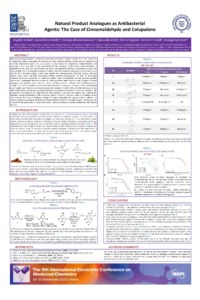
The ever-growing antibiotic resistance to currently prescribed antibiotics constitutes a main reason for investigating natural compounds for antibacterial action. Natural products can be used as leads for new synthetic antibacterial agents or as a source of novel bioactive compounds. Cinnamaldehyde and colupulone were selected as lead compounds for the purposes of this study. Cinnamaldehyde, a byproduct of the stem bark of Cinnamomum cassia, was isolated in 1834 by Jean-Baptiste Dumas, with uses ranging from the food and cosmetics to pharmaceutical industries. Colupulone, is a known hop b-acid found in Humulus lupulus, a plant also used in the pharmaceutical and food industry. Previous studies have shown that both compounds exhibit antibacterial properties. In order to investigate essential structures responsible for enhanced action, some functionalities on the selected parental compounds, cinnamaldehyde and colupulone, were preserved while others altered. Synthesis of these analogues was based on short synthetic routes, including efficient methods like Wittig reaction, Fries rearrangement and C-alkylation of phloroglucinol derivatives. Subsequent testing for their antibacterial action against gram-positive and gram-negative microorganisms Escherichia coli, Staphylococcus aureus and Pseudomonas aeruginosa revealed important functionalities required for increased activities. The prospective development of a ligand-based pharmacophore was also investigated, by analyzing the structural-activity relationship of their bacterial growth inhibitory potencies. Enhance inhibitory action was observed for the para-methoxy analogue of trans-cinnamaldehyde against E.coli. In addition, all tested colupulone analogues exhibited enhanced activities for both E. coli and S.aureus. These results set the base for designing new compounds to better understand structure-activity relationship and improve activity.
Keywords
cinnamaldehyde analogues
colupulone analogues
antibacterial activity
structure-activity relationship
Manuscript
9th-ECMC 2023_Abstract.pdf
Poster
9th-ECMC 2023_Poster.pdf
Prognostic significance of neurodegradation/neuroplasticity markers and endothelial dysfunction indicators in assessing the efficiency of therapy for children with CNS disorders after prenatal hypoxia
Assessment of 3T3-L1 transduction using different AAV capsid variants