Event submissions
Published
 10.3390/ECMC2023-15635 (registering DOI)
 This submission belongs to the session S7. Emerging technologies in drug discovery of the event 9th International Electronic Conference on Medicinal Chemistry
Published date
01 Nov, 2023
Academic Editor
'%3e%3cpath%20d='M12.6657%2010.9104C12.4185%2010.325%2012.0599%209.79327%2011.6097%209.34482C11.1609%208.89508%2010.6293%208.5365%2010.0442%208.28888C10.0389%208.28626%2010.0337%208.28495%2010.0285%208.28233C10.8446%207.69279%2011.3752%206.73249%2011.3752%205.64904C11.3752%203.8542%209.92103%202.39999%208.1262%202.39999C6.33136%202.39999%204.87715%203.8542%204.87715%205.64904C4.87715%206.73249%205.40774%207.69279%206.22393%208.28364C6.21869%208.28626%206.21345%208.28757%206.20821%208.29019C5.62129%208.5378%205.09463%208.89284%204.64265%209.34613C4.1929%209.79493%203.83432%2010.3266%203.58671%2010.9117C3.34345%2011.4845%203.21226%2012.0987%203.20023%2012.7209C3.19988%2012.7349%203.20233%2012.7488%203.20744%2012.7619C3.21255%2012.7749%203.22022%2012.7867%203.22998%2012.7968C3.23975%2012.8068%203.25142%2012.8147%203.26431%2012.8202C3.2772%2012.8256%203.29105%2012.8284%203.30504%2012.8284H4.09109C4.14874%2012.8284%204.19459%2012.7825%204.1959%2012.7262C4.2221%2011.7148%204.62823%2010.7676%205.34617%2010.0497C6.08899%209.30683%207.0755%208.89808%208.1262%208.89808C9.17689%208.89808%2010.1634%209.30683%2010.9062%2010.0497C11.6242%2010.7676%2012.0303%2011.7148%2012.0565%2012.7262C12.0578%2012.7838%2012.1037%2012.8284%2012.1613%2012.8284H12.9474C12.9613%2012.8284%2012.9752%2012.8256%2012.9881%2012.8202C13.001%2012.8147%2013.0126%2012.8068%2013.0224%2012.7968C13.0322%2012.7867%2013.0398%2012.7749%2013.0449%2012.7619C13.0501%2012.7488%2013.0525%2012.7349%2013.0522%2012.7209C13.0391%2012.0947%2012.9094%2011.4855%2012.6657%2010.9104ZM8.1262%207.9024C7.52486%207.9024%206.9589%207.6679%206.53312%207.24211C6.10733%206.81633%205.87283%206.25037%205.87283%205.64904C5.87283%205.0477%206.10733%204.48174%206.53312%204.05596C6.9589%203.63018%207.52486%203.39567%208.1262%203.39567C8.72753%203.39567%209.29349%203.63018%209.71927%204.05596C10.1451%204.48174%2010.3796%205.0477%2010.3796%205.64904C10.3796%206.25037%2010.1451%206.81633%209.71927%207.24211C9.29349%207.6679%208.72753%207.9024%208.1262%207.9024Z'%20fill='%235D1EE1'/%3e%3c/g%3e%3c/svg%3e) Alfredo Berzal-Herranz
Alfredo Berzal-HerranzCitation
Tan Thanh Mai, Thua-Phong Lam, Long-Hung Dinh Pham, Kim-Hung Nguyen, Khac-Minh Thai, Identification of Putative Orthosteric and Allosteric Binding Sites of Interleukin-33 using Extensive Molecular Dynamics Simulations, in Proceedings of 9th International Electronic Conference on Medicinal Chemistry, 1 November–30 November 2023, MDPI: Basel, Switzerland, doi: 10.3390/ECMC2023-15635
Share
Email
Facebook
Twitter
LinkedIn
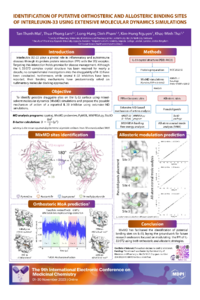
Identification of Putative Orthosteric and Allosteric Binding Sites of Interleukin-33 using Extensive Molecular Dynamics Simulations
'%3e%3cpath%20d='M12.6647%2010.9104C12.4176%2010.325%2012.0589%209.7933%2011.6088%209.34485C11.16%208.89511%2010.6283%208.53653%2010.0432%208.28891C10.038%208.28629%2010.0327%208.28498%2010.0275%208.28236C10.8437%207.69282%2011.3743%206.73252%2011.3743%205.64907C11.3743%203.85423%209.92005%202.40002%208.12522%202.40002C6.33038%202.40002%204.87618%203.85423%204.87618%205.64907C4.87618%206.73252%205.40677%207.69282%206.22296%208.28367C6.21772%208.28629%206.21248%208.2876%206.20724%208.29022C5.62031%208.53783%205.09365%208.89287%204.64167%209.34616C4.19192%209.79496%203.83334%2010.3266%203.58573%2010.9117C3.34247%2011.4846%203.21128%2012.0987%203.19925%2012.721C3.1989%2012.735%203.20135%2012.7489%203.20646%2012.7619C3.21157%2012.7749%203.21924%2012.7868%203.22901%2012.7968C3.23877%2012.8068%203.25045%2012.8148%203.26334%2012.8202C3.27623%2012.8256%203.29007%2012.8284%203.30406%2012.8284H4.09012C4.14776%2012.8284%204.19362%2012.7825%204.19493%2012.7262C4.22113%2011.7148%204.62726%2010.7676%205.34519%2010.0497C6.08802%209.30686%207.07452%208.89811%208.12522%208.89811C9.17592%208.89811%2010.1624%209.30686%2010.9052%2010.0497C11.6232%2010.7676%2012.0293%2011.7148%2012.0555%2012.7262C12.0568%2012.7839%2012.1027%2012.8284%2012.1603%2012.8284H12.9464C12.9604%2012.8284%2012.9742%2012.8256%2012.9871%2012.8202C13%2012.8148%2013.0117%2012.8068%2013.0214%2012.7968C13.0312%2012.7868%2013.0389%2012.7749%2013.044%2012.7619C13.0491%2012.7489%2013.0515%2012.735%2013.0512%2012.721C13.0381%2012.0947%2012.9084%2011.4856%2012.6647%2010.9104ZM8.12522%207.90243C7.52388%207.90243%206.95792%207.66793%206.53214%207.24215C6.10636%206.81636%205.87185%206.2504%205.87185%205.64907C5.87185%205.04773%206.10636%204.48177%206.53214%204.05599C6.95792%203.63021%207.52388%203.3957%208.12522%203.3957C8.72655%203.3957%209.29252%203.63021%209.7183%204.05599C10.1441%204.48177%2010.3786%205.04773%2010.3786%205.64907C10.3786%206.2504%2010.1441%206.81636%209.7183%207.24215C9.29252%207.66793%208.72655%207.90243%208.12522%207.90243Z'%20fill='%235D1EE1'/%3e%3c/g%3e%3c/svg%3e)
Tan Thanh Mai 1
Thua-Phong Lam 1,2
Long-Hung Dinh Pham 1,3
Kim-Hung Nguyen 1

Khac-Minh Thai 1
1. Faculty of Pharmacy, University of Medicine and Pharmacy at Ho Chi Minh City
2. Faculty of Pharmacy, Uppsala University
3. Department of Chemistry, Imperial College London
Abstract
Interleukin (IL)-33, the newest member of the IL-1 family, plays a pivotal role in inflammatory and autoimmune diseases through its protein-protein interaction (PPI) with the ST2 receptor. Targeting this interaction holds promise for disease management. Although the IL-33/ST2 complex crystal structure has been resolved for nearly a decade, no comprehensive investigations into the druggability of IL-33 have been conducted. Furthermore, while several IL-33 inhibitors have been reported, their binding mechanisms have predominantly relied on rudimentary molecular docking approaches. In this study, we sought to identify possible druggable sites on the IL-33 surface using mixed-solvent molecular dynamics (MixMD) simulations and propose the possible mechanism of action of a reported IL-33 inhibitor using extensive-MD simulations. MixMD is an advanced MD technique that not only captures the protein's flexibility but also considers its interactions with small chemical probes. Our findings revealed five potential druggable sites on the IL-33 surface, two of which overlaid well with the interface of the ST2 receptor. The three remaining sites were investigated for their allosteric potential via all-atom normal mode analysis in the presence of pseudoligands. The current results suggested that interaction with these binding sites could exert possible dynamical change compared to the apoprotein conformation and serve as starting points for IL-33 allosteric modulation. Additionally, the binding modes of an orthosteric IL-33 inhibitor were also extracted and analyzed using the results from a 5-microseconds simulation. Our study can pave the way for future studies aiming to modulate the PPI of IL-33/ST2 employing both orthosteric and allosteric approaches.
Keywords
interleukin-33
ST2 receptor
binding site
cryptic pockets
mixed-solvent
molecular dynamics
Manuscript
Abstract_9th-ECMC_TanThanhMai_sciforum-081405.pdf
Poster
Potser_9th-ECMC_TanThanhMai_sciforum-081405.pdf
Combining Autodisplay and Flow Cytometry for Functional Analysis of HCN4 CNBD Residues Essential for Ligand Binding
Photopolymerization as a Method for Synthesis Hydrogel-Based Transdermal Systems