Event submissions
Published
 10.3390/ECMC2023-15636 (registering DOI)
 This submission belongs to the session S5. Natural Products and Biopharmaceuticals of the event 9th International Electronic Conference on Medicinal Chemistry
Published date
01 Nov, 2023
Academic Editor
'%3e%3cpath%20d='M12.6657%2010.9104C12.4185%2010.325%2012.0599%209.79327%2011.6097%209.34482C11.1609%208.89508%2010.6293%208.5365%2010.0442%208.28888C10.0389%208.28626%2010.0337%208.28495%2010.0285%208.28233C10.8446%207.69279%2011.3752%206.73249%2011.3752%205.64904C11.3752%203.8542%209.92103%202.39999%208.1262%202.39999C6.33136%202.39999%204.87715%203.8542%204.87715%205.64904C4.87715%206.73249%205.40774%207.69279%206.22393%208.28364C6.21869%208.28626%206.21345%208.28757%206.20821%208.29019C5.62129%208.5378%205.09463%208.89284%204.64265%209.34613C4.1929%209.79493%203.83432%2010.3266%203.58671%2010.9117C3.34345%2011.4845%203.21226%2012.0987%203.20023%2012.7209C3.19988%2012.7349%203.20233%2012.7488%203.20744%2012.7619C3.21255%2012.7749%203.22022%2012.7867%203.22998%2012.7968C3.23975%2012.8068%203.25142%2012.8147%203.26431%2012.8202C3.2772%2012.8256%203.29105%2012.8284%203.30504%2012.8284H4.09109C4.14874%2012.8284%204.19459%2012.7825%204.1959%2012.7262C4.2221%2011.7148%204.62823%2010.7676%205.34617%2010.0497C6.08899%209.30683%207.0755%208.89808%208.1262%208.89808C9.17689%208.89808%2010.1634%209.30683%2010.9062%2010.0497C11.6242%2010.7676%2012.0303%2011.7148%2012.0565%2012.7262C12.0578%2012.7838%2012.1037%2012.8284%2012.1613%2012.8284H12.9474C12.9613%2012.8284%2012.9752%2012.8256%2012.9881%2012.8202C13.001%2012.8147%2013.0126%2012.8068%2013.0224%2012.7968C13.0322%2012.7867%2013.0398%2012.7749%2013.0449%2012.7619C13.0501%2012.7488%2013.0525%2012.7349%2013.0522%2012.7209C13.0391%2012.0947%2012.9094%2011.4855%2012.6657%2010.9104ZM8.1262%207.9024C7.52486%207.9024%206.9589%207.6679%206.53312%207.24211C6.10733%206.81633%205.87283%206.25037%205.87283%205.64904C5.87283%205.0477%206.10733%204.48174%206.53312%204.05596C6.9589%203.63018%207.52486%203.39567%208.1262%203.39567C8.72753%203.39567%209.29349%203.63018%209.71927%204.05596C10.1451%204.48174%2010.3796%205.0477%2010.3796%205.64904C10.3796%206.25037%2010.1451%206.81633%209.71927%207.24211C9.29349%207.6679%208.72753%207.9024%208.1262%207.9024Z'%20fill='%235D1EE1'/%3e%3c/g%3e%3c/svg%3e) Alfredo Berzal-Herranz
Alfredo Berzal-HerranzCitation
Katarzyna Sala, Magdalena Bańkosz, Wojciech Bańkosz, Magdalena Kędzierska, Bożena Tyliszczak, Photopolymerization as a Method for Synthesis Hydrogel-Based Transdermal Systems, in Proceedings of 9th International Electronic Conference on Medicinal Chemistry, 1 November–30 November 2023, MDPI: Basel, Switzerland, doi: 10.3390/ECMC2023-15636
Share
Email
Facebook
Twitter
LinkedIn
Photopolymerization as a Method for Synthesis Hydrogel-Based Transdermal Systems
'%3e%3cpath%20d='M12.6647%2010.9104C12.4176%2010.325%2012.0589%209.7933%2011.6088%209.34485C11.16%208.89511%2010.6283%208.53653%2010.0432%208.28891C10.038%208.28629%2010.0327%208.28498%2010.0275%208.28236C10.8437%207.69282%2011.3743%206.73252%2011.3743%205.64907C11.3743%203.85423%209.92005%202.40002%208.12522%202.40002C6.33038%202.40002%204.87618%203.85423%204.87618%205.64907C4.87618%206.73252%205.40677%207.69282%206.22296%208.28367C6.21772%208.28629%206.21248%208.2876%206.20724%208.29022C5.62031%208.53783%205.09365%208.89287%204.64167%209.34616C4.19192%209.79496%203.83334%2010.3266%203.58573%2010.9117C3.34247%2011.4846%203.21128%2012.0987%203.19925%2012.721C3.1989%2012.735%203.20135%2012.7489%203.20646%2012.7619C3.21157%2012.7749%203.21924%2012.7868%203.22901%2012.7968C3.23877%2012.8068%203.25045%2012.8148%203.26334%2012.8202C3.27623%2012.8256%203.29007%2012.8284%203.30406%2012.8284H4.09012C4.14776%2012.8284%204.19362%2012.7825%204.19493%2012.7262C4.22113%2011.7148%204.62726%2010.7676%205.34519%2010.0497C6.08802%209.30686%207.07452%208.89811%208.12522%208.89811C9.17592%208.89811%2010.1624%209.30686%2010.9052%2010.0497C11.6232%2010.7676%2012.0293%2011.7148%2012.0555%2012.7262C12.0568%2012.7839%2012.1027%2012.8284%2012.1603%2012.8284H12.9464C12.9604%2012.8284%2012.9742%2012.8256%2012.9871%2012.8202C13%2012.8148%2013.0117%2012.8068%2013.0214%2012.7968C13.0312%2012.7868%2013.0389%2012.7749%2013.044%2012.7619C13.0491%2012.7489%2013.0515%2012.735%2013.0512%2012.721C13.0381%2012.0947%2012.9084%2011.4856%2012.6647%2010.9104ZM8.12522%207.90243C7.52388%207.90243%206.95792%207.66793%206.53214%207.24215C6.10636%206.81636%205.87185%206.2504%205.87185%205.64907C5.87185%205.04773%206.10636%204.48177%206.53214%204.05599C6.95792%203.63021%207.52388%203.3957%208.12522%203.3957C8.72655%203.3957%209.29252%203.63021%209.7183%204.05599C10.1441%204.48177%2010.3786%205.04773%2010.3786%205.64907C10.3786%206.2504%2010.1441%206.81636%209.7183%207.24215C9.29252%207.66793%208.72655%207.90243%208.12522%207.90243Z'%20fill='%235D1EE1'/%3e%3c/g%3e%3c/svg%3e)
Katarzyna Sala 1
Magdalena Bańkosz 1
Wojciech Bańkosz 2
Magdalena Kędzierska 3

Bożena Tyliszczak 1
1. Cracow University of Technology, Faculty of Materials Engineering and Physics, Department of Materials Engineering
2. Cracow University of Technology, Faculty of Electrical and Computer Engineering, Department of Automation and Computer Science
3. Department of Chemotherapy, Medical University of Lodz, Copernicus Memorial Hospital of Lodz, 90-549 Lodz, Poland
Abstract
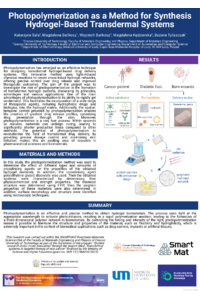
Photopolymerization has emerged as a powerful technique for designing hydrogel-based transdermal delivery systems. This innovative method harnesses light-induced chemical reactions to create crosslinked hydrogel networks, offering precise control over drug release and enhanced therapeutic outcomes. This abstract explores the multifaceted role of photopolymerization in the formulation of transdermal hydrogel systems, discussing its principles, advantages, and diverse applications.
One of the primary advantages of photopolymerization is its ability to achieve rapid and on-demand gelation. This facilitates the incorporation of a wide range of therapeutic agents, including hydrophobic drugs and biologics, into the hydrogel matrix. Additionally, the spatiotemporal control afforded by photopolymerization enables the creation of gradient drug release profiles, optimizing drug permeation through the skin.
This abstract described challenges associated with photopolymerization-based hydrogel systems. The potential of photopolymerization to revolutionize the transdermal drug delivery field, by providing precise dosing control and minimizing skin irritation, makes it an exciting area of research in pharmaceutical and biomaterial sciences.
This research was carried out within the SMART-MAT Functional Materials Science Club of the Faculty of Materials Engineering and Physics of Cracow University of Technology as part of the 3rd edition of the program "Student research clubs create innovation" through the project titled „Transdermal systems in targeted therapy of skin cancer” financed by the Ministry of Science and Higher Education (grant no: SKN 157/568410/2023)
Keywords
photopolymerization
hydrogels
transdermal systems
Manuscript
sciforum-081464.pdf
Poster
Poster_sciforum-081464.pdf
Identification of Putative Orthosteric and Allosteric Binding Sites of Interleukin-33 using Extensive Molecular Dynamics Simulations
Biopolymeric Hydrogels as Transdermal Delivery Systems