Event submissions
Published
 10.3390/ECMC2023-15645 (registering DOI)
 This submission belongs to the session S4. New Small molecules as drug candidates of the event 9th International Electronic Conference on Medicinal Chemistry
Published date
01 Nov, 2023
Academic Editor
'%3e%3cpath%20d='M12.6657%2010.9104C12.4185%2010.325%2012.0599%209.79327%2011.6097%209.34482C11.1609%208.89508%2010.6293%208.5365%2010.0442%208.28888C10.0389%208.28626%2010.0337%208.28495%2010.0285%208.28233C10.8446%207.69279%2011.3752%206.73249%2011.3752%205.64904C11.3752%203.8542%209.92103%202.39999%208.1262%202.39999C6.33136%202.39999%204.87715%203.8542%204.87715%205.64904C4.87715%206.73249%205.40774%207.69279%206.22393%208.28364C6.21869%208.28626%206.21345%208.28757%206.20821%208.29019C5.62129%208.5378%205.09463%208.89284%204.64265%209.34613C4.1929%209.79493%203.83432%2010.3266%203.58671%2010.9117C3.34345%2011.4845%203.21226%2012.0987%203.20023%2012.7209C3.19988%2012.7349%203.20233%2012.7488%203.20744%2012.7619C3.21255%2012.7749%203.22022%2012.7867%203.22998%2012.7968C3.23975%2012.8068%203.25142%2012.8147%203.26431%2012.8202C3.2772%2012.8256%203.29105%2012.8284%203.30504%2012.8284H4.09109C4.14874%2012.8284%204.19459%2012.7825%204.1959%2012.7262C4.2221%2011.7148%204.62823%2010.7676%205.34617%2010.0497C6.08899%209.30683%207.0755%208.89808%208.1262%208.89808C9.17689%208.89808%2010.1634%209.30683%2010.9062%2010.0497C11.6242%2010.7676%2012.0303%2011.7148%2012.0565%2012.7262C12.0578%2012.7838%2012.1037%2012.8284%2012.1613%2012.8284H12.9474C12.9613%2012.8284%2012.9752%2012.8256%2012.9881%2012.8202C13.001%2012.8147%2013.0126%2012.8068%2013.0224%2012.7968C13.0322%2012.7867%2013.0398%2012.7749%2013.0449%2012.7619C13.0501%2012.7488%2013.0525%2012.7349%2013.0522%2012.7209C13.0391%2012.0947%2012.9094%2011.4855%2012.6657%2010.9104ZM8.1262%207.9024C7.52486%207.9024%206.9589%207.6679%206.53312%207.24211C6.10733%206.81633%205.87283%206.25037%205.87283%205.64904C5.87283%205.0477%206.10733%204.48174%206.53312%204.05596C6.9589%203.63018%207.52486%203.39567%208.1262%203.39567C8.72753%203.39567%209.29349%203.63018%209.71927%204.05596C10.1451%204.48174%2010.3796%205.0477%2010.3796%205.64904C10.3796%206.25037%2010.1451%206.81633%209.71927%207.24211C9.29349%207.6679%208.72753%207.9024%208.1262%207.9024Z'%20fill='%235D1EE1'/%3e%3c/g%3e%3c/svg%3e) Osvaldo Santos-Filho
Osvaldo Santos-FilhoCitation
Eduvan Daniel Valencia Cristancho, Wilson Eduardo Olarte Rojas, IN-SILICO STUDY OF ADMET PROPERTIES, MOLECULAR DOCKING AND MOLECULAR DYNAMICS OF POTENTIAL INHIBITORS OF New Delhi metallo-β-lactamase (NDM-1)., in Proceedings of 9th International Electronic Conference on Medicinal Chemistry, 1 November–30 November 2023, MDPI: Basel, Switzerland, doi: 10.3390/ECMC2023-15645
Share
Email
Facebook
Twitter
LinkedIn
IN-SILICO STUDY OF ADMET PROPERTIES, MOLECULAR DOCKING AND MOLECULAR DYNAMICS OF POTENTIAL INHIBITORS OF New Delhi metallo-β-lactamase (NDM-1).

Eduvan Daniel Valencia Cristancho 1
'%3e%3cpath%20d='M12.6647%2010.9104C12.4176%2010.325%2012.0589%209.7933%2011.6088%209.34485C11.16%208.89511%2010.6283%208.53653%2010.0432%208.28891C10.038%208.28629%2010.0327%208.28498%2010.0275%208.28236C10.8437%207.69282%2011.3743%206.73252%2011.3743%205.64907C11.3743%203.85423%209.92005%202.40002%208.12522%202.40002C6.33038%202.40002%204.87618%203.85423%204.87618%205.64907C4.87618%206.73252%205.40677%207.69282%206.22296%208.28367C6.21772%208.28629%206.21248%208.2876%206.20724%208.29022C5.62031%208.53783%205.09365%208.89287%204.64167%209.34616C4.19192%209.79496%203.83334%2010.3266%203.58573%2010.9117C3.34247%2011.4846%203.21128%2012.0987%203.19925%2012.721C3.1989%2012.735%203.20135%2012.7489%203.20646%2012.7619C3.21157%2012.7749%203.21924%2012.7868%203.22901%2012.7968C3.23877%2012.8068%203.25045%2012.8148%203.26334%2012.8202C3.27623%2012.8256%203.29007%2012.8284%203.30406%2012.8284H4.09012C4.14776%2012.8284%204.19362%2012.7825%204.19493%2012.7262C4.22113%2011.7148%204.62726%2010.7676%205.34519%2010.0497C6.08802%209.30686%207.07452%208.89811%208.12522%208.89811C9.17592%208.89811%2010.1624%209.30686%2010.9052%2010.0497C11.6232%2010.7676%2012.0293%2011.7148%2012.0555%2012.7262C12.0568%2012.7839%2012.1027%2012.8284%2012.1603%2012.8284H12.9464C12.9604%2012.8284%2012.9742%2012.8256%2012.9871%2012.8202C13%2012.8148%2013.0117%2012.8068%2013.0214%2012.7968C13.0312%2012.7868%2013.0389%2012.7749%2013.044%2012.7619C13.0491%2012.7489%2013.0515%2012.735%2013.0512%2012.721C13.0381%2012.0947%2012.9084%2011.4856%2012.6647%2010.9104ZM8.12522%207.90243C7.52388%207.90243%206.95792%207.66793%206.53214%207.24215C6.10636%206.81636%205.87185%206.2504%205.87185%205.64907C5.87185%205.04773%206.10636%204.48177%206.53214%204.05599C6.95792%203.63021%207.52388%203.3957%208.12522%203.3957C8.72655%203.3957%209.29252%203.63021%209.7183%204.05599C10.1441%204.48177%2010.3786%205.04773%2010.3786%205.64907C10.3786%206.2504%2010.1441%206.81636%209.7183%207.24215C9.29252%207.66793%208.72655%207.90243%208.12522%207.90243Z'%20fill='%235D1EE1'/%3e%3c/g%3e%3c/svg%3e)
Wilson Eduardo Olarte Rojas 1
1. Secretaría de Educación del Distrito Bogotá
Abstract
Both the metalloenzyme, New Delhi Metallo-β-lactamase-1 (NDM-1), and its reported variants, show multi-resistance to different antibiotics for the treatment of infectious diseases, due to their ability to hydrolyze a large number of beta-lactam compounds such a carbapenems, a factor that has an impact on microbial resistance, which is a worldwide concern. The present work shows initially, an in-silico study of some ADMET properties of potential NDM-1 enzyme inhibitors. A total of 56 compounds reported in the literature and the reference drugs meropenem and imipinem were used. Taking into account some values obtained with the online platform ADMETlab 2.0, of absorption, distribution, metabolism, excretion and toxicity, a filtering was performed, from which 22 compounds were generated, finding that the molecules with the best oral bioavailability and toxicity profile were derivatives of: ethylenediamine, N,N',N''-triacetate-1,4,7-triazacyclonononane, phosphonic acid ester mercaptans, sulfur-containing carboxylic acids, dipicolinic acid, cyclic borate, chromones, natural compounds and derivatives of thioamides. For this group of selected molecules, molecular docking was performed with AutoDock4 and AutoDock4Zn, the latter employing a specific force field for the docking of small molecules with zinc-containing metalloproteins, in order to compare whether there are point differences in the force fields applied in the different dockings. Finally, molecular dynamics calculations were performed for the best Dockings with GROMACS software, finding the best approximations of the possible real behavior of the analyzed molecular systems.
Keywords
ADMET properties
molecular docking
molecular dynamics
Manuscript
PAPER_3_ NDM-CONGRESS.pdf
Poster
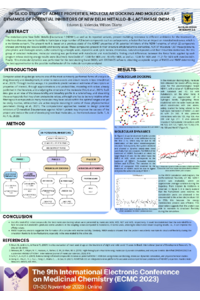
Póster-Congress-2023.pdf
DABCO-functionalized nanoemulsions with antimicrobial properties for potential treatment of ocular myasthenia gravis
Impact of Radiotherapy on Oxidative Stress and Inflammatory Biomarkers in Brain Tumor Patients – preliminary studies