Event submissions
Published
 10.3390/ECMC2023-15661 (registering DOI)
 This submission belongs to the session S5. Natural Products and Biopharmaceuticals of the event 9th International Electronic Conference on Medicinal Chemistry
Published date
01 Nov, 2023
Academic Editor
'%3e%3cpath%20d='M12.6657%2010.9104C12.4185%2010.325%2012.0599%209.79327%2011.6097%209.34482C11.1609%208.89508%2010.6293%208.5365%2010.0442%208.28888C10.0389%208.28626%2010.0337%208.28495%2010.0285%208.28233C10.8446%207.69279%2011.3752%206.73249%2011.3752%205.64904C11.3752%203.8542%209.92103%202.39999%208.1262%202.39999C6.33136%202.39999%204.87715%203.8542%204.87715%205.64904C4.87715%206.73249%205.40774%207.69279%206.22393%208.28364C6.21869%208.28626%206.21345%208.28757%206.20821%208.29019C5.62129%208.5378%205.09463%208.89284%204.64265%209.34613C4.1929%209.79493%203.83432%2010.3266%203.58671%2010.9117C3.34345%2011.4845%203.21226%2012.0987%203.20023%2012.7209C3.19988%2012.7349%203.20233%2012.7488%203.20744%2012.7619C3.21255%2012.7749%203.22022%2012.7867%203.22998%2012.7968C3.23975%2012.8068%203.25142%2012.8147%203.26431%2012.8202C3.2772%2012.8256%203.29105%2012.8284%203.30504%2012.8284H4.09109C4.14874%2012.8284%204.19459%2012.7825%204.1959%2012.7262C4.2221%2011.7148%204.62823%2010.7676%205.34617%2010.0497C6.08899%209.30683%207.0755%208.89808%208.1262%208.89808C9.17689%208.89808%2010.1634%209.30683%2010.9062%2010.0497C11.6242%2010.7676%2012.0303%2011.7148%2012.0565%2012.7262C12.0578%2012.7838%2012.1037%2012.8284%2012.1613%2012.8284H12.9474C12.9613%2012.8284%2012.9752%2012.8256%2012.9881%2012.8202C13.001%2012.8147%2013.0126%2012.8068%2013.0224%2012.7968C13.0322%2012.7867%2013.0398%2012.7749%2013.0449%2012.7619C13.0501%2012.7488%2013.0525%2012.7349%2013.0522%2012.7209C13.0391%2012.0947%2012.9094%2011.4855%2012.6657%2010.9104ZM8.1262%207.9024C7.52486%207.9024%206.9589%207.6679%206.53312%207.24211C6.10733%206.81633%205.87283%206.25037%205.87283%205.64904C5.87283%205.0477%206.10733%204.48174%206.53312%204.05596C6.9589%203.63018%207.52486%203.39567%208.1262%203.39567C8.72753%203.39567%209.29349%203.63018%209.71927%204.05596C10.1451%204.48174%2010.3796%205.0477%2010.3796%205.64904C10.3796%206.25037%2010.1451%206.81633%209.71927%207.24211C9.29349%207.6679%208.72753%207.9024%208.1262%207.9024Z'%20fill='%235D1EE1'/%3e%3c/g%3e%3c/svg%3e) Maria Emília Sousa
Maria Emília SousaCitation
Jousef Angel Issa, Rocío Redondo-Castillejo, Marina Hernández-Martín, Claudia Quevedo-Torremocha, Rosa García-Fernández, Alba Garcimartín, Juana Benedí, Aranzazu Bocanegra, Maria Elvira Lopez-Oliva, Can consumption of diatomaceous earth improve intestinal health?, in Proceedings of 9th International Electronic Conference on Medicinal Chemistry, 1 November–30 November 2023, MDPI: Basel, Switzerland, doi: 10.3390/ECMC2023-15661
Share
Email
Facebook
Twitter
LinkedIn
Can consumption of diatomaceous earth improve intestinal health?
'%3e%3cpath%20d='M12.6647%2010.9104C12.4176%2010.325%2012.0589%209.7933%2011.6088%209.34485C11.16%208.89511%2010.6283%208.53653%2010.0432%208.28891C10.038%208.28629%2010.0327%208.28498%2010.0275%208.28236C10.8437%207.69282%2011.3743%206.73252%2011.3743%205.64907C11.3743%203.85423%209.92005%202.40002%208.12522%202.40002C6.33038%202.40002%204.87618%203.85423%204.87618%205.64907C4.87618%206.73252%205.40677%207.69282%206.22296%208.28367C6.21772%208.28629%206.21248%208.2876%206.20724%208.29022C5.62031%208.53783%205.09365%208.89287%204.64167%209.34616C4.19192%209.79496%203.83334%2010.3266%203.58573%2010.9117C3.34247%2011.4846%203.21128%2012.0987%203.19925%2012.721C3.1989%2012.735%203.20135%2012.7489%203.20646%2012.7619C3.21157%2012.7749%203.21924%2012.7868%203.22901%2012.7968C3.23877%2012.8068%203.25045%2012.8148%203.26334%2012.8202C3.27623%2012.8256%203.29007%2012.8284%203.30406%2012.8284H4.09012C4.14776%2012.8284%204.19362%2012.7825%204.19493%2012.7262C4.22113%2011.7148%204.62726%2010.7676%205.34519%2010.0497C6.08802%209.30686%207.07452%208.89811%208.12522%208.89811C9.17592%208.89811%2010.1624%209.30686%2010.9052%2010.0497C11.6232%2010.7676%2012.0293%2011.7148%2012.0555%2012.7262C12.0568%2012.7839%2012.1027%2012.8284%2012.1603%2012.8284H12.9464C12.9604%2012.8284%2012.9742%2012.8256%2012.9871%2012.8202C13%2012.8148%2013.0117%2012.8068%2013.0214%2012.7968C13.0312%2012.7868%2013.0389%2012.7749%2013.044%2012.7619C13.0491%2012.7489%2013.0515%2012.735%2013.0512%2012.721C13.0381%2012.0947%2012.9084%2011.4856%2012.6647%2010.9104ZM8.12522%207.90243C7.52388%207.90243%206.95792%207.66793%206.53214%207.24215C6.10636%206.81636%205.87185%206.2504%205.87185%205.64907C5.87185%205.04773%206.10636%204.48177%206.53214%204.05599C6.95792%203.63021%207.52388%203.3957%208.12522%203.3957C8.72655%203.3957%209.29252%203.63021%209.7183%204.05599C10.1441%204.48177%2010.3786%205.04773%2010.3786%205.64907C10.3786%206.2504%2010.1441%206.81636%209.7183%207.24215C9.29252%207.66793%208.72655%207.90243%208.12522%207.90243Z'%20fill='%235D1EE1'/%3e%3c/g%3e%3c/svg%3e)
Jousef Angel Issa 1
Rocío Redondo-Castillejo 2
Marina Hernández-Martín 1
Claudia Quevedo-Torremocha 2
Rosa García-Fernández 3
Alba Garcimartín 2
Juana Benedí 2
Aranzazu Bocanegra 2
Maria Elvira Lopez-Oliva 1
1. Departmental Section of Physiology. Faculty of Pharmacy, Complutense University of Madrid, Spain.
2. Department of Pharmacology, Pharmacognosy and Botany. Faculty of Pharmacy. Complutense University of Madrid, Spain
3. Animal Medicine and Surgery Department, Veterinary School, Complutense University of Madrid, Spain.
Abstract
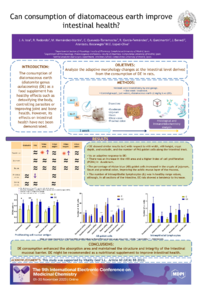
The consumption of diatomaceous earth (DE) as a food supplement has healthy effects such as detoxifying the body, controlling parasites or improving joint and bone health. However, its effects on intestinal health have not been demonstrated. The aim of this study was to analyze the adaptive morphology changes at the intestinal level derived from the consumption of DE (Vitality Gesf SL) in rats. Animals were treated daily by oral gavage for one week without (C, control group) or with DE (2 mg/kg b.w) (DE group). The villi absorption area, the renewal and differentiation of the epithelium and the integrity of the barrier of the small and large intestine have been studied. DE-supplemented group showed similar results to C group with respect to villi width, crypt depth, and occludin, and the number of PAS goblet cells along the intestinal tract. As an adaptive response to DE, there was an increase in the villi area and absorption surface due to the higher index of cell proliferation in the duodenum and ileum. Furthermore, the percentage of AB goblet cells increased in the crypts of jejunum, ileum and proximal colon, improving the acidic mucus layer of the mucosa. The number of intraepithelial lymphocytes was in healthy range values, although, in all sections of the intestine, DE rats showed a tendency to increase, improving the defense system. No DE-induced negative effects have been found. DE consumption may be recommended to improve intestinal health by increasing the absorption area and maintaining the integrity of the intestinal mucosal barrier.
Keywords
Diatomaceous earth
supplementary food
gut morphology
small intestine
colon
intestine barrier.
Manuscript
9th-ECMC_Abstract_template.pdf
Poster
9th-ECMC_Poster_template.pdf
Adarotene-related retinoids as potential antimicrobial agents against multidrug-resistant gram-positive strains
DNA/BSA binding study of phenothiazine and its N-methyl-substituted derivative