Event submissions
Published
 10.3390/ECMC2023-15673 (registering DOI)
 This submission belongs to the session S7. Emerging technologies in drug discovery of the event 9th International Electronic Conference on Medicinal Chemistry
Published date
01 Nov, 2023
Academic Editor
'%3e%3cpath%20d='M12.6657%2010.9104C12.4185%2010.325%2012.0599%209.79327%2011.6097%209.34482C11.1609%208.89508%2010.6293%208.5365%2010.0442%208.28888C10.0389%208.28626%2010.0337%208.28495%2010.0285%208.28233C10.8446%207.69279%2011.3752%206.73249%2011.3752%205.64904C11.3752%203.8542%209.92103%202.39999%208.1262%202.39999C6.33136%202.39999%204.87715%203.8542%204.87715%205.64904C4.87715%206.73249%205.40774%207.69279%206.22393%208.28364C6.21869%208.28626%206.21345%208.28757%206.20821%208.29019C5.62129%208.5378%205.09463%208.89284%204.64265%209.34613C4.1929%209.79493%203.83432%2010.3266%203.58671%2010.9117C3.34345%2011.4845%203.21226%2012.0987%203.20023%2012.7209C3.19988%2012.7349%203.20233%2012.7488%203.20744%2012.7619C3.21255%2012.7749%203.22022%2012.7867%203.22998%2012.7968C3.23975%2012.8068%203.25142%2012.8147%203.26431%2012.8202C3.2772%2012.8256%203.29105%2012.8284%203.30504%2012.8284H4.09109C4.14874%2012.8284%204.19459%2012.7825%204.1959%2012.7262C4.2221%2011.7148%204.62823%2010.7676%205.34617%2010.0497C6.08899%209.30683%207.0755%208.89808%208.1262%208.89808C9.17689%208.89808%2010.1634%209.30683%2010.9062%2010.0497C11.6242%2010.7676%2012.0303%2011.7148%2012.0565%2012.7262C12.0578%2012.7838%2012.1037%2012.8284%2012.1613%2012.8284H12.9474C12.9613%2012.8284%2012.9752%2012.8256%2012.9881%2012.8202C13.001%2012.8147%2013.0126%2012.8068%2013.0224%2012.7968C13.0322%2012.7867%2013.0398%2012.7749%2013.0449%2012.7619C13.0501%2012.7488%2013.0525%2012.7349%2013.0522%2012.7209C13.0391%2012.0947%2012.9094%2011.4855%2012.6657%2010.9104ZM8.1262%207.9024C7.52486%207.9024%206.9589%207.6679%206.53312%207.24211C6.10733%206.81633%205.87283%206.25037%205.87283%205.64904C5.87283%205.0477%206.10733%204.48174%206.53312%204.05596C6.9589%203.63018%207.52486%203.39567%208.1262%203.39567C8.72753%203.39567%209.29349%203.63018%209.71927%204.05596C10.1451%204.48174%2010.3796%205.0477%2010.3796%205.64904C10.3796%206.25037%2010.1451%206.81633%209.71927%207.24211C9.29349%207.6679%208.72753%207.9024%208.1262%207.9024Z'%20fill='%235D1EE1'/%3e%3c/g%3e%3c/svg%3e) Alfredo Berzal-Herranz
Alfredo Berzal-HerranzCitation
Yuliya Martyshkina, Valeriy Tereshchenko, Stanislav Rybtsov, Identification and characterization of senescent cells in human and nonhuman primate peripheral blood CD3+ T-lymphocyte populations., in Proceedings of 9th International Electronic Conference on Medicinal Chemistry, 1 November–30 November 2023, MDPI: Basel, Switzerland, doi: 10.3390/ECMC2023-15673
Share
Email
Facebook
Twitter
LinkedIn
Identification and characterization of senescent cells in human and nonhuman primate peripheral blood CD3+ T-lymphocyte populations.
'%3e%3cpath%20d='M12.6647%2010.9104C12.4176%2010.325%2012.0589%209.7933%2011.6088%209.34485C11.16%208.89511%2010.6283%208.53653%2010.0432%208.28891C10.038%208.28629%2010.0327%208.28498%2010.0275%208.28236C10.8437%207.69282%2011.3743%206.73252%2011.3743%205.64907C11.3743%203.85423%209.92005%202.40002%208.12522%202.40002C6.33038%202.40002%204.87618%203.85423%204.87618%205.64907C4.87618%206.73252%205.40677%207.69282%206.22296%208.28367C6.21772%208.28629%206.21248%208.2876%206.20724%208.29022C5.62031%208.53783%205.09365%208.89287%204.64167%209.34616C4.19192%209.79496%203.83334%2010.3266%203.58573%2010.9117C3.34247%2011.4846%203.21128%2012.0987%203.19925%2012.721C3.1989%2012.735%203.20135%2012.7489%203.20646%2012.7619C3.21157%2012.7749%203.21924%2012.7868%203.22901%2012.7968C3.23877%2012.8068%203.25045%2012.8148%203.26334%2012.8202C3.27623%2012.8256%203.29007%2012.8284%203.30406%2012.8284H4.09012C4.14776%2012.8284%204.19362%2012.7825%204.19493%2012.7262C4.22113%2011.7148%204.62726%2010.7676%205.34519%2010.0497C6.08802%209.30686%207.07452%208.89811%208.12522%208.89811C9.17592%208.89811%2010.1624%209.30686%2010.9052%2010.0497C11.6232%2010.7676%2012.0293%2011.7148%2012.0555%2012.7262C12.0568%2012.7839%2012.1027%2012.8284%2012.1603%2012.8284H12.9464C12.9604%2012.8284%2012.9742%2012.8256%2012.9871%2012.8202C13%2012.8148%2013.0117%2012.8068%2013.0214%2012.7968C13.0312%2012.7868%2013.0389%2012.7749%2013.044%2012.7619C13.0491%2012.7489%2013.0515%2012.735%2013.0512%2012.721C13.0381%2012.0947%2012.9084%2011.4856%2012.6647%2010.9104ZM8.12522%207.90243C7.52388%207.90243%206.95792%207.66793%206.53214%207.24215C6.10636%206.81636%205.87185%206.2504%205.87185%205.64907C5.87185%205.04773%206.10636%204.48177%206.53214%204.05599C6.95792%203.63021%207.52388%203.3957%208.12522%203.3957C8.72655%203.3957%209.29252%203.63021%209.7183%204.05599C10.1441%204.48177%2010.3786%205.04773%2010.3786%205.64907C10.3786%206.2504%2010.1441%206.81636%209.7183%207.24215C9.29252%207.66793%208.72655%207.90243%208.12522%207.90243Z'%20fill='%235D1EE1'/%3e%3c/g%3e%3c/svg%3e)
Yuliya Martyshkina 1
Valeriy Tereshchenko 1
Stanislav Rybtsov 1
1. Sirius university of science and technology, Olimpiyskiy ave. b.1, Sirius, Krasnodar region, Russia, 354340
Abstract
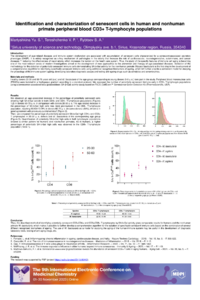
The development of age-related diseases and immune system dysfunction are associated with accumulation of senescent cells characterized by a senescent-associated secretory phenotype (SASP). It is widely recognized as a key mechanism of pathologies in the elderly that increase the risk of cardiovascular, neurodegenerative, autoimmune, and cancer diseases, reducing the effectiveness of vaccinations, which increases the burden on the health care system. Research the mechanisms of immunosenescence offers new approaches for the prevention and therapy of age-related diseases. In this study, immune cells aging were measured using a senescence-associated beta-galactosidase (SA-β-Gal) assay by FACS. The number of SA-β-Galhigh CD3+ Т-cells significantly increases in peripheral blood of aged donors (>60 y.o.) compared with 20-30 y.o. The most dramatic differences in the number of senescent cells were observed in CD8+ T-cells, while the differences were less pronounced in CD4+ T cells. In agreement with previously published data SA-β-Galhigh lymphocytes express p16 and p21 (cell cycle arrest proteins). Further verification by secretion of SASP inflammatory cytokines, extra-nuclear localization of HMGB1, histone H2AX phosphorylation (γH2AX) and functional tests will confirm senescent status of SA-β-Galhigh T-cells. A comparative study of Macaca fascicularis samples of different ages, including very old, 20-30-year-old animals, will contribute for uncovering the conservative aging mechanisms in primates. This research will facilitate establishing a convenient model for testing small molecules and FDA-approved substances as potential anti-aging drugs and will serve as a basis for the development of new effective solutions to support active and healthy longevity. Study supported by Russian Science Foundation https://rscf.ru/project/23-15-00443.
Keywords
senescence
immunosenescence
SA-b-Gal
ageing
drug testing models
Manuscript
Manuscript_Identification and characterization of senescent cells in human and nonhuman primate peripheral blood CD3+ T-lymphocyte populations.pdf
Poster
9th-ECMC_Poster.pdf
Identification of novel steroidal inhibitors of AKR1C4
Investigation of Polymeric Carrier Uptake and Passage within Cellular Spheroids Using Advanced Analytical Techniques