Event submissions
Published
 10.3390/ECMC2023-15692 (registering DOI)
 This submission belongs to the session S6. Novel and Sustainable approaches in Medicinal Chemistry of the event 9th International Electronic Conference on Medicinal Chemistry
Published date
01 Nov, 2023
Academic Editor
'%3e%3cpath%20d='M12.6657%2010.9104C12.4185%2010.325%2012.0599%209.79327%2011.6097%209.34482C11.1609%208.89508%2010.6293%208.5365%2010.0442%208.28888C10.0389%208.28626%2010.0337%208.28495%2010.0285%208.28233C10.8446%207.69279%2011.3752%206.73249%2011.3752%205.64904C11.3752%203.8542%209.92103%202.39999%208.1262%202.39999C6.33136%202.39999%204.87715%203.8542%204.87715%205.64904C4.87715%206.73249%205.40774%207.69279%206.22393%208.28364C6.21869%208.28626%206.21345%208.28757%206.20821%208.29019C5.62129%208.5378%205.09463%208.89284%204.64265%209.34613C4.1929%209.79493%203.83432%2010.3266%203.58671%2010.9117C3.34345%2011.4845%203.21226%2012.0987%203.20023%2012.7209C3.19988%2012.7349%203.20233%2012.7488%203.20744%2012.7619C3.21255%2012.7749%203.22022%2012.7867%203.22998%2012.7968C3.23975%2012.8068%203.25142%2012.8147%203.26431%2012.8202C3.2772%2012.8256%203.29105%2012.8284%203.30504%2012.8284H4.09109C4.14874%2012.8284%204.19459%2012.7825%204.1959%2012.7262C4.2221%2011.7148%204.62823%2010.7676%205.34617%2010.0497C6.08899%209.30683%207.0755%208.89808%208.1262%208.89808C9.17689%208.89808%2010.1634%209.30683%2010.9062%2010.0497C11.6242%2010.7676%2012.0303%2011.7148%2012.0565%2012.7262C12.0578%2012.7838%2012.1037%2012.8284%2012.1613%2012.8284H12.9474C12.9613%2012.8284%2012.9752%2012.8256%2012.9881%2012.8202C13.001%2012.8147%2013.0126%2012.8068%2013.0224%2012.7968C13.0322%2012.7867%2013.0398%2012.7749%2013.0449%2012.7619C13.0501%2012.7488%2013.0525%2012.7349%2013.0522%2012.7209C13.0391%2012.0947%2012.9094%2011.4855%2012.6657%2010.9104ZM8.1262%207.9024C7.52486%207.9024%206.9589%207.6679%206.53312%207.24211C6.10733%206.81633%205.87283%206.25037%205.87283%205.64904C5.87283%205.0477%206.10733%204.48174%206.53312%204.05596C6.9589%203.63018%207.52486%203.39567%208.1262%203.39567C8.72753%203.39567%209.29349%203.63018%209.71927%204.05596C10.1451%204.48174%2010.3796%205.0477%2010.3796%205.64904C10.3796%206.25037%2010.1451%206.81633%209.71927%207.24211C9.29349%207.6679%208.72753%207.9024%208.1262%207.9024Z'%20fill='%235D1EE1'/%3e%3c/g%3e%3c/svg%3e) Alfredo Berzal-Herranz
Alfredo Berzal-HerranzCitation
Bojarska Joanna, Krzysztof Kaczmarek, Wojciech Wolf, Pseudo-cyclic short peptides: new supramolecular synthons in design of effective anticancer theranostics, in Proceedings of 9th International Electronic Conference on Medicinal Chemistry, 1 November–30 November 2023, MDPI: Basel, Switzerland, doi: 10.3390/ECMC2023-15692
Share
Email
Facebook
Twitter
LinkedIn
Pseudo-cyclic short peptides: new supramolecular synthons in design of effective anticancer theranostics
'%3e%3cpath%20d='M12.6647%2010.9104C12.4176%2010.325%2012.0589%209.7933%2011.6088%209.34485C11.16%208.89511%2010.6283%208.53653%2010.0432%208.28891C10.038%208.28629%2010.0327%208.28498%2010.0275%208.28236C10.8437%207.69282%2011.3743%206.73252%2011.3743%205.64907C11.3743%203.85423%209.92005%202.40002%208.12522%202.40002C6.33038%202.40002%204.87618%203.85423%204.87618%205.64907C4.87618%206.73252%205.40677%207.69282%206.22296%208.28367C6.21772%208.28629%206.21248%208.2876%206.20724%208.29022C5.62031%208.53783%205.09365%208.89287%204.64167%209.34616C4.19192%209.79496%203.83334%2010.3266%203.58573%2010.9117C3.34247%2011.4846%203.21128%2012.0987%203.19925%2012.721C3.1989%2012.735%203.20135%2012.7489%203.20646%2012.7619C3.21157%2012.7749%203.21924%2012.7868%203.22901%2012.7968C3.23877%2012.8068%203.25045%2012.8148%203.26334%2012.8202C3.27623%2012.8256%203.29007%2012.8284%203.30406%2012.8284H4.09012C4.14776%2012.8284%204.19362%2012.7825%204.19493%2012.7262C4.22113%2011.7148%204.62726%2010.7676%205.34519%2010.0497C6.08802%209.30686%207.07452%208.89811%208.12522%208.89811C9.17592%208.89811%2010.1624%209.30686%2010.9052%2010.0497C11.6232%2010.7676%2012.0293%2011.7148%2012.0555%2012.7262C12.0568%2012.7839%2012.1027%2012.8284%2012.1603%2012.8284H12.9464C12.9604%2012.8284%2012.9742%2012.8256%2012.9871%2012.8202C13%2012.8148%2013.0117%2012.8068%2013.0214%2012.7968C13.0312%2012.7868%2013.0389%2012.7749%2013.044%2012.7619C13.0491%2012.7489%2013.0515%2012.735%2013.0512%2012.721C13.0381%2012.0947%2012.9084%2011.4856%2012.6647%2010.9104ZM8.12522%207.90243C7.52388%207.90243%206.95792%207.66793%206.53214%207.24215C6.10636%206.81636%205.87185%206.2504%205.87185%205.64907C5.87185%205.04773%206.10636%204.48177%206.53214%204.05599C6.95792%203.63021%207.52388%203.3957%208.12522%203.3957C8.72655%203.3957%209.29252%203.63021%209.7183%204.05599C10.1441%204.48177%2010.3786%205.04773%2010.3786%205.64907C10.3786%206.2504%2010.1441%206.81636%209.7183%207.24215C9.29252%207.66793%208.72655%207.90243%208.12522%207.90243Z'%20fill='%235D1EE1'/%3e%3c/g%3e%3c/svg%3e)
Bojarska Joanna 1
Krzysztof Kaczmarek 2
Wojciech Wolf 3
1. Chemistry Department, Institute of Ecological and Inorganic Chemistry, Technical University of Lodz, 116 Zeromskiego St, Lodz 90-924, Poland
2. Technical University of Lodz
3. The Lodz University of Technology, Faculty of Chemistry, Institute of General & Inorganic Chemistry, Lodz, Poland
Abstract
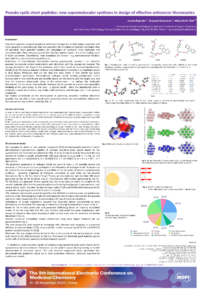
Ultra-short peptides have great promise in anticancer therapy due to their unique properties and recent progress in biotechnology that help overcome the limitations of peptides and realize their full potential. Short peptides combine the advantages of traditional small molecules and macromolecules, i.e. greater conformational rigidity, stability, bioactivity, bioavailability, tissue specificity, selectivity, permeability through cell membranes, faster biological effect, biocompatibility, biodegradability, lower toxicity, and immunogenicity, easier and cheaper for large synthesis scale. The main disadvantages of peptides include high conformational freedom, short half-life in vivo, and low bioavailability. Modulating intramolecular interactions forming pseudo-cyclic systems is an attractive approach to precisely control conformation and interaction with the appropriate receptor. These interactions increase both in vivo stability and permeability across cell membranes and into target cells. Our studies concentrate on the development of ultra-short peptides that are able to form pseudo-cyclic systems/synthons via intramolecular interactions. In addition, these systems can be stabilized by weak π-based intramolecular interactions. The interactions play a role in protecting the polar group (in this case - peptide bond). Thus, these compounds can be useful in research on molecules that can adapt the particles to the environment (molecular chameleons) - when the closed/cyclic form is preferred in an apolar environment, e.g. inside a cell membrane, and the open one - in an aqueous medium. On the poster, we will present the results of our studies on the development and characterization of these peptides in detail. We will focus on discussing the new synthons - pseudo-(bi)cyclic systems via intramolecular interactions in the rational design of a new generation of safe and effective theranostics.
Keywords
ultra-short peptides
pseudo-cyclic systems
anticancer theranostics
supramolecular synthons
Manuscript
9th-ECMC_Poster_JB.pdf
Poster
9th-ECMC_Poster_JB.pdf
Synthesis, in vitro steroid receptor binding and in silico testing of novel 17α-(pyridin-2-yl)estra-1,3,5(10),16-tetraen derivatives
Novel sulfonamide inhibitors of CYP19A1: design, synthesis, biological assays, and in silico study