Event submissions
Published
 10.3390/ECMC2023-15695 (registering DOI)
 This submission belongs to the session S4. New Small molecules as drug candidates of the event 9th International Electronic Conference on Medicinal Chemistry
Published date
01 Nov, 2023
Academic Editor
'%3e%3cpath%20d='M12.6657%2010.9104C12.4185%2010.325%2012.0599%209.79327%2011.6097%209.34482C11.1609%208.89508%2010.6293%208.5365%2010.0442%208.28888C10.0389%208.28626%2010.0337%208.28495%2010.0285%208.28233C10.8446%207.69279%2011.3752%206.73249%2011.3752%205.64904C11.3752%203.8542%209.92103%202.39999%208.1262%202.39999C6.33136%202.39999%204.87715%203.8542%204.87715%205.64904C4.87715%206.73249%205.40774%207.69279%206.22393%208.28364C6.21869%208.28626%206.21345%208.28757%206.20821%208.29019C5.62129%208.5378%205.09463%208.89284%204.64265%209.34613C4.1929%209.79493%203.83432%2010.3266%203.58671%2010.9117C3.34345%2011.4845%203.21226%2012.0987%203.20023%2012.7209C3.19988%2012.7349%203.20233%2012.7488%203.20744%2012.7619C3.21255%2012.7749%203.22022%2012.7867%203.22998%2012.7968C3.23975%2012.8068%203.25142%2012.8147%203.26431%2012.8202C3.2772%2012.8256%203.29105%2012.8284%203.30504%2012.8284H4.09109C4.14874%2012.8284%204.19459%2012.7825%204.1959%2012.7262C4.2221%2011.7148%204.62823%2010.7676%205.34617%2010.0497C6.08899%209.30683%207.0755%208.89808%208.1262%208.89808C9.17689%208.89808%2010.1634%209.30683%2010.9062%2010.0497C11.6242%2010.7676%2012.0303%2011.7148%2012.0565%2012.7262C12.0578%2012.7838%2012.1037%2012.8284%2012.1613%2012.8284H12.9474C12.9613%2012.8284%2012.9752%2012.8256%2012.9881%2012.8202C13.001%2012.8147%2013.0126%2012.8068%2013.0224%2012.7968C13.0322%2012.7867%2013.0398%2012.7749%2013.0449%2012.7619C13.0501%2012.7488%2013.0525%2012.7349%2013.0522%2012.7209C13.0391%2012.0947%2012.9094%2011.4855%2012.6657%2010.9104ZM8.1262%207.9024C7.52486%207.9024%206.9589%207.6679%206.53312%207.24211C6.10733%206.81633%205.87283%206.25037%205.87283%205.64904C5.87283%205.0477%206.10733%204.48174%206.53312%204.05596C6.9589%203.63018%207.52486%203.39567%208.1262%203.39567C8.72753%203.39567%209.29349%203.63018%209.71927%204.05596C10.1451%204.48174%2010.3796%205.0477%2010.3796%205.64904C10.3796%206.25037%2010.1451%206.81633%209.71927%207.24211C9.29349%207.6679%208.72753%207.9024%208.1262%207.9024Z'%20fill='%235D1EE1'/%3e%3c/g%3e%3c/svg%3e) Alfredo Berzal-Herranz
Alfredo Berzal-HerranzCitation
Diana Grigoreva, Lyubov Grebenkina, Varvara Maksimova, Ekaterina Mikhina, Ekaterina Lesovaya, Andrey Matveev, Marianna Yakubovskaya, Ekaterina Zhidkova, In vitro anticancer effects of 1,2,4-triazole-3-carboxamides, in Proceedings of 9th International Electronic Conference on Medicinal Chemistry, 1 November–30 November 2023, MDPI: Basel, Switzerland, doi: 10.3390/ECMC2023-15695
Share
Email
Facebook
Twitter
LinkedIn
In vitro anticancer effects of 1,2,4-triazole-3-carboxamides
'%3e%3cpath%20d='M12.6647%2010.9104C12.4176%2010.325%2012.0589%209.7933%2011.6088%209.34485C11.16%208.89511%2010.6283%208.53653%2010.0432%208.28891C10.038%208.28629%2010.0327%208.28498%2010.0275%208.28236C10.8437%207.69282%2011.3743%206.73252%2011.3743%205.64907C11.3743%203.85423%209.92005%202.40002%208.12522%202.40002C6.33038%202.40002%204.87618%203.85423%204.87618%205.64907C4.87618%206.73252%205.40677%207.69282%206.22296%208.28367C6.21772%208.28629%206.21248%208.2876%206.20724%208.29022C5.62031%208.53783%205.09365%208.89287%204.64167%209.34616C4.19192%209.79496%203.83334%2010.3266%203.58573%2010.9117C3.34247%2011.4846%203.21128%2012.0987%203.19925%2012.721C3.1989%2012.735%203.20135%2012.7489%203.20646%2012.7619C3.21157%2012.7749%203.21924%2012.7868%203.22901%2012.7968C3.23877%2012.8068%203.25045%2012.8148%203.26334%2012.8202C3.27623%2012.8256%203.29007%2012.8284%203.30406%2012.8284H4.09012C4.14776%2012.8284%204.19362%2012.7825%204.19493%2012.7262C4.22113%2011.7148%204.62726%2010.7676%205.34519%2010.0497C6.08802%209.30686%207.07452%208.89811%208.12522%208.89811C9.17592%208.89811%2010.1624%209.30686%2010.9052%2010.0497C11.6232%2010.7676%2012.0293%2011.7148%2012.0555%2012.7262C12.0568%2012.7839%2012.1027%2012.8284%2012.1603%2012.8284H12.9464C12.9604%2012.8284%2012.9742%2012.8256%2012.9871%2012.8202C13%2012.8148%2013.0117%2012.8068%2013.0214%2012.7968C13.0312%2012.7868%2013.0389%2012.7749%2013.044%2012.7619C13.0491%2012.7489%2013.0515%2012.735%2013.0512%2012.721C13.0381%2012.0947%2012.9084%2011.4856%2012.6647%2010.9104ZM8.12522%207.90243C7.52388%207.90243%206.95792%207.66793%206.53214%207.24215C6.10636%206.81636%205.87185%206.2504%205.87185%205.64907C5.87185%205.04773%206.10636%204.48177%206.53214%204.05599C6.95792%203.63021%207.52388%203.3957%208.12522%203.3957C8.72655%203.3957%209.29252%203.63021%209.7183%204.05599C10.1441%204.48177%2010.3786%205.04773%2010.3786%205.64907C10.3786%206.2504%2010.1441%206.81636%209.7183%207.24215C9.29252%207.66793%208.72655%207.90243%208.12522%207.90243Z'%20fill='%235D1EE1'/%3e%3c/g%3e%3c/svg%3e)
Diana Grigoreva 1
Lyubov Grebenkina 2
Varvara Maksimova 1
Ekaterina Mikhina 2
Ekaterina Lesovaya 1,3,4
Andrey Matveev 2
Marianna Yakubovskaya 1
Ekaterina Zhidkova 1
1. N.N. Blokhin Russian Cancer Research Center, Ministry of Health of Russia; 24 Kashirskoe Shosse, Moscow, 115478, Russia
2. MIREA - Russian Technological University, Lomonosov Institute of Fine Chemical Technologies; 78 Vernadsky Avenue, Moscow 119571, Russia
3. I.P. Pavlov Ryazan State Medical University, Ministry of Health of Russia; 9 Vysokovol’tnaya St., Ryazan, 390026, Russia
4. Peoples’ Friendship University of Russia; 6 Miklukho-Maklaya St., Moscow 117198, Russia
Abstract
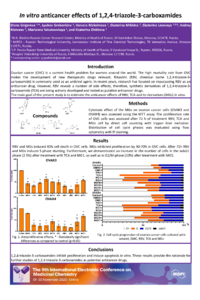
Ovarian cancer (OVC) is a current health problem for women around the world. The high mortality rate from OVC makes the development of new therapeutic drugs relevant. Ribavirin (RBV, chemical name 1,2,4-triazole-3-carboxamide) is commonly used as an antiviral agent. In recent years, research has focused on repurposing RBV as an anticancer drug. However, RBV reveals a number of side effects, so synthetic derivatives of 1,2,4-triazole-3-carboxamide (TCA) are being actively developed and tested as putative anticancer drugs. The purpose of this study is to estimate the anticancer effects of RBV, TCA and its derivatives (MGs) in vitro. Cytotoxic effect of the MGs on ovarian cancer cells (OVAR3 and OVAR4) was assessed using the MTT assay. The proliferation rate of OVC cells was assessed after 72 h of treatment RBV, ТСА and MGs cell counting with trypan blue exclusion. Distribution of cell cycle phases was evaluated using flow cytometry with PI staining. RBV and MGs induced 40% cell death in OVC cells. MGs inhibited proliferation by 50-70% in OVC cells. After 72h RBV and MGs induces S-phase stunting. Furthermore, we demonstrated an increase in the number of cells in the subG1 phase (2.5%) after treatment with MG0 and MG1, as well as in G2/M-phase (10%) after treatment with MG5. According to the results obtained, 1,2,4-triazole-3-carboxamides can inhibit proliferation and induce apoptosis in vitro. These results provide the rationale for further studies of 1,2,4-triazole-3-carboxamides like anticancer drugs.
Keywords
ovarian cancer
ribavirin
1,2,4-triazole-3-carboxamides
cell cycle
Manuscript
9th-ECMC_Abstract_template_Grigoreva_DD.pdf
Poster
9th-ECMC_Poster_template_Grigoreva_DD.pdf
Anti-neuroinflammatory activity of selected 2-pyridone derivatives: In vitro and in silico study
In silico identification of a potential inhibitor of the SARS-CoV-2 S-glycoprotein receptor-binding domain interaction with human ACE2