Event submissions
Published
 10.3390/ECMC2023-15701 (registering DOI)
 This submission belongs to the session S5. Natural Products and Biopharmaceuticals of the event 9th International Electronic Conference on Medicinal Chemistry
Published date
01 Nov, 2023
Academic Editor
'%3e%3cpath%20d='M12.6657%2010.9104C12.4185%2010.325%2012.0599%209.79327%2011.6097%209.34482C11.1609%208.89508%2010.6293%208.5365%2010.0442%208.28888C10.0389%208.28626%2010.0337%208.28495%2010.0285%208.28233C10.8446%207.69279%2011.3752%206.73249%2011.3752%205.64904C11.3752%203.8542%209.92103%202.39999%208.1262%202.39999C6.33136%202.39999%204.87715%203.8542%204.87715%205.64904C4.87715%206.73249%205.40774%207.69279%206.22393%208.28364C6.21869%208.28626%206.21345%208.28757%206.20821%208.29019C5.62129%208.5378%205.09463%208.89284%204.64265%209.34613C4.1929%209.79493%203.83432%2010.3266%203.58671%2010.9117C3.34345%2011.4845%203.21226%2012.0987%203.20023%2012.7209C3.19988%2012.7349%203.20233%2012.7488%203.20744%2012.7619C3.21255%2012.7749%203.22022%2012.7867%203.22998%2012.7968C3.23975%2012.8068%203.25142%2012.8147%203.26431%2012.8202C3.2772%2012.8256%203.29105%2012.8284%203.30504%2012.8284H4.09109C4.14874%2012.8284%204.19459%2012.7825%204.1959%2012.7262C4.2221%2011.7148%204.62823%2010.7676%205.34617%2010.0497C6.08899%209.30683%207.0755%208.89808%208.1262%208.89808C9.17689%208.89808%2010.1634%209.30683%2010.9062%2010.0497C11.6242%2010.7676%2012.0303%2011.7148%2012.0565%2012.7262C12.0578%2012.7838%2012.1037%2012.8284%2012.1613%2012.8284H12.9474C12.9613%2012.8284%2012.9752%2012.8256%2012.9881%2012.8202C13.001%2012.8147%2013.0126%2012.8068%2013.0224%2012.7968C13.0322%2012.7867%2013.0398%2012.7749%2013.0449%2012.7619C13.0501%2012.7488%2013.0525%2012.7349%2013.0522%2012.7209C13.0391%2012.0947%2012.9094%2011.4855%2012.6657%2010.9104ZM8.1262%207.9024C7.52486%207.9024%206.9589%207.6679%206.53312%207.24211C6.10733%206.81633%205.87283%206.25037%205.87283%205.64904C5.87283%205.0477%206.10733%204.48174%206.53312%204.05596C6.9589%203.63018%207.52486%203.39567%208.1262%203.39567C8.72753%203.39567%209.29349%203.63018%209.71927%204.05596C10.1451%204.48174%2010.3796%205.0477%2010.3796%205.64904C10.3796%206.25037%2010.1451%206.81633%209.71927%207.24211C9.29349%207.6679%208.72753%207.9024%208.1262%207.9024Z'%20fill='%235D1EE1'/%3e%3c/g%3e%3c/svg%3e) Alfredo Berzal-Herranz
Alfredo Berzal-HerranzCitation
Haifa Alhaidal, Sahar Alghamdi, Lamis Alsaqer, Layan Al Tuhayni, Fai Alanazi, Afrah Mohammed, Arwa Alsubait, Maali Alshammari, Zeyad Alehaideb, Nanoparticles Derived from Rhazya Stricta: Promising Advances for Anti-Cancer/Anti-Bacterial Treatment - In Vitro Studies, in Proceedings of 9th International Electronic Conference on Medicinal Chemistry, 1 November–30 November 2023, MDPI: Basel, Switzerland, doi: 10.3390/ECMC2023-15701
Share
Email
Facebook
Twitter
LinkedIn
Nanoparticles Derived from Rhazya Stricta: Promising Advances for Anti-Cancer/Anti-Bacterial Treatment - In Vitro Studies
'%3e%3cpath%20d='M12.6647%2010.9104C12.4176%2010.325%2012.0589%209.7933%2011.6088%209.34485C11.16%208.89511%2010.6283%208.53653%2010.0432%208.28891C10.038%208.28629%2010.0327%208.28498%2010.0275%208.28236C10.8437%207.69282%2011.3743%206.73252%2011.3743%205.64907C11.3743%203.85423%209.92005%202.40002%208.12522%202.40002C6.33038%202.40002%204.87618%203.85423%204.87618%205.64907C4.87618%206.73252%205.40677%207.69282%206.22296%208.28367C6.21772%208.28629%206.21248%208.2876%206.20724%208.29022C5.62031%208.53783%205.09365%208.89287%204.64167%209.34616C4.19192%209.79496%203.83334%2010.3266%203.58573%2010.9117C3.34247%2011.4846%203.21128%2012.0987%203.19925%2012.721C3.1989%2012.735%203.20135%2012.7489%203.20646%2012.7619C3.21157%2012.7749%203.21924%2012.7868%203.22901%2012.7968C3.23877%2012.8068%203.25045%2012.8148%203.26334%2012.8202C3.27623%2012.8256%203.29007%2012.8284%203.30406%2012.8284H4.09012C4.14776%2012.8284%204.19362%2012.7825%204.19493%2012.7262C4.22113%2011.7148%204.62726%2010.7676%205.34519%2010.0497C6.08802%209.30686%207.07452%208.89811%208.12522%208.89811C9.17592%208.89811%2010.1624%209.30686%2010.9052%2010.0497C11.6232%2010.7676%2012.0293%2011.7148%2012.0555%2012.7262C12.0568%2012.7839%2012.1027%2012.8284%2012.1603%2012.8284H12.9464C12.9604%2012.8284%2012.9742%2012.8256%2012.9871%2012.8202C13%2012.8148%2013.0117%2012.8068%2013.0214%2012.7968C13.0312%2012.7868%2013.0389%2012.7749%2013.044%2012.7619C13.0491%2012.7489%2013.0515%2012.735%2013.0512%2012.721C13.0381%2012.0947%2012.9084%2011.4856%2012.6647%2010.9104ZM8.12522%207.90243C7.52388%207.90243%206.95792%207.66793%206.53214%207.24215C6.10636%206.81636%205.87185%206.2504%205.87185%205.64907C5.87185%205.04773%206.10636%204.48177%206.53214%204.05599C6.95792%203.63021%207.52388%203.3957%208.12522%203.3957C8.72655%203.3957%209.29252%203.63021%209.7183%204.05599C10.1441%204.48177%2010.3786%205.04773%2010.3786%205.64907C10.3786%206.2504%2010.1441%206.81636%209.7183%207.24215C9.29252%207.66793%208.72655%207.90243%208.12522%207.90243Z'%20fill='%235D1EE1'/%3e%3c/g%3e%3c/svg%3e)
Haifa Alhaidal 1,2
Sahar Alghamdi 1,2,3
Lamis Alsaqer 1,2
Layan Al Tuhayni 1,2
Fai Alanazi 1,2
Afrah Mohammed 4
Arwa Alsubait 3
Maali Alshammari 5
Zeyad Alehaideb 3
1. College of Pharmacy (COP), King Saud bin Abdulaziz University for Health Sciences (KSAU-HS), Riyadh, Kingdom of Saudi Arabia
2. King Abdulaziz Medical City, Ministry of the National Guard - Health Affairs, Riyadh 11426, Saudi Arabia
3. Medical Research Core Facility and Platforms, King Abdullah International Medical Research Center (KAIMRC), Ministry of National Guard Health Affairs, Riyadh, Saudi Arabia
4. Department of Biology, College of Science, Princess Nourah bint Abdulrahman University (PNU), P.O. Box 84428, Riyadh 11671, Saudi Arabia
5. Department of Pharmaceutical Chemistry, College of Pharmacy, University of Hail, Hail, Saudi Arabia
Abstract
Introduction:
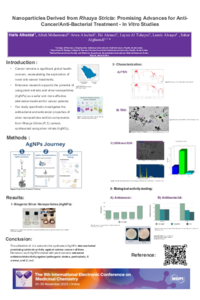
Cancer remains a significant global health concern, necessitating the exploration of novel anti-cancer treatments. Extensive research supports the potential of using plant extracts and silver nanoparticles (AgNPs) as a safer and more effective alternative treatment for cancer patients. Our study specifically investigates the antibacterial and anticancer properties of silver nanoparticles and bio-components from Rhazya Stricta (R.S.) extract, synthesized using silver nitrate (AgNO3). By exploring this treatment option, we aim to provide a safer and more effective alternative to chemotherapy, which can cause severe side effects and increased infection risks for patients.
Method:
AgNPs were synthesized using an aqueous extract of R.S. aerial parts. The organic components were detected using Fourier Transform Infrared (FTIR) spectroscopy, while size distribution, morphology, and surface analysis were examined using Transmission Electron Microscopy (TEM), Scanning Electron Microscopy (SEM) with Energy Dispersive X-ray (EDX) analysis, and Zetasizer measurements. The cytotoxicity of AgNPs was evaluated using an MTT assay on various cancer cell lines (KAIMRC2, MDA-MB231, MCF-7, HCT-116, and MCF-10A). Liquid Chromatography-Mass Spectrometry (LC-MS) was employed to identify biometabolites. Additionally, the antibacterial activity of the prepared nanoparticles was evaluated against Staphylococcus aureus (S. aureus) and Escherichia coli (E. coli) bacterial strains.
Result:
FTIR analysis confirmed the successful synthesis of AgNPs. The average size of AgNPs synthesized was 54.30 nm. SEM and EDX analysis showed speciallyshaped NPs and the presence of several bio-molecules, mainly carbon, oxygen, and silver. The MTT assay demonstrated the cytotoxic activity of AgNPs synthesized from R.S. extract against various cancer cell lines, with IC50 values of 204.5 μg/mL, 154.7 µg/mL, and 168.1 μg/mL, 162.9 μg/mL, 321 μg/mLrespectively. The cytotoxicity was further enhanced after coupling the R.S. extract with AgNO3. Additionally, AgNPs exhibited antimicrobial activity against S. aureus and E. coli strains, with larger zones of inhibition (19mm, 20mm) compared to the crude extract (13mm, 10mm).
Conclusion:
Our study shed light on the potential use of medicinal plant-encapsulatednanoparticles for treating fatal human diseases. The utilization of R.S. extract in the synthesis of AgNPs demonstrated promising cytotoxic activity against various cancer cell lines. Moreover, such AgNPs treated with R.S. extract enhanced antimicrobial activity against pathogenic strains, particularly S. aureus, and E. coli.
Keywords
Rhazya stricta
nanoparticles
anti-cancer therapy
in vitro studies
liquid chromatography-mass spectrometry
Manuscript
Abstract 0909.pdf
Poster
9th-ECMC_Poster_template.pdf
Evaluation of the Antioxidant Activity of Alkaloids Extracted from Peganum harmala Seeds
Evaluation of in vitro cytotoxic and hemolytic effects of a new series of hydroxy- and nitro-containing arylcoumarins