Event submissions
Published
 10.3390/ECMC2023-15706 (registering DOI)
 This submission belongs to the session S5. Natural Products and Biopharmaceuticals of the event 9th International Electronic Conference on Medicinal Chemistry
Published date
01 Nov, 2023
Academic Editor
'%3e%3cpath%20d='M12.6657%2010.9104C12.4185%2010.325%2012.0599%209.79327%2011.6097%209.34482C11.1609%208.89508%2010.6293%208.5365%2010.0442%208.28888C10.0389%208.28626%2010.0337%208.28495%2010.0285%208.28233C10.8446%207.69279%2011.3752%206.73249%2011.3752%205.64904C11.3752%203.8542%209.92103%202.39999%208.1262%202.39999C6.33136%202.39999%204.87715%203.8542%204.87715%205.64904C4.87715%206.73249%205.40774%207.69279%206.22393%208.28364C6.21869%208.28626%206.21345%208.28757%206.20821%208.29019C5.62129%208.5378%205.09463%208.89284%204.64265%209.34613C4.1929%209.79493%203.83432%2010.3266%203.58671%2010.9117C3.34345%2011.4845%203.21226%2012.0987%203.20023%2012.7209C3.19988%2012.7349%203.20233%2012.7488%203.20744%2012.7619C3.21255%2012.7749%203.22022%2012.7867%203.22998%2012.7968C3.23975%2012.8068%203.25142%2012.8147%203.26431%2012.8202C3.2772%2012.8256%203.29105%2012.8284%203.30504%2012.8284H4.09109C4.14874%2012.8284%204.19459%2012.7825%204.1959%2012.7262C4.2221%2011.7148%204.62823%2010.7676%205.34617%2010.0497C6.08899%209.30683%207.0755%208.89808%208.1262%208.89808C9.17689%208.89808%2010.1634%209.30683%2010.9062%2010.0497C11.6242%2010.7676%2012.0303%2011.7148%2012.0565%2012.7262C12.0578%2012.7838%2012.1037%2012.8284%2012.1613%2012.8284H12.9474C12.9613%2012.8284%2012.9752%2012.8256%2012.9881%2012.8202C13.001%2012.8147%2013.0126%2012.8068%2013.0224%2012.7968C13.0322%2012.7867%2013.0398%2012.7749%2013.0449%2012.7619C13.0501%2012.7488%2013.0525%2012.7349%2013.0522%2012.7209C13.0391%2012.0947%2012.9094%2011.4855%2012.6657%2010.9104ZM8.1262%207.9024C7.52486%207.9024%206.9589%207.6679%206.53312%207.24211C6.10733%206.81633%205.87283%206.25037%205.87283%205.64904C5.87283%205.0477%206.10733%204.48174%206.53312%204.05596C6.9589%203.63018%207.52486%203.39567%208.1262%203.39567C8.72753%203.39567%209.29349%203.63018%209.71927%204.05596C10.1451%204.48174%2010.3796%205.0477%2010.3796%205.64904C10.3796%206.25037%2010.1451%206.81633%209.71927%207.24211C9.29349%207.6679%208.72753%207.9024%208.1262%207.9024Z'%20fill='%235D1EE1'/%3e%3c/g%3e%3c/svg%3e) Alfredo Berzal-Herranz
Alfredo Berzal-HerranzCitation
Maryna Knupp, Camila Malafaia, Patricia Homobono, Denise Maria Freire, Luzineide Tinoco, Shaft Correa Pinto, Michelle Frazão Muzitano, Ivana Correa Ramos Leal, Obtaining and purifying esculin acetates through reactions catalyzed by Novozyme 435, in Proceedings of 9th International Electronic Conference on Medicinal Chemistry, 1 November–30 November 2023, MDPI: Basel, Switzerland, doi: 10.3390/ECMC2023-15706
Share
Email
Facebook
Twitter
LinkedIn
Obtaining and purifying esculin acetates through reactions catalyzed by Novozyme 435
'%3e%3cpath%20d='M12.6647%2010.9104C12.4176%2010.325%2012.0589%209.7933%2011.6088%209.34485C11.16%208.89511%2010.6283%208.53653%2010.0432%208.28891C10.038%208.28629%2010.0327%208.28498%2010.0275%208.28236C10.8437%207.69282%2011.3743%206.73252%2011.3743%205.64907C11.3743%203.85423%209.92005%202.40002%208.12522%202.40002C6.33038%202.40002%204.87618%203.85423%204.87618%205.64907C4.87618%206.73252%205.40677%207.69282%206.22296%208.28367C6.21772%208.28629%206.21248%208.2876%206.20724%208.29022C5.62031%208.53783%205.09365%208.89287%204.64167%209.34616C4.19192%209.79496%203.83334%2010.3266%203.58573%2010.9117C3.34247%2011.4846%203.21128%2012.0987%203.19925%2012.721C3.1989%2012.735%203.20135%2012.7489%203.20646%2012.7619C3.21157%2012.7749%203.21924%2012.7868%203.22901%2012.7968C3.23877%2012.8068%203.25045%2012.8148%203.26334%2012.8202C3.27623%2012.8256%203.29007%2012.8284%203.30406%2012.8284H4.09012C4.14776%2012.8284%204.19362%2012.7825%204.19493%2012.7262C4.22113%2011.7148%204.62726%2010.7676%205.34519%2010.0497C6.08802%209.30686%207.07452%208.89811%208.12522%208.89811C9.17592%208.89811%2010.1624%209.30686%2010.9052%2010.0497C11.6232%2010.7676%2012.0293%2011.7148%2012.0555%2012.7262C12.0568%2012.7839%2012.1027%2012.8284%2012.1603%2012.8284H12.9464C12.9604%2012.8284%2012.9742%2012.8256%2012.9871%2012.8202C13%2012.8148%2013.0117%2012.8068%2013.0214%2012.7968C13.0312%2012.7868%2013.0389%2012.7749%2013.044%2012.7619C13.0491%2012.7489%2013.0515%2012.735%2013.0512%2012.721C13.0381%2012.0947%2012.9084%2011.4856%2012.6647%2010.9104ZM8.12522%207.90243C7.52388%207.90243%206.95792%207.66793%206.53214%207.24215C6.10636%206.81636%205.87185%206.2504%205.87185%205.64907C5.87185%205.04773%206.10636%204.48177%206.53214%204.05599C6.95792%203.63021%207.52388%203.3957%208.12522%203.3957C8.72655%203.3957%209.29252%203.63021%209.7183%204.05599C10.1441%204.48177%2010.3786%205.04773%2010.3786%205.64907C10.3786%206.2504%2010.1441%206.81636%209.7183%207.24215C9.29252%207.66793%208.72655%207.90243%208.12522%207.90243Z'%20fill='%235D1EE1'/%3e%3c/g%3e%3c/svg%3e)
Maryna Knupp 1
Camila Malafaia 1
Patricia Homobono 1
Denise Maria Freire 1

Luzineide Tinoco 1
Shaft Correa Pinto 1
Michelle Frazão Muzitano 1
Ivana Correa Ramos Leal 1
1. Universidade Federal do Rio de Janeiro
Abstract
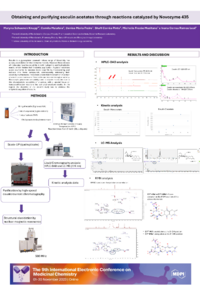
Esculin is a glycosylated coumarin whose range of bioactivity has already been demonstrated in murine models. However, these classes of molecules have low solubility in both hydrophilic and hydrophobic media, which hinders their industrial application. Acylation reactions allow coumarins to become more lipophilic by incorporating acyl radicals into these compounds, consequently enhancing their solubility. Biocatalytic processes are widely used to acylate molecules due to the characteristic selectivity of enzymes, with a special focus on transesterification reactions that can yield excellent results. In this regard, the objective of the present study was to promote the enzymatic acylation of esculin. Vinyl acetate was used as the acylating agent, and Novozyme 435, an immobilized lipase, served as the catalyst, with both reagents solubilized in THF. The biocatalytic transformation occurred at a temperature of 60°C, six hours after the start of the reaction. The products were isolated using high-speed countercurrent chromatography. The chemical structures of esculin monoacetate and diacetate were determined through 1H and 13C and two-dimensional Nuclear Magnetic Resonance, as well as liquid chromatography coupled with mass spectrometry. The formation of the products was monitored by thin-layer chromatography and high-performance liquid chromatography coupled with diode arrays at regular time intervals between 0 and 8 hours of the reaction to obtain retention time data for kinetic analysis. The λmax values of esculin monoacetate were found to be 196, 225, and 334 nm, while those of esculin diacetate were 196, 228, and 335 nm. The evaluated methods confirmed that one reaction product was esterified at the 6'OH position (RT: 10.01 min and m/z 382.93 [M-H]-) of the glycosidic portion of esculin, and the other at both the 6'OH and 3'OH positions (RT: 12.67 min and m/z 424.93 [M-H]-) in that moiety of the molecule.
Keywords
Biocatalysis
Esculin acetates
Liquid chromatography
Manuscript
Abstract Maryna Knupp (2).pdf
Poster
Poster maryna Knupp.pdf
Investigation of binding mode of isoamyl derivative of thiosalicylic acid and human serum albumin
Photodynamic inactivation of planktonic cells, pseudohyphae and biofilms Candida albicans by cationic porphyrins