Event submissions
Published
 10.3390/ECMC2023-15708 (registering DOI)
 This submission belongs to the session S4. New Small molecules as drug candidates of the event 9th International Electronic Conference on Medicinal Chemistry
Published date
01 Nov, 2023
Academic Editor
'%3e%3cpath%20d='M12.6657%2010.9104C12.4185%2010.325%2012.0599%209.79327%2011.6097%209.34482C11.1609%208.89508%2010.6293%208.5365%2010.0442%208.28888C10.0389%208.28626%2010.0337%208.28495%2010.0285%208.28233C10.8446%207.69279%2011.3752%206.73249%2011.3752%205.64904C11.3752%203.8542%209.92103%202.39999%208.1262%202.39999C6.33136%202.39999%204.87715%203.8542%204.87715%205.64904C4.87715%206.73249%205.40774%207.69279%206.22393%208.28364C6.21869%208.28626%206.21345%208.28757%206.20821%208.29019C5.62129%208.5378%205.09463%208.89284%204.64265%209.34613C4.1929%209.79493%203.83432%2010.3266%203.58671%2010.9117C3.34345%2011.4845%203.21226%2012.0987%203.20023%2012.7209C3.19988%2012.7349%203.20233%2012.7488%203.20744%2012.7619C3.21255%2012.7749%203.22022%2012.7867%203.22998%2012.7968C3.23975%2012.8068%203.25142%2012.8147%203.26431%2012.8202C3.2772%2012.8256%203.29105%2012.8284%203.30504%2012.8284H4.09109C4.14874%2012.8284%204.19459%2012.7825%204.1959%2012.7262C4.2221%2011.7148%204.62823%2010.7676%205.34617%2010.0497C6.08899%209.30683%207.0755%208.89808%208.1262%208.89808C9.17689%208.89808%2010.1634%209.30683%2010.9062%2010.0497C11.6242%2010.7676%2012.0303%2011.7148%2012.0565%2012.7262C12.0578%2012.7838%2012.1037%2012.8284%2012.1613%2012.8284H12.9474C12.9613%2012.8284%2012.9752%2012.8256%2012.9881%2012.8202C13.001%2012.8147%2013.0126%2012.8068%2013.0224%2012.7968C13.0322%2012.7867%2013.0398%2012.7749%2013.0449%2012.7619C13.0501%2012.7488%2013.0525%2012.7349%2013.0522%2012.7209C13.0391%2012.0947%2012.9094%2011.4855%2012.6657%2010.9104ZM8.1262%207.9024C7.52486%207.9024%206.9589%207.6679%206.53312%207.24211C6.10733%206.81633%205.87283%206.25037%205.87283%205.64904C5.87283%205.0477%206.10733%204.48174%206.53312%204.05596C6.9589%203.63018%207.52486%203.39567%208.1262%203.39567C8.72753%203.39567%209.29349%203.63018%209.71927%204.05596C10.1451%204.48174%2010.3796%205.0477%2010.3796%205.64904C10.3796%206.25037%2010.1451%206.81633%209.71927%207.24211C9.29349%207.6679%208.72753%207.9024%208.1262%207.9024Z'%20fill='%235D1EE1'/%3e%3c/g%3e%3c/svg%3e) Alfredo Berzal-Herranz
Alfredo Berzal-HerranzCitation
Olga Garbuz, Roman Rusnac, Victor Tsapcov, Ion Toderas, Aurelian Gulea, Synthesis, characterization, and antioxidant activity of the copper(II) complexes with novel ligand: N-[4-({2-[1-(pyridin-2-yl)ethylidene]hydrazinecarbothioyl}amino)phenyl]acetamide, in Proceedings of 9th International Electronic Conference on Medicinal Chemistry, 1 November–30 November 2023, MDPI: Basel, Switzerland, doi: 10.3390/ECMC2023-15708
Share
Email
Facebook
Twitter
LinkedIn
Synthesis, characterization, and antioxidant activity of the copper(II) complexes with novel ligand: N-[4-({2-[1-(pyridin-2-yl)ethylidene]hydrazinecarbothioyl}amino)phenyl]acetamide
'%3e%3cpath%20d='M12.6647%2010.9104C12.4176%2010.325%2012.0589%209.7933%2011.6088%209.34485C11.16%208.89511%2010.6283%208.53653%2010.0432%208.28891C10.038%208.28629%2010.0327%208.28498%2010.0275%208.28236C10.8437%207.69282%2011.3743%206.73252%2011.3743%205.64907C11.3743%203.85423%209.92005%202.40002%208.12522%202.40002C6.33038%202.40002%204.87618%203.85423%204.87618%205.64907C4.87618%206.73252%205.40677%207.69282%206.22296%208.28367C6.21772%208.28629%206.21248%208.2876%206.20724%208.29022C5.62031%208.53783%205.09365%208.89287%204.64167%209.34616C4.19192%209.79496%203.83334%2010.3266%203.58573%2010.9117C3.34247%2011.4846%203.21128%2012.0987%203.19925%2012.721C3.1989%2012.735%203.20135%2012.7489%203.20646%2012.7619C3.21157%2012.7749%203.21924%2012.7868%203.22901%2012.7968C3.23877%2012.8068%203.25045%2012.8148%203.26334%2012.8202C3.27623%2012.8256%203.29007%2012.8284%203.30406%2012.8284H4.09012C4.14776%2012.8284%204.19362%2012.7825%204.19493%2012.7262C4.22113%2011.7148%204.62726%2010.7676%205.34519%2010.0497C6.08802%209.30686%207.07452%208.89811%208.12522%208.89811C9.17592%208.89811%2010.1624%209.30686%2010.9052%2010.0497C11.6232%2010.7676%2012.0293%2011.7148%2012.0555%2012.7262C12.0568%2012.7839%2012.1027%2012.8284%2012.1603%2012.8284H12.9464C12.9604%2012.8284%2012.9742%2012.8256%2012.9871%2012.8202C13%2012.8148%2013.0117%2012.8068%2013.0214%2012.7968C13.0312%2012.7868%2013.0389%2012.7749%2013.044%2012.7619C13.0491%2012.7489%2013.0515%2012.735%2013.0512%2012.721C13.0381%2012.0947%2012.9084%2011.4856%2012.6647%2010.9104ZM8.12522%207.90243C7.52388%207.90243%206.95792%207.66793%206.53214%207.24215C6.10636%206.81636%205.87185%206.2504%205.87185%205.64907C5.87185%205.04773%206.10636%204.48177%206.53214%204.05599C6.95792%203.63021%207.52388%203.3957%208.12522%203.3957C8.72655%203.3957%209.29252%203.63021%209.7183%204.05599C10.1441%204.48177%2010.3786%205.04773%2010.3786%205.64907C10.3786%206.2504%2010.1441%206.81636%209.7183%207.24215C9.29252%207.66793%208.72655%207.90243%208.12522%207.90243Z'%20fill='%235D1EE1'/%3e%3c/g%3e%3c/svg%3e)
Olga Garbuz 1,2
Roman Rusnac 1
Victor Tsapcov 1
Ion Toderas 2
Aurelian Gulea 1
1. Laboratory of Advanced Materials in Biopharmaceutics and Technics, Moldova State University, 60 Mateevici Street, MD-2009 Chisinau, Republic of Moldova
2. Biological Invasions Research Center, Institute of Zoology, Moldova State University, 1 Academiei Street, MD 2028, Chisinau, Republic of Moldova
Abstract
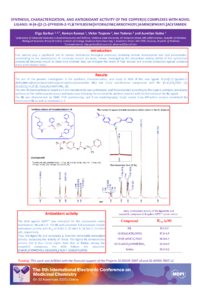
Free radicals play a significant role in various detrimental biological processes, including protein denaturation and lipid peroxidation, contributing to the development of numerous human diseases. Hence, investigating the antiradical potential of the synthesized compounds becomes crucial to determine whether they can mitigate the levels of free radicals and provide protection against oxidative stress in the human body. The aim of the present investigation is the synthesis, characterization, and study of antioxidant activity of the new ligand: N-[4-({2-[1-(pyridin-2-yl)ethylidene]hydrazinecarbothioyl}amino)phenyl]acetamide (HL) and Cu(II) coordination compounds with HL: [Cu(L)CH3COO] (1), [{Cu(L)Cl}2]·H2O (2), [Cu(L)H2O·DMF]NO3 (3). The new thiosemicarbazone based on 4-aminoacetanilide was synthesized, and functionalized according to the organic synthesis procedure: synthesis of the isothiocyanate group and hydrazone following the nucleophilic addition reaction with the formation of the HL ligand. The HL was characterized by NMR, FTIR spectroscopy, and X-ray crystallography. Single crystal X-ray diffraction analysis elucidated the structures of thiosemicarbazone HL as well as complexes 1-3. The antiradical activity against the 2,2-azinobis-(3-ethylbenzothiazoline-6-sulphonate) radical cation (ABTS•+) was evaluated for the compounds under examination: HL and copper(II) complexes 1–3. The obtained results are represented as semimaximal inhibitory concentrations (IC50). The HL and complexes 1-3 possessed notable antioxidant activity with IC50 values of 8.5±1.5, 47.44±1.9, 24.3±1.3, 23.3±0.9 µM, respectively. Thus, the ligand HL and complexes 2, 3 exhibit remarkable antioxidant activity, surpassing the activity of Trolox, a standard antioxidant utilized in medical applications. The tested ligand HL demonstrates an activity that is four times higher than that of Trolox. Among the copper(II) complexes, the antioxidant potency follows this sequence: Cu(L)H2O·DMF]NO3 ≥ [{Cu(L)Cl}2]·H2O ≥ [Cu(L)CH3COO].
Keywords
coordination compound
thiosemicarbazone
antioxidant activity.
Manuscript
9th-ECMC Manuscript PDF.pdf
Poster
9th-ECMC_Poster_template.pdf
Photodynamic inactivation of planktonic cells, pseudohyphae and biofilms Candida albicans by cationic porphyrins
Discovery of novel SIRT5 activators as potential anti-inflammatory agents