Event submissions
Published
 10.3390/ECMC2023-15717 (registering DOI)
 This submission belongs to the session S5. Natural Products and Biopharmaceuticals of the event 9th International Electronic Conference on Medicinal Chemistry
Published date
01 Nov, 2023
Academic Editor
'%3e%3cpath%20d='M12.6657%2010.9104C12.4185%2010.325%2012.0599%209.79327%2011.6097%209.34482C11.1609%208.89508%2010.6293%208.5365%2010.0442%208.28888C10.0389%208.28626%2010.0337%208.28495%2010.0285%208.28233C10.8446%207.69279%2011.3752%206.73249%2011.3752%205.64904C11.3752%203.8542%209.92103%202.39999%208.1262%202.39999C6.33136%202.39999%204.87715%203.8542%204.87715%205.64904C4.87715%206.73249%205.40774%207.69279%206.22393%208.28364C6.21869%208.28626%206.21345%208.28757%206.20821%208.29019C5.62129%208.5378%205.09463%208.89284%204.64265%209.34613C4.1929%209.79493%203.83432%2010.3266%203.58671%2010.9117C3.34345%2011.4845%203.21226%2012.0987%203.20023%2012.7209C3.19988%2012.7349%203.20233%2012.7488%203.20744%2012.7619C3.21255%2012.7749%203.22022%2012.7867%203.22998%2012.7968C3.23975%2012.8068%203.25142%2012.8147%203.26431%2012.8202C3.2772%2012.8256%203.29105%2012.8284%203.30504%2012.8284H4.09109C4.14874%2012.8284%204.19459%2012.7825%204.1959%2012.7262C4.2221%2011.7148%204.62823%2010.7676%205.34617%2010.0497C6.08899%209.30683%207.0755%208.89808%208.1262%208.89808C9.17689%208.89808%2010.1634%209.30683%2010.9062%2010.0497C11.6242%2010.7676%2012.0303%2011.7148%2012.0565%2012.7262C12.0578%2012.7838%2012.1037%2012.8284%2012.1613%2012.8284H12.9474C12.9613%2012.8284%2012.9752%2012.8256%2012.9881%2012.8202C13.001%2012.8147%2013.0126%2012.8068%2013.0224%2012.7968C13.0322%2012.7867%2013.0398%2012.7749%2013.0449%2012.7619C13.0501%2012.7488%2013.0525%2012.7349%2013.0522%2012.7209C13.0391%2012.0947%2012.9094%2011.4855%2012.6657%2010.9104ZM8.1262%207.9024C7.52486%207.9024%206.9589%207.6679%206.53312%207.24211C6.10733%206.81633%205.87283%206.25037%205.87283%205.64904C5.87283%205.0477%206.10733%204.48174%206.53312%204.05596C6.9589%203.63018%207.52486%203.39567%208.1262%203.39567C8.72753%203.39567%209.29349%203.63018%209.71927%204.05596C10.1451%204.48174%2010.3796%205.0477%2010.3796%205.64904C10.3796%206.25037%2010.1451%206.81633%209.71927%207.24211C9.29349%207.6679%208.72753%207.9024%208.1262%207.9024Z'%20fill='%235D1EE1'/%3e%3c/g%3e%3c/svg%3e) Alfredo Berzal-Herranz
Alfredo Berzal-HerranzCitation
Bellik Yuva, Chemical composition and anti-hemolytic activity of Algerian honey samples, in Proceedings of 9th International Electronic Conference on Medicinal Chemistry, 1 November–30 November 2023, MDPI: Basel, Switzerland, doi: 10.3390/ECMC2023-15717
Share
Email
Facebook
Twitter
LinkedIn
Chemical composition and anti-hemolytic activity of Algerian honey samples

Bellik Yuva 1
1. University of Bordj Bou Arreridj, Algeria
Abstract
The use of natural substances for medical purposes is associated with the earlier times of humankind. The present study compared the phenolic profiles and anti-hemolytic properties of two honey samples. The total phenolic content and the total flavonoid content were determined spectrophotometrically. The anti-hemolytic activity was tested in-vitro using human erythrocytes pretreated separately with honey samples and ascorbic acid in the presence of aluminium. Five different treatment groups were considered: untreated erythrocytes (negative control), aluminium treated erythrocytes (positive control), honey 1 + aluminium treated erythrocytes, honey 2 + aluminium treated erythrocytes, and ascorbic acid + aluminium treated erythrocytes. Samples were then evaluated by simultaneous measurement of cellular turbidity and hemoglobin. The results showed that Honey 2 contained the highest phenolic content with mean value of 1.55 ± 0.04 mg GAE/g while honey 1 showed a concentration of 0.63 ± 0.03 mg GAE/g. As with the phenolic content, honey 2 showed the highest levels of flavonoid content (0.17 ± 0.003 mg QE/g) when compared to honey 1 (0.075 ± 0.005 QE/g). Erythrocytes suspensions treated with honey samples, particularly honey 2 presented highest cell and hemoglobin values compared to that of ascorbic acid and positive control, whereas, ascorbic acid exhibited a prooxidant effect on cell and hemoglobin. The results of this study demonstrated a protective effect of honey against Al-induced erythrocytes hemolysis and hemoglobin degradation.
Keywords
Honey
ascorbic acid
aluminium
erythrocytes
hemoglobin.
Manuscript
9th-ECMC_Abstract_Bellik.pdf
Poster
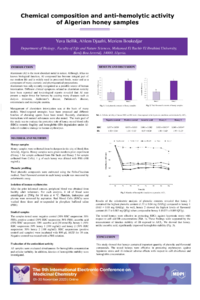
9th-ECMC_Poster_Bellik.pdf
Cytotoxicity of novel heterometallic dinuclear complexes on colon carcinoma cell lines
Inhibition of Tumor-Promoting Effects of Nicotine by the Sesquiterpene Lactone Parthenolide in Lung Cancer