Event submissions
Published
 10.3390/ECMC2023-15719 (registering DOI)
 This submission belongs to the session S5. Natural Products and Biopharmaceuticals of the event 9th International Electronic Conference on Medicinal Chemistry
Published date
01 Nov, 2023
Academic Editor
'%3e%3cpath%20d='M12.6657%2010.9104C12.4185%2010.325%2012.0599%209.79327%2011.6097%209.34482C11.1609%208.89508%2010.6293%208.5365%2010.0442%208.28888C10.0389%208.28626%2010.0337%208.28495%2010.0285%208.28233C10.8446%207.69279%2011.3752%206.73249%2011.3752%205.64904C11.3752%203.8542%209.92103%202.39999%208.1262%202.39999C6.33136%202.39999%204.87715%203.8542%204.87715%205.64904C4.87715%206.73249%205.40774%207.69279%206.22393%208.28364C6.21869%208.28626%206.21345%208.28757%206.20821%208.29019C5.62129%208.5378%205.09463%208.89284%204.64265%209.34613C4.1929%209.79493%203.83432%2010.3266%203.58671%2010.9117C3.34345%2011.4845%203.21226%2012.0987%203.20023%2012.7209C3.19988%2012.7349%203.20233%2012.7488%203.20744%2012.7619C3.21255%2012.7749%203.22022%2012.7867%203.22998%2012.7968C3.23975%2012.8068%203.25142%2012.8147%203.26431%2012.8202C3.2772%2012.8256%203.29105%2012.8284%203.30504%2012.8284H4.09109C4.14874%2012.8284%204.19459%2012.7825%204.1959%2012.7262C4.2221%2011.7148%204.62823%2010.7676%205.34617%2010.0497C6.08899%209.30683%207.0755%208.89808%208.1262%208.89808C9.17689%208.89808%2010.1634%209.30683%2010.9062%2010.0497C11.6242%2010.7676%2012.0303%2011.7148%2012.0565%2012.7262C12.0578%2012.7838%2012.1037%2012.8284%2012.1613%2012.8284H12.9474C12.9613%2012.8284%2012.9752%2012.8256%2012.9881%2012.8202C13.001%2012.8147%2013.0126%2012.8068%2013.0224%2012.7968C13.0322%2012.7867%2013.0398%2012.7749%2013.0449%2012.7619C13.0501%2012.7488%2013.0525%2012.7349%2013.0522%2012.7209C13.0391%2012.0947%2012.9094%2011.4855%2012.6657%2010.9104ZM8.1262%207.9024C7.52486%207.9024%206.9589%207.6679%206.53312%207.24211C6.10733%206.81633%205.87283%206.25037%205.87283%205.64904C5.87283%205.0477%206.10733%204.48174%206.53312%204.05596C6.9589%203.63018%207.52486%203.39567%208.1262%203.39567C8.72753%203.39567%209.29349%203.63018%209.71927%204.05596C10.1451%204.48174%2010.3796%205.0477%2010.3796%205.64904C10.3796%206.25037%2010.1451%206.81633%209.71927%207.24211C9.29349%207.6679%208.72753%207.9024%208.1262%207.9024Z'%20fill='%235D1EE1'/%3e%3c/g%3e%3c/svg%3e) Alfredo Berzal-Herranz
Alfredo Berzal-HerranzCitation
Radhika Khanna, Dr VK Varshney, Dr H.R. Chitme, Toxicity studies, Hypoglycaemic activity of Cupressus torulosa needles and recognition of active molecules, in Proceedings of 9th International Electronic Conference on Medicinal Chemistry, 1 November–30 November 2023, MDPI: Basel, Switzerland, doi: 10.3390/ECMC2023-15719
Share
Email
Facebook
Twitter
LinkedIn
Toxicity studies, Hypoglycaemic activity of Cupressus torulosa needles and recognition of active molecules
'%3e%3cpath%20d='M12.6647%2010.9104C12.4176%2010.325%2012.0589%209.7933%2011.6088%209.34485C11.16%208.89511%2010.6283%208.53653%2010.0432%208.28891C10.038%208.28629%2010.0327%208.28498%2010.0275%208.28236C10.8437%207.69282%2011.3743%206.73252%2011.3743%205.64907C11.3743%203.85423%209.92005%202.40002%208.12522%202.40002C6.33038%202.40002%204.87618%203.85423%204.87618%205.64907C4.87618%206.73252%205.40677%207.69282%206.22296%208.28367C6.21772%208.28629%206.21248%208.2876%206.20724%208.29022C5.62031%208.53783%205.09365%208.89287%204.64167%209.34616C4.19192%209.79496%203.83334%2010.3266%203.58573%2010.9117C3.34247%2011.4846%203.21128%2012.0987%203.19925%2012.721C3.1989%2012.735%203.20135%2012.7489%203.20646%2012.7619C3.21157%2012.7749%203.21924%2012.7868%203.22901%2012.7968C3.23877%2012.8068%203.25045%2012.8148%203.26334%2012.8202C3.27623%2012.8256%203.29007%2012.8284%203.30406%2012.8284H4.09012C4.14776%2012.8284%204.19362%2012.7825%204.19493%2012.7262C4.22113%2011.7148%204.62726%2010.7676%205.34519%2010.0497C6.08802%209.30686%207.07452%208.89811%208.12522%208.89811C9.17592%208.89811%2010.1624%209.30686%2010.9052%2010.0497C11.6232%2010.7676%2012.0293%2011.7148%2012.0555%2012.7262C12.0568%2012.7839%2012.1027%2012.8284%2012.1603%2012.8284H12.9464C12.9604%2012.8284%2012.9742%2012.8256%2012.9871%2012.8202C13%2012.8148%2013.0117%2012.8068%2013.0214%2012.7968C13.0312%2012.7868%2013.0389%2012.7749%2013.044%2012.7619C13.0491%2012.7489%2013.0515%2012.735%2013.0512%2012.721C13.0381%2012.0947%2012.9084%2011.4856%2012.6647%2010.9104ZM8.12522%207.90243C7.52388%207.90243%206.95792%207.66793%206.53214%207.24215C6.10636%206.81636%205.87185%206.2504%205.87185%205.64907C5.87185%205.04773%206.10636%204.48177%206.53214%204.05599C6.95792%203.63021%207.52388%203.3957%208.12522%203.3957C8.72655%203.3957%209.29252%203.63021%209.7183%204.05599C10.1441%204.48177%2010.3786%205.04773%2010.3786%205.64907C10.3786%206.2504%2010.1441%206.81636%209.7183%207.24215C9.29252%207.66793%208.72655%207.90243%208.12522%207.90243Z'%20fill='%235D1EE1'/%3e%3c/g%3e%3c/svg%3e)
Radhika Khanna 1
Dr VK Varshney 1

Dr H.R. Chitme 2
1. Forest Research Institute, Dehradun
2. DIT university, Dehradun
Abstract
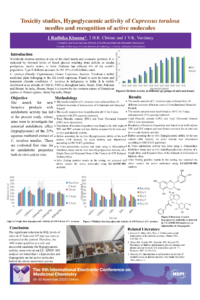
Cupressus torulosa (CT) of family cupressaceae, commonly known as ‘Surai’, is a coniferous tree distributed in the states of Uttarakhand and Himachal Pradesh between 1800 to 3300 m. It is an aromatic plant used traditionally claimed to have medicinal properties. Its needles are reported to contain terpenoids and phenolics. Needles of the plant were collected from various locations of Uttarakhand and Himachal. Dried and powdered leaves were at first defatted with Hexane and then sequentially extracted followed by removal of chlorophyll which yielded 19.2% of total extract. Before assessing the in vivo Hypoglycaemic ability of the test extract (AM extract), its acute toxicity was determined according to OECD 423 guidelines. AM extract was orally administered to 3 groups of 3 experimental animals each at three defined doses (500, 1000, 2000mg/kg per os (po)). No mortality was seen at 2000mg/kg so this was selected as a safe dose and with much higher LD50. Moreover, Subacute toxicity study was conducted in mice for 14 days. In this study control groups of animals were given 10 mL/kg normal saline and treated group of animals were given 400 mg/kg dose of extract orally. On last day animals were sacrificed by overdose of ketamine and heart, kidney and liver were isolated for histological study. It was seen that statistically there was no significant difference between control and treated group of mice. For in vivo Hypoglycaemic activity screening 1% acacia suspension of AM extract (AMAS) was formed and Hypoglycaemic studies were performed by single-dose and repeated-dose streptozotocin-induced diabetic mice model (positive standard glibenclamide). The greatest reduction in Blood Glucose Level (BGL) was recorded in 400mg/kg AMAS treated group at the 4th hour, 14th day compared to the respective baseline BGL (p< 0.05), further significant weight gain (p<0.05) was seen in contrast with the Hypoglycaemic negative group after 14 days treatment. Therefore, the AM suspension qualifies as a safe and successful drug candidate for Hypoglycaemic activity. Further, the extract was run on LCQTOF-MS to find out active molecules responsible for antidiabetic activity and we found Harpagoside and (-)-Epicatechin which were responsible for the above mentioned activity.
Keywords
Cupressus torulosa
antidiabetic
natural products
LCQTOF-MS
Manuscript
new conference.pdf
Poster
9th-ECMC_Poster conference.pdf
Inhibition of Tumor-Promoting Effects of Nicotine by the Sesquiterpene Lactone Parthenolide in Lung Cancer
Complexes of oligoribonucleotides with D-mannitol inhibit the interaction of SARS-CoV-2 Spike pseudotyped lentiviral particles with host cells